Haiti police retake national stadium from gangs after two years
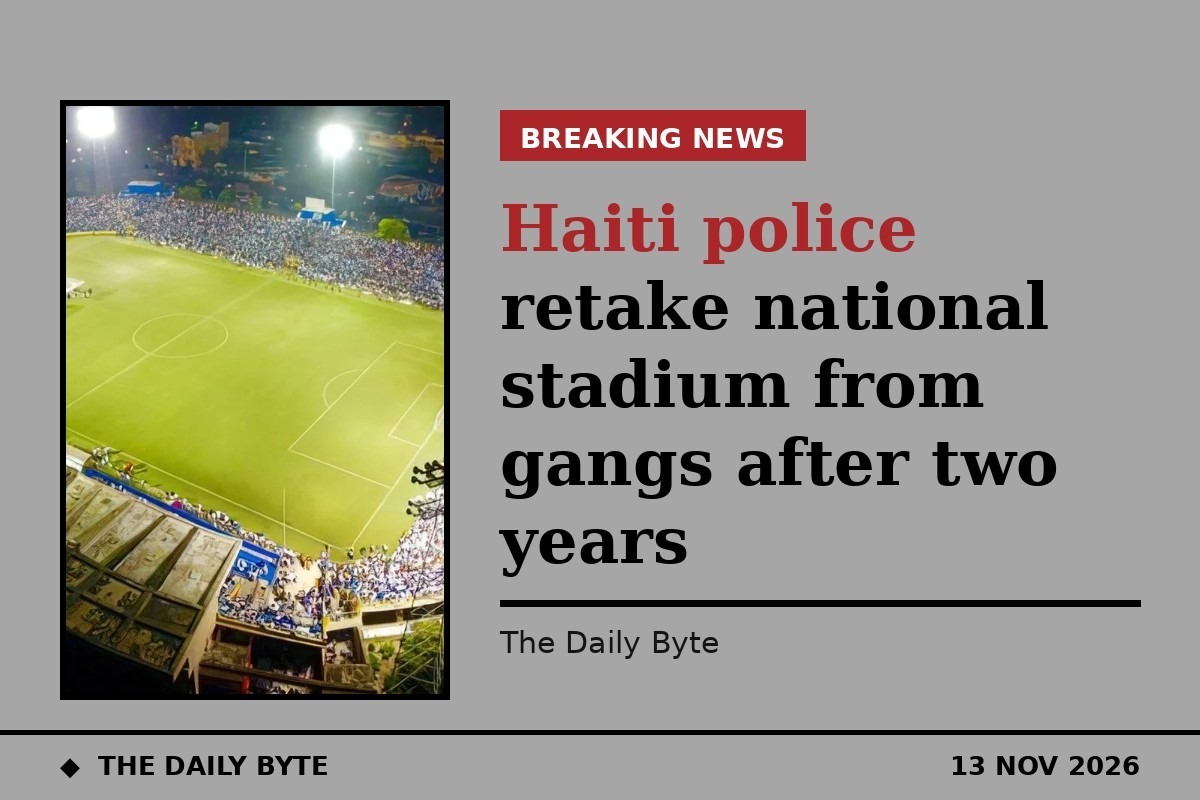
Haitian security forces have regained control of the country's national football stadium after two years under gang control, in one of the most visible gains so far in the campaign to retake territory in the capital, Port-au-Prince.
The Haitian National Police said on Thursday that it had taken "full control" of the Sylvio Cator Stadium with the Task Force, a government security group, and had then left the venue under the custody of Salvadoran soldiers. The 10,000-seat stadium fell into the hands of gangs in 2024, forcing Haiti's national football team to play its home matches abroad.
The operation is part of the deployment of some 2,000 soldiers ordered by the president of El Salvador, Nayib Bukele. Salvadoran state television said Salvadoran forces "took position" at the stadium on Thursday, and Haitian newspaper Le Nouvelliste reported that Salvadoran troops and vehicles were stationed inside the venue.
A stadium that became a symbol of the crisis
The Sylvio Cator Stadium, named after the Haitian Olympic long jump medallist, sits near the Bicentenaire, Portail-Leogane and Martissant districts, areas long threatened by armed groups. Its loss in 2024 was a powerful symbol of how far gang control had spread across the capital, and of how everyday life, including sport, had been pushed out of the city.
Since then, Haiti has been unable to stage international football at home. The national team played its 2026 World Cup qualifiers in Curacao, Aruba and Barbados, and its home Nations League match against the United States was moved to Miami. Despite those conditions, Haiti qualified for the World Cup finals for the first time since 1974.
Bukele announced last Tuesday that his forces had destroyed the "headquarters" of 400 Mawozo, one of the main gangs in Haiti. The Salvadoran deployment followed an ambush in October in which four Salvadoran troops went missing.
Stadium to become an operational base
Bukele said the joint operation involved Haiti's National Police, the Haitian Armed Forces, the government's Task Force and Salvadoran Special Forces, and that the stadium would now serve as an operational base from which security forces could move into surrounding areas held by gangs. He warned gang members operating nearby to leave before the next phase of the offensive begins.
Bukele also said officers found several human skulls inside the stadium during the operation. That claim has not been independently verified in the reporting available so far.
The recapture comes as Haitian and Salvadoran forces, alongside the UN-backed Gang Suppression Force, press an offensive that began in early November across metropolitan Port-au-Prince, including Kenscoff, Petion-Ville and Gressier, with plans to extend into the West and Artibonite departments and the Central Plateau.
What happens next
The stadium's recapture is a significant gain, but it does not by itself restore safety across the capital, where armed groups remain active and large areas are still outside government control. Haiti's government has said it aims to restore security and create the conditions for credible elections, with the first round of voting now scheduled for July 2027 after earlier dates slipped.
For now, the return of the Sylvio Cator Stadium gives the security forces a strategic position in the heart of Port-au-Prince, and gives Haitians a visible sign that territory lost to the gangs can be taken back.
Sources: France 24 with AFP and The Haitian Tribune