Iraq Puts Military on Highest Alert Amid Militia Tensions
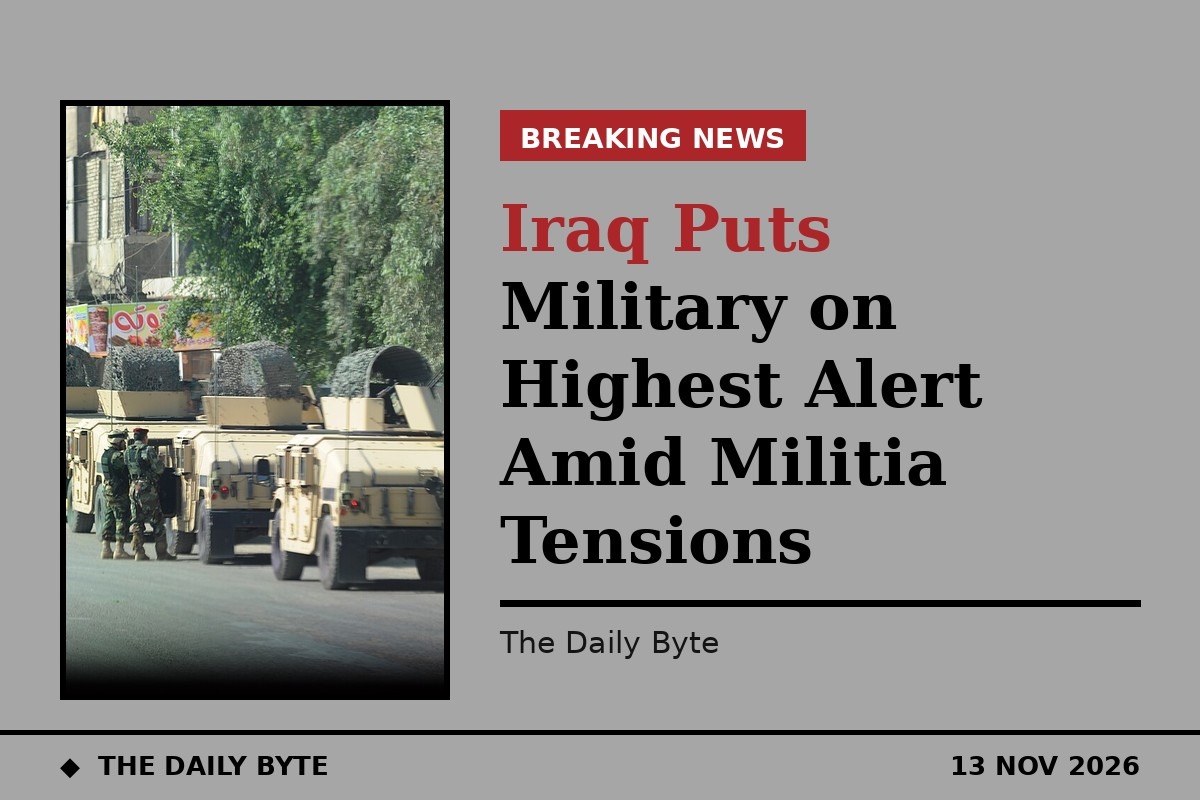
Iraq has placed all military units operating under the command of the commander-in-chief of the armed forces on Alert “C”, the highest state of military readiness, a security source told Shafaq News late on Thursday, 12 November. The order was reported in Baghdad on Friday, 13 November.
Under Alert “C”, troops must report to their units and leave is restricted as the armed forces move to maximum preparedness. The source said the reasons behind the alert were unknown and that the directives did not specify when the heightened state of readiness would end. There has been no official confirmation of the order from the government or the armed forces.
The security source did not link the alert to any specific incident. But it comes as Prime Minister Ali al-Zaidi, who is also commander-in-chief, is locked in a deepening standoff with the Iran-aligned armed group Kataib Hezbollah over the district of Jurf al-Sakhr in northern Babil province.
Wider inquiry into Jurf al-Sakhr oil smuggling
Early on Friday, the state-run Iraqi News Agency (INA) reported that Zaidi had ordered a high committee to carry out an expanded investigation into oil smuggling from Jurf al-Sakhr, two days after a first inquiry he set up was unable to begin work on the ground. A senior source told INA that Zaidi gave the order, but the agency did not say who would sit on the new committee, what powers it would have or when it must report. The government has not issued a statement of its own.
Zaidi named the first committee on Wednesday. A document from his office put Lt. Gen. Saad Mohsen Oraibi in charge, alongside senior federal police, energy police, PMF and integrity commission officials.
That committee has not been able to inspect the sites named in the smuggling allegations. Government forces moved toward the outskirts of the district to secure its entry, but political interventions and mediation halted the advance amid disagreements over how the committee would enter and who would oversee its work, Shafaq News reported.
District at the centre of the standoff
Jurf al-Sakhr, which the authorities have renamed Jurf al-Nasr, has been largely closed to its displaced Sunni residents since Iraqi forces and Shiite armed groups retook it from the Islamic State group in 2014. It is widely reported to be controlled by Kataib Hezbollah, which said on Wednesday it would hold Zaidi “fully responsible” for any attack on its positions.
The inquiry follows a government intelligence report that pointed to oil being drawn from two pipelines inside the district. A confidential technical report obtained by Shafaq News and published on 9 November documented five years of activity consistent with suspected illegal oil extraction and smuggling near pipelines in the area between 2021 and 2026, including large tankers repeatedly visiting sites near the pipelines. The report did not identify the group controlling the area, describing it only as “an armed faction”.
Babil Governor Ali Turki, who toured the area with journalists on Tuesday and said no pipeline ran through it, resigned on Thursday.
Prime minister seeks to bring weapons under state control
On Thursday, Zaidi met Badr Organization leader Hadi al-Amiri and the leadership of the Popular Mobilization Forces (PMF), including chairman Falih al-Fayyadh, for talks lasting more than three hours. His office said they discussed security and political issues and stressed coordination among the security agencies under the commander-in-chief. It did not mention Kataib Hezbollah, but sources said allies urged Zaidi to give the faction more time to negotiate rather than pursue it through the courts.
Washington has also pressed Baghdad to curb Iran-aligned groups: The Wall Street Journal reported this week that the United States has halted dollar shipments from Iraq's oil revenues and paused some security cooperation programmes.
For now, the alert order remains unexplained in public. What is clear is that Iraq's prime minister is pressing ahead with an inquiry into a district his government cannot yet enter, while the group that controls it warns him against any attack.
Frequently asked questions
What is Alert “C” in Iraq? It is the highest level of military readiness in Iraq's armed forces, requiring units to reach maximum preparedness, personnel to report to their units, and leave to be restricted or suspended.
Why was the alert ordered? The security source who disclosed it to Shafaq News did not give a reason, and there has been no official confirmation. The source did not link it to Jurf al-Sakhr.
What is the Jurf al-Sakhr dispute about? The government is investigating suspected oil smuggling from pipelines in the district, which is widely reported to be controlled by Kataib Hezbollah. A first inquiry committee was unable to inspect the sites, and the prime minister has now ordered a wider investigation.
Sources: Shafaq News; The Insight International.