Health Bill Returns to Lords as Private NHS Role Debated
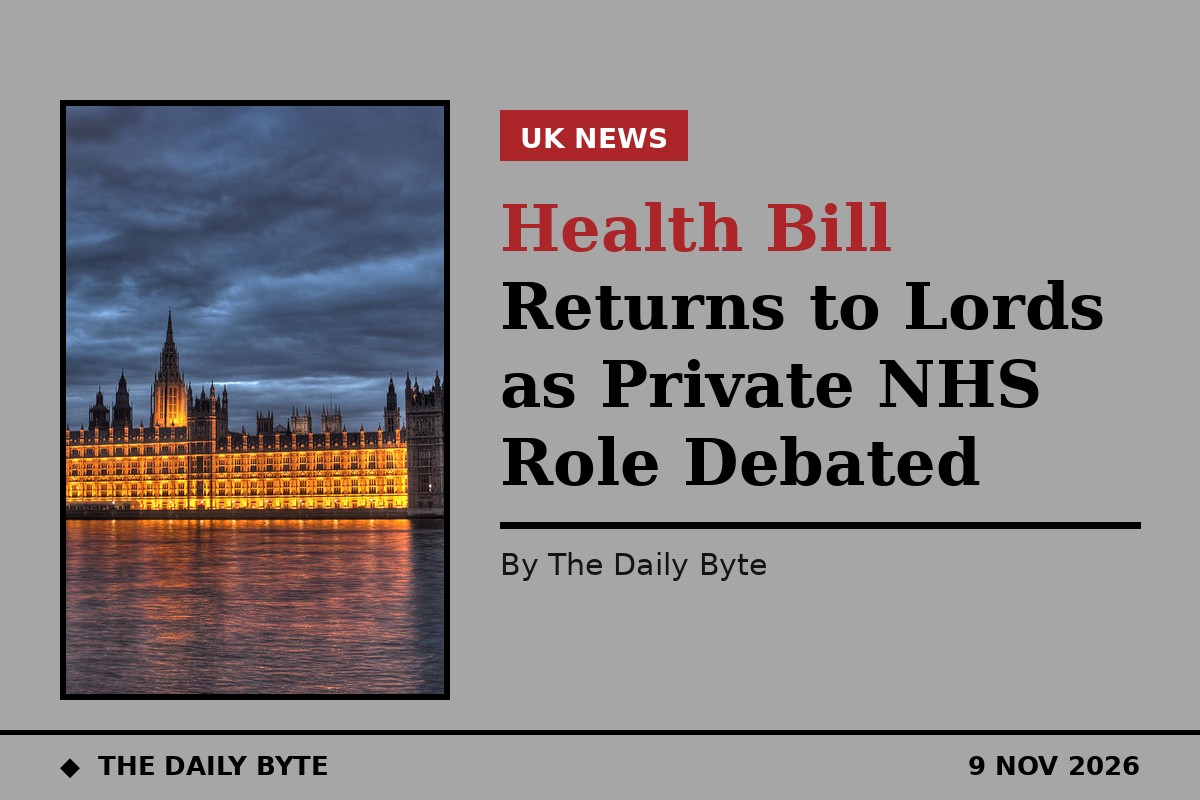
Members of the House of Lords return to the Health Bill on Monday 9 November for the third day of its committee stage, with the role of private companies in the NHS at the centre of the debate. Peers will work through the Bill clause by clause from 3.15pm, and the session can be watched live on Parliament TV.
The Bill aims to restructure NHS governance in England. It would abolish Healthwatch and NHS England, move the Health Services Safety Inspectorate Board into the Care Quality Commission, and establish a single patient record, making data available in healthcare settings and to patients.
On day three, peers will consider amendments on whether NHS services should be provided by public bodies, with private-sector provision restricted to cases where there is no reasonable alternative. They will also debate a requirement for the Secretary of State to review existing private-sector provision of health services, along with amendments on integrated care boards and cancer outcome objectives.
One amendment, tabled by Baroness Bennett of Manor Castle, would create a presumption in favour of public provision. Under it, a health service could be provided by a private-sector body only where the Secretary of State or another relevant public authority is satisfied that no reasonable alternative is available from a public body within a clinically appropriate timeframe, and that private provision is necessary to meet patients' needs. Any such decision would have to be supported by a published assessment of the alternatives, explaining why provision by a public body is not reasonably practicable, and limited to the extent and duration necessary to meet the need identified.
A second amendment from Baroness Bennett would require the Secretary of State, within 12 months of the Act being passed, to undertake and publish a review of existing arrangements under which health services are provided by private-sector bodies. The review would assess whether each arrangement remains necessary, whether the service could feasibly be provided by a public body, and the financial, clinical and workforce implications of returning it to public provision. It would be followed by a published plan for the progressive return to public provision of services where private-sector provision is no longer necessary, with an annual report on progress.
Amendments on integrated care boards will also be debated. Proposals from Lord Scriven would limit directions to integrated care boards to public health functions, or require a board's agreement before it is directed to exercise any other function. Further amendments from Lord Kamall and Earl Howe would require the Secretary of State to publish a statement within seven working days of giving a direction, and to show that a direction is necessary and proportionate, with the board consulted first except in urgent cases.
The first two days of committee stage set the tone for the scrutiny ahead. On day one, 28 October, peers considered a transition plan for the abolition of NHS England, a government duty to reduce healthcare inequalities, and the promotion of innovation in diabetes technology. On day two, 3 November, the debate covered the involvement of health and care partners in decisions about a patient, patient choice in onward referrals, access to health innovation networks, and private-sector involvement in the NHS.
Four further days of committee stage have been scheduled so far, on 11, 17, 23 and 25 November, although the timetable is subject to change and extra dates may be added. A transcript of today's debate will be published in Lords Hansard around three hours after the session ends.