HEC Adopts Islamabad Declaration on Health Education
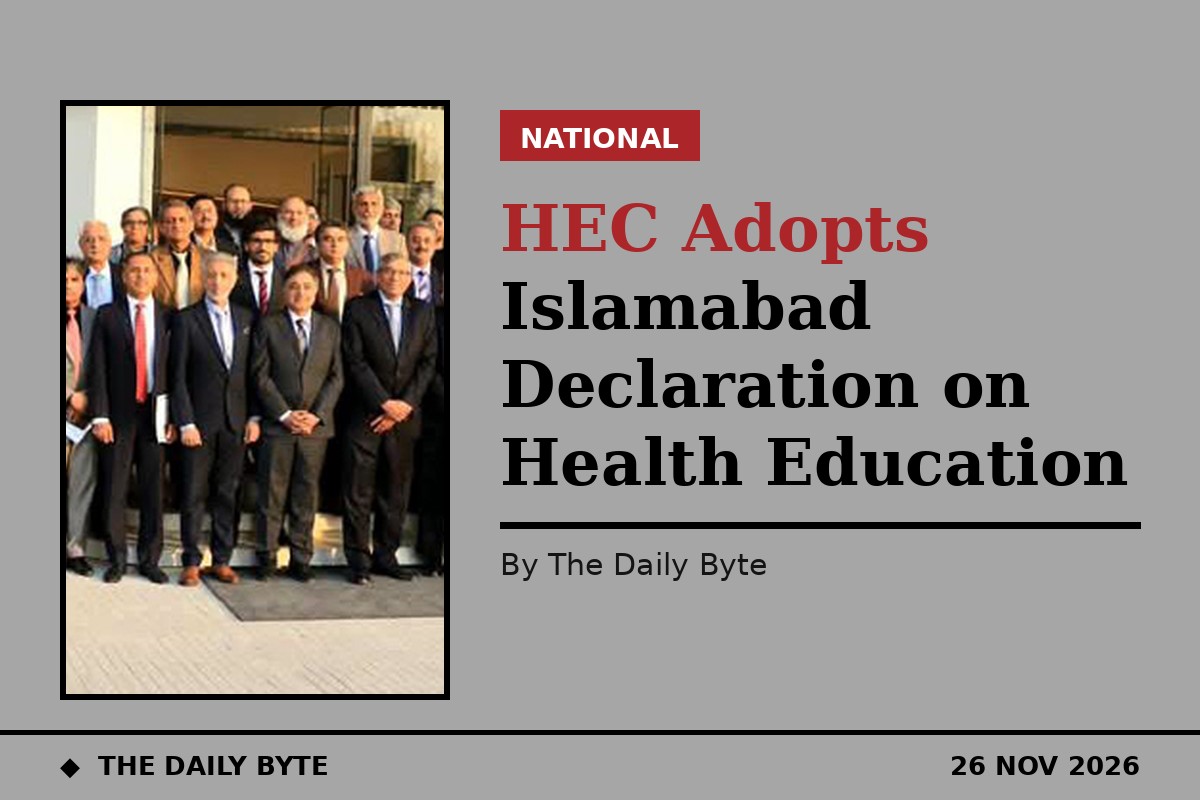
The Higher Education Commission (HEC) has adopted the Islamabad Declaration on health education reform, pledging closer coordination between regulators, accreditation councils and universities after a national consultation in Islamabad on Thursday.
The National Stakeholder Consultation on Health Education Reform brought together medical university vice chancellors, accreditation councils and other stakeholders to align governance and standards. Participants agreed that overlapping mandates, dual approvals and conflicting notices have historically created institutional uncertainty, delayed student careers, driven health professionals abroad and weakened healthcare delivery.
What the Islamabad Declaration says
Adopted at the close, the Islamabad Declaration reflects a shared commitment to respect statutory mandates and formalise coordination through a joint committee. Bringing leaders onto one collaborative platform sought to replace fragmented actions with shared accountability, while linking research with policy, clinical training and equity for women and under-resourced regions.
In his inaugural speech, Executive Director HEC Prof Dr Zia Ul Haq underscored health education’s national importance and the value of close collaboration among HEC, accreditation councils, universities and other stakeholders. He emphasised the need to respect statutory mandates, strengthen institutional coordination, consult before regulatory decisions, avoid duplication and safeguard the interests of students and institutions through a coherent national framework.
Ministers and regulators back a roadmap
Minister of State for Federal Education and Professional Training Ms Wajiha Qamar commended HEC for bringing stakeholders together and called for a comprehensive, time-bound roadmap to close systemic gaps and align standards across health professions. She emphasised student facilitation as a shared priority and encouraged institutions to pool capacities and resources to move beyond fragmented approaches. She also highlighted harnessing artificial intelligence and emerging technologies, modernising teaching and clinical training, and upgrading facilities through simulation laboratories.
Joining virtually, Chairman HEC Prof Dr Niaz Ahmed Akhtar emphasised a student-centric approach in institutional policies and initiatives, calling for tangible measures to improve the overall performance of higher education institutions. He underscored the role of hospitals in giving graduates opportunities for practical engagement, and the need to prepare graduates in line with emerging global workforce demands.
President of the Pakistan Medical and Dental Council (PMDC) Prof Dr Rizwan Taj acknowledged the pressing need for enhanced institutional collaboration to drive reform, noting that harmonised policies and mutual trust are essential to resolving long-standing administrative bottlenecks. He reaffirmed the PMDC’s commitment to working alongside HEC and all stakeholders to uphold medical education standards and streamline accreditation.
Research, exams and AI on the agenda
Thematic group discussions examined curriculum alignment, medical and allied health accreditation, a possible centralised examination board, AI integration and clinical modernisation. A dedicated research session featured global health researcher Prof Dr Zulfiqar A Bhutta, who set out a five-point way forward: strengthening university research environments and financing coordination, advocating minimum national research resources for a population of 250 million, advancing an equity agenda for less well-endowed provinces, leveraging AI and data science with due safeguards, and fostering an early research culture through intercalated MBBS and MPH, MPhil and PhD programmes.
Dr Haider Abbas, Director General of the National Cyber Emergency Response Team, spoke on strengthening cyber resilience in universities as they expand digital operations, while Dr Muhammad Ali Malik, Joint Secretary of the Prime Minister’s National Youth Programme, briefed vice chancellors on the programme’s digital youth hub initiatives.