Hezbollah Chief Naim Qassem Rejects Disarmament and Calls for Wider
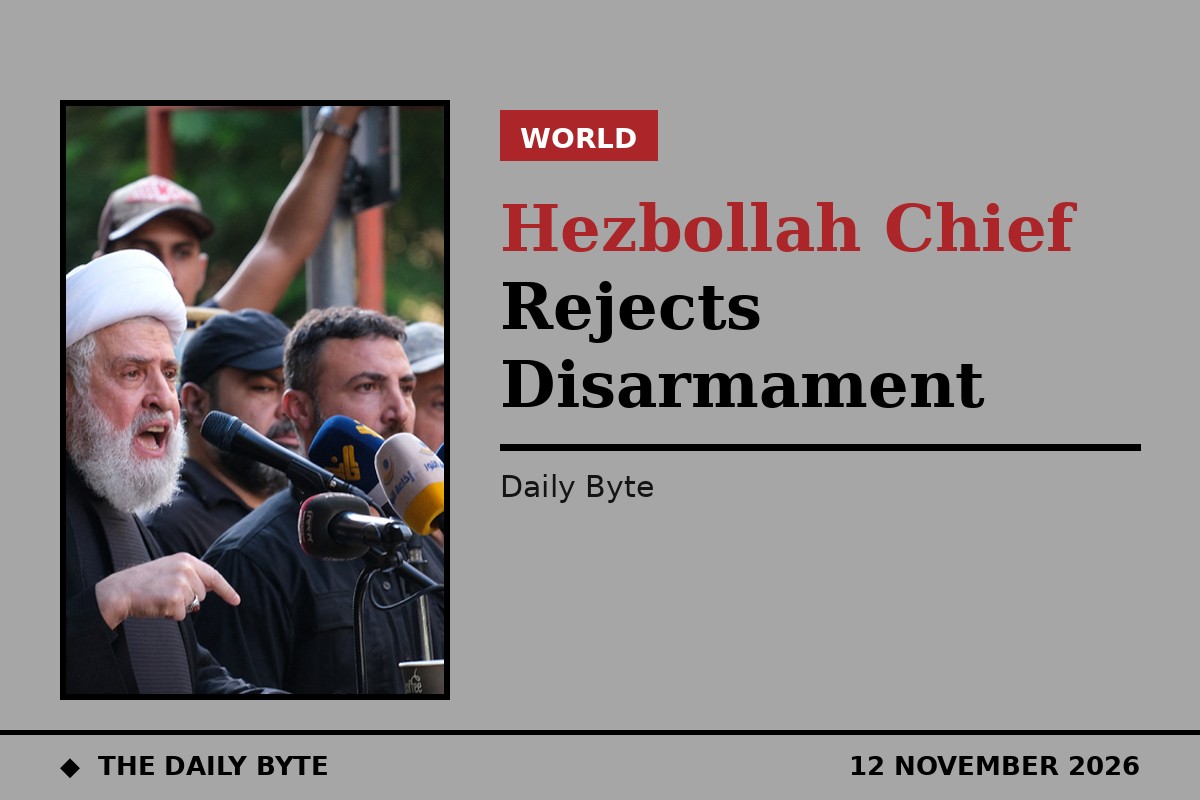
Hezbollah's leader, Naim Qassem, has rejected calls for the group to disarm and called for a broader regional resistance front, in a speech in Beirut marking the group's annual Martyrs' Day.
Speaking on Wednesday, 11 November, Qassem said the resistance front "must be much broader and more inclusive, involving many countries and peoples", and called for broader support from Iran, Yemen and Iraq for what he described as the Islamic resistance in Lebanon and Palestine. He said confronting attacks required everyone capable of bearing arms wherever resistance was possible in the region.
Qassem also insisted that Hezbollah must retain its weapons and remain prepared to fight when necessary to defend Lebanese territory. He urged the Lebanese authorities to stop discussing disarmament while Israeli attacks continued, and said there should be no discussion of a state monopoly on arms or the disarmament of the resistance as long as Israel continues to occupy parts of southern Lebanon.
Pressure from Beirut and abroad
The speech was delivered against a background of sustained pressure on Hezbollah to give up its weapons. The Lebanese government has been working on a plan to place all weapons under state control, with decisions on war and peace resting exclusively with the Lebanese authorities, and the embassies of the United States, Britain, Australia, Japan and Canada issued a joint statement on 5 November supporting that effort.
Qassem criticised that statement, describing it as interference in Lebanon's internal affairs and an attempt to incite opposition to Hezbollah. He demanded that Beirut summon the ambassadors of the United States, the United Kingdom, Australia and Canada, and said some Lebanese officials sought to surrender the resistance and the Arab nation to Israel in pursuit of their own interests.
Hezbollah has faced repeated Israeli strikes in southern Lebanon in recent months, and Lebanese prosecutors have charged members of the group over an explosives shipment seized at Dahr al-Baidar. Reports in recent weeks have also said the group is rebuilding its networks in southern Lebanon, despite the Lebanese Army's claims of operational control in the area.
Reading the regional moment
Qassem used the speech to present the recent electoral setbacks suffered by US President Donald Trump and Israeli Prime Minister Benjamin Netanyahu as a positive development for Hezbollah and its regional allies. He said Trump had suffered a crushing electoral defeat and Netanyahu had also been defeated, and claimed that Iran and the resistance across the region had played a role in their downfall.
He also said Iran had established itself as an influential power in West Asia, and that any future regional order would be shaped with its support. "The regional landscape will change, but not in accordance with the US-Israeli vision. Their era is over," he said, adding that Gulf and regional countries had an opportunity to reach an understanding with Iran on shaping the region's future.
The remarks underline how Hezbollah is positioning itself as part of a wider regional alliance involving Iran and armed groups in Lebanon, Palestine, Iraq and Yemen, at a time when the war between the United States and Iran, now in its ninth month, has put that alliance under severe strain.
What happens next in Lebanon
The Lebanese government has not yet responded publicly to the speech in the reporting seen so far, but the disarmament question remains the central fault line in Lebanese politics. The government is committed, on paper, to bringing all weapons under state control, while Hezbollah says it will not discuss disarmament while Israeli forces remain in southern Lebanon and Israeli strikes continue.
That deadlock is unlikely to be resolved soon. Qassem's speech suggests Hezbollah intends to hold its position and to frame disarmament as a demand imposed by Israel and the United States, rather than as a domestic Lebanese decision, while seeking to widen the circle of countries and groups it describes as part of the resistance front.
Sources: Europe Says, reporting Shafaq News and Press TV.