HIVE Mines 49% More Bitcoin but Revenue Falls
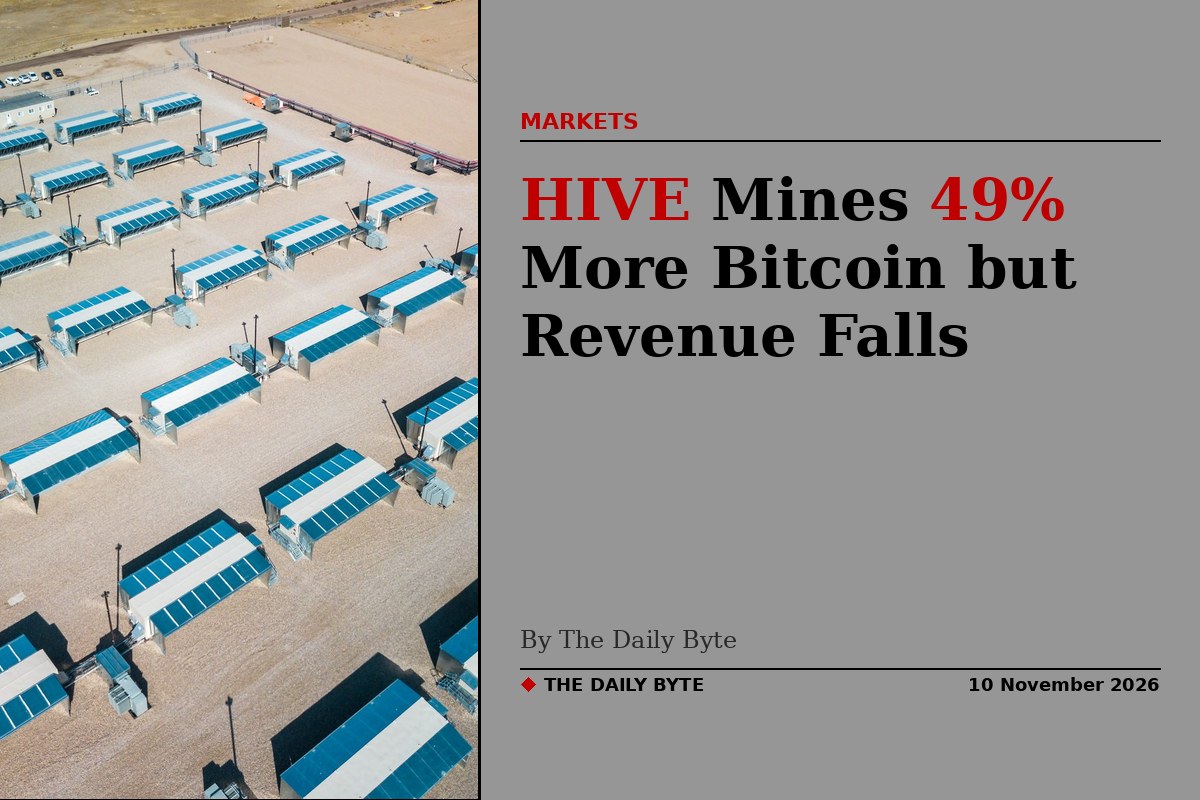
HIVE Digital Technologies mined almost half as much Bitcoin again in the September quarter as it did a year earlier, but brought in less money for it, as a steep fall in the price of Bitcoin outweighed the production gains.
The Nasdaq-listed miner said it produced 1,070 Bitcoin in the three months ended 30 September 2026, up 49% from 718 Bitcoin in the same quarter a year earlier. Mining revenue, however, fell 7.4% to $76 million, because the average price of Bitcoin it realised dropped to $71,003 from $114,382 in the prior-year period.
The figures, taken from the company's latest regulatory filing, show how quickly a weaker Bitcoin price can overwhelm even strong growth in output. HIVE's total revenue for the quarter was $84.9 million, down 2.7% from a year earlier but above the $79.4 million consensus estimate. The company reported a GAAP net loss of $78.7 million, or $0.29 per share.
Power costs climb as capacity grows
The weaker revenue came alongside a rising power bill. Electricity costs increased to $45.6 million from $37.9 million a year earlier as HIVE expanded its global mining capacity, and the company recorded a $31.2 million noncash write-down on mining equipment, citing depressed mining economics.
HIVE's Nasdaq-listed shares fell 1.7% to $1.78 in after-hours trading on Monday, after closing the regular session up 1.7% at $1.81.
The miner is not alone in facing the squeeze. MARA Holdings, a larger rival, reported a similar pattern in the same quarter, with production rising 5% to 2,247 Bitcoin while mining revenue dropped 34% to $159 million.
Miners pivot towards AI hosting
Like other miners, HIVE is expanding into high-performance computing and AI infrastructure to reduce its reliance on the Bitcoin price. Its HPC hosting revenue rose 71% to $8.8 million in the September quarter, accounting for 10.4% of its total revenue.
The shift reflects a broader change across the mining industry. American Bitcoin reported weaker mining margins last week despite a profit driven by its treasury holdings, while Core Scientific said it plans to leave mining entirely by the end of the year.
Bitcoin itself has been under pressure in recent weeks. The cryptocurrency traded at around $75,000 on Tuesday, 10 November, after falling to a two-month low near $73,700 over the weekend. Spot Bitcoin exchange-traded funds recorded about $1.28 billion in net outflows last week, the largest weekly withdrawal since June, according to market reports.
What comes next for miners
For HIVE, the September quarter shows both sides of the mining business in 2026. Output is growing fast as new capacity comes online, but the economics depend heavily on the Bitcoin price and on power costs, and both moved against the company in the quarter.
The growth in its AI hosting business offers a second source of income that is less tied to the crypto market, and investors will be watching whether that division can keep growing fast enough to offset the pressure on mining.
Whether the mining business recovers will depend largely on the Bitcoin price. If it stays near current levels, miners will face continued pressure on margins; a sustained recovery would quickly restore the value of the extra coins they are now producing.