How Did $7.5 Billion of Banned Nvidia Chips Allegedly Reach China?
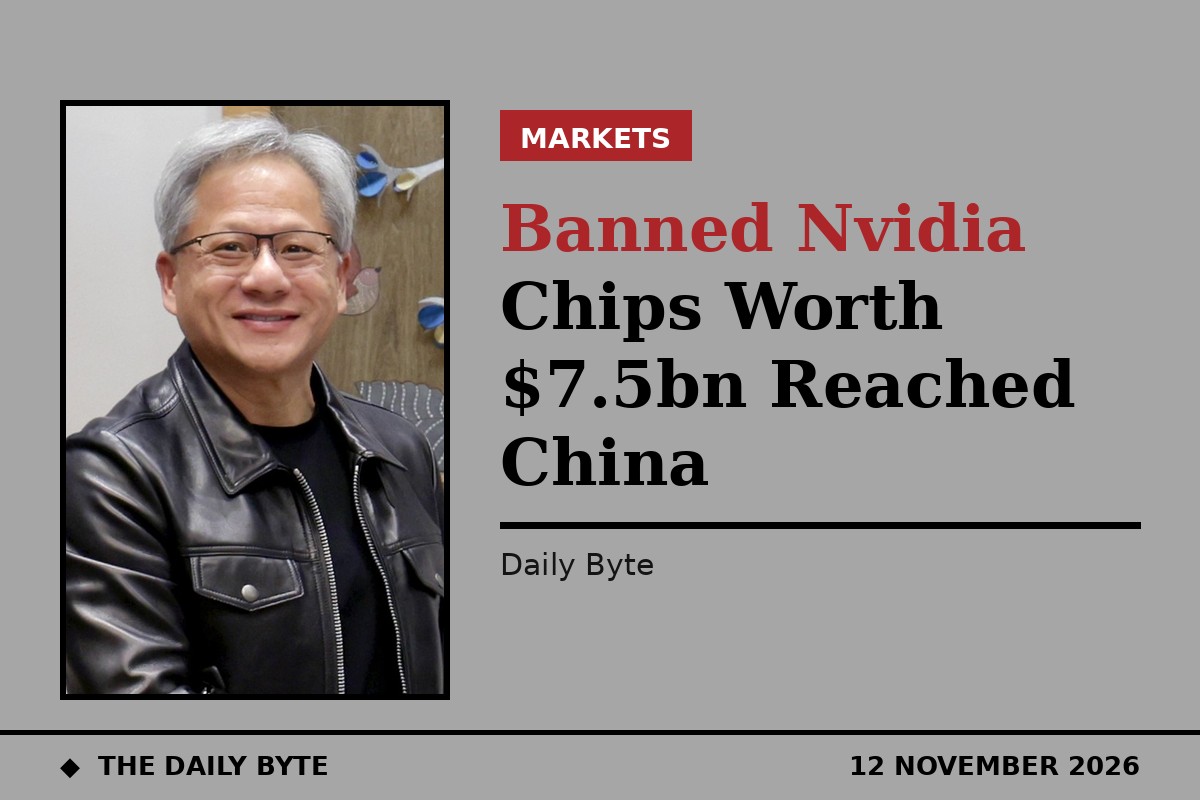
At least 7.5 billion dollars' worth of Nvidia's most advanced AI chips allegedly reached Chinese companies despite United States export controls, according to a report by The Information published on 10 November 2026 — and the report says the network behind the shipments was helped by a personal relationship between Nvidia chief executive Jensen Huang and a Chinese businesswoman suspected of having ties to Chinese intelligence. Around 240,000 chips are said to have been moved, including H100, H200 and A100 models that are restricted for sale to China. Nothing in the report has been proven in court, and Reuters has said it could not independently verify the central claims, but the allegations have already triggered an internal investigation by Nvidia's board and scrutiny from the FBI.
This is not a story about a single smuggled shipment. The report describes a network of companies built up over years, a preferred-partner status granted by Nvidia itself, and a route through Singapore that US authorities were already investigating. Understanding it means understanding what the chips are, what the export controls actually ban, and how a control system built for direct sales can be defeated by intermediaries.
What did The Information report?
The Information, a US technology news outlet, reported on 10 November 2026 that Alice Huang, a Chinese businesswoman, used her personal relationship with Jensen Huang to help move at least 7.5 billion dollars' worth of Nvidia chips to Chinese firms. The report, cited by Reuters, said the network moved about 240,000 H100, H200 and some A100 chips into China, and that the shipments were helped along when orders for chips subject to US export restrictions ran into difficulties.
The report named Shanghai Century Litong, a China-based company, as the centre of the network. Corporate records cited by The Information link Alice Huang's sister, Huang Yu, to Century Litong through a company that held an ownership stake when the Chinese firm was founded in June 2023. By October 2023, Century Litong had secured preferred cloud partner status with Nvidia, giving it priority access to the company's hardware through distributors as Washington tightened restrictions on advanced processors bound for China.
The report also identified Megaspeed, a Singapore-registered company where Alice Huang was managing director for eight months in 2023, as another company linked to the network. Megaspeed had already been investigated by US authorities over Nvidia chip shipments from Southeast Asia to China. According to customs records cited by Bloomberg, Megaspeed imported at least 4.6 billion dollars' worth of Nvidia equipment from 2023 through November 2025.
Crucially, the report does not say Jensen Huang broke the law, and it does not present evidence that he knowingly took part in any violation of US export controls. It describes a relationship that helped move restricted chips, and says Nvidia's board has launched an independent investigation into whether Huang was targeted by a foreign intelligence operation. The FBI is also reported to be examining the matter.
What are H100, H200 and A100 chips?
The H100, H200 and A100 are graphics processing units, or GPUs — specialised chips originally designed for computer graphics that turned out to be exceptionally good at the parallel calculations used to train artificial intelligence systems. Training a large AI model requires thousands of these chips working together in data centres, and Nvidia's high-end GPUs are the industry standard for the job.
That is why they are controlled. The United States restricts the sale of advanced AI chips to China because the same hardware that trains a chatbot can also train systems used for surveillance, cyber operations and military applications. The H200 is one of Nvidia's most powerful processors for training and running advanced AI systems, and exports of the chips require US government approval. The A100 is an older generation, but still powerful enough to be restricted.
The scale of the alleged shipments is what makes the report so striking. At 240,000 chips, the network is said to have moved enough hardware to equip data centres providing computing capacity to Alibaba and Tencent, China's two largest technology companies, as well as smaller Chinese AI developers. The computing capacity, The Information reported, was used for purposes including training AI models.
What are US export controls and how do they work?
Export controls are government rules that restrict what goods can be sold to certain countries and who can buy them. The United States began tightening controls on advanced AI chips to China in 2022 and has expanded the restrictions since, adding more chip models, more types of equipment and more Chinese companies to its Entity List — the US Commerce Department's blacklist of organisations that American companies may not supply without a licence, with licences generally denied.
The system works by controlling the seller, not the chip. Nvidia itself must not sell a restricted chip to a Chinese customer, and its distributors are expected to comply with the same rules. Nvidia has said it expects distributors and other business partners to comply with American export restrictions, and that its due diligence has helped identify suspected attempts to circumvent the controls, leading to federal prosecutions.
The weakness in that system is the intermediary. A chip sold legally to a company in Singapore, for example, can be resold or rented onward to a customer in China. Cloud computing makes the diversion harder still to police: instead of shipping a physical chip, a company can rent out computing time on servers located elsewhere, or place servers in China and claim they are being used for a permitted purpose. The alleged network is said to have used both routes — physical shipments through Singapore-registered companies and computing capacity supplied to Chinese firms.
How did the chips allegedly reach China?
According to the reporting, the route ran through companies in China and Singapore built up by Alice Huang together with her husband and sister. Century Litong, the company at the centre of the network, obtained preferred cloud partner status with Nvidia in October 2023, which gave it an advantage in obtaining hardware through distributors just as Washington was tightening restrictions. When orders for restricted chips were halted or delayed, the report says, Alice Huang used her connections at Nvidia and elsewhere to secure supplies.
Megaspeed, the Singapore company, is the other half of the route. Alice Huang acquired the Singapore subsidiary of a Chinese online game developer in 2023 through a shell company registered in the British Virgin Islands and renamed it Megaspeed. The company's large-scale orders for AI chips drew the attention of the US Commerce Department, and it was investigated by US authorities over shipments from Southeast Asia to China.
A separate Reuters report, published on 11 November, shows the problem is not limited to one network. A Chinese university with links to the country's military bought two of Nvidia's H200 chips last month despite being on the US export blacklist. Northwestern Polytechnical University purchased the chips for 874,700 yuan, about 123,000 dollars, on 21 October through a local supplier, Shaanxi Bosuan Network Technology, rather than directly from Nvidia. The university was added to the US trade blacklist in 2001 over alleged missile-proliferation activities and military research, with restrictions tightened in 2019. A Reuters review of 26 Chinese procurement and corporate records from this year found that universities and research institutions had purchased US-restricted Nvidia chips or rented access to computing services powered by them through domestic suppliers.
What do Nvidia and the companies involved say?
Nvidia has defended its oversight of chip sales, telling The Information that it expects distributors and other business partners to comply with American export restrictions. The company has launched an independent investigation by its board into whether Jensen Huang was targeted by a foreign intelligence operation, and the FBI is reported to be looking into the matter. The board's investigation and the FBI's interest are about whether Huang himself was a target, not an accusation that he committed a crime.
Century Litong denied having any business dealings with Alice Huang, telling The Information that it secured Nvidia's partner credentials through its professional expertise and compliant channels. That denial is part of the record, and it underlines why the figures in the report should be treated as allegations rather than established findings: the central claims rest on two people who know Alice Huang, cited by The Information, and Reuters has said it could not independently verify them.
Bloomberg has separately reported that financing documents filed with Chinese regulators linked AI startup Moonshot to a contract for renting 32 servers equipped with Nvidia's B300 processors, valued at approximately 64.8 million dollars and listed as being located in China, despite US restrictions on exporting the advanced chips without a licence.
Why does this matter?
The allegations matter for three reasons. The first is the AI race itself: access to Nvidia's most advanced chips is one of the main advantages the United States holds over China in artificial intelligence, and if that advantage can be defeated by routing hardware through Singapore, the control system needs to be rethought. The second is corporate governance: the chief executive of the world's most valuable chipmaker is now the subject of a board investigation into whether he was targeted by a foreign intelligence operation, which raises questions about how Nvidia vets the partners it grants preferred status. The third is enforcement: the separate case of a blacklisted military-linked university buying H200 chips through a local supplier suggests the diversion routes are wider than a single network.
For shareholders, the most important unanswered question is whether investigators find evidence that Nvidia or its distributors knowingly helped bypass US export restrictions. No penalties or financial impact have been established in connection with the new allegations, and the reported 7.5 billion dollar figure is the alleged value of chips moved through the network, not confirmed revenue earned by Nvidia from illegal shipments.
What happens next?
The board investigation and the FBI examination will determine whether there is evidence of wrongdoing and, if so, by whom. Congress has also taken an interest: Nvidia's H200 chips have already been the subject of congressional attention, with lawmakers summoning Jensen Huang over stranded H200 stock. Any findings could lead to tighter rules on distributors, stricter checks on cloud partners, or new restrictions on where high-end chips can be shipped.
The wider question is whether export controls can keep pace with the ways chips move. As long as a GPU can be rented as a cloud service, or resold through a company in a third country, a rule that only controls the first sale will leak. The 7.5 billion dollar allegation, if it holds up, would be the clearest evidence yet of how large that leak has become.
Frequently asked questions
How much are the Nvidia chips allegedly worth? At least 7.5 billion dollars, according to The Information, covering about 240,000 H100, H200 and A100 chips moved to Chinese firms.
What are US export controls on AI chips? Rules introduced in 2022 and expanded since that restrict the sale of advanced AI chips to China, enforced through licensing requirements and the Commerce Department's Entity List of blacklisted organisations.
Did Jensen Huang break the law? The report does not say so, and presents no evidence that he knowingly took part in export control violations. Nvidia's board is investigating whether he was targeted by a foreign intelligence operation.
Has the report been independently verified? No. Reuters, which cited the report, said it could not independently verify the central claims. The figures should be treated as allegations, not established findings.
Sources: New York Post and TipRanks.