How Are UK Storms Named? Boelo, Chloe and the 2026/27 List
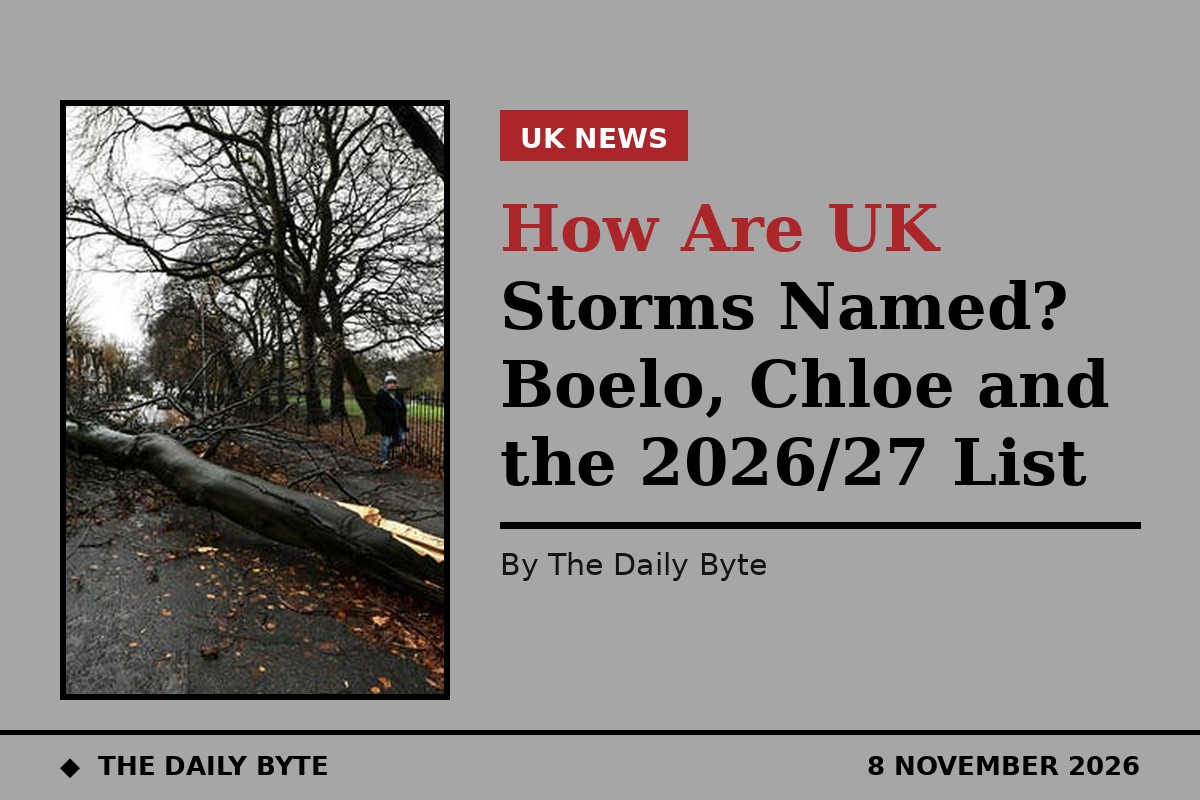
UK storms are named by the Met Office, Ireland's Met Éireann and the Netherlands' KNMI when a weather system is expected to cause enough disruption to trigger an amber or red weather warning. Names are taken in alphabetical order from a list published each September, and the next name on the 2026/27 list is Chloe. Storm Boelo, named on 22 October 2026, was the second named storm of the season after Storm Austen.
The naming system exists for a practical reason: a named storm is easier to follow, warn about and prepare for than an anonymous area of low pressure. This guide explains who chooses the names, when a storm qualifies, the full list for 2026/27, and why some letters never appear.
Who names UK storms?
The scheme began in 2015 and is run jointly by three national weather services: the UK's Met Office, Met Éireann in Ireland and the Dutch service KNMI. Each organisation contributes seven names to the annual list, and any of the three can name a storm, taking the next name from the shared list in alphabetical order.
The names come from suggestions sent in by the public. More than 40,000 name suggestions were submitted to the Met Office for the 2026/27 list. The three services screen the suggestions for how easy they are to pronounce, whether they mean something different in another country, whether they belong to a public figure and whether they could cause controversy. The finished list is unveiled on 1 September and runs until the following August.
When does a storm get a name?
A storm is named when forecasters expect it to bring weather severe enough to trigger an amber or red warning under the Met Office's National Severe Weather Warning service, which weighs both the likely impact and how likely that impact is to happen. Strong winds are the usual trigger, but heavy rain and snow can also qualify.
That threshold matters. Plenty of wet and windy weather crosses the UK every winter without ever receiving a name, because it is not expected to cause medium or high impacts. Naming is a communication tool, not a measure of a storm's strength on its own. A named storm is one the forecasters believe could disrupt travel, damage property or endanger life.
There is one exception to the list. Former hurricanes and ex-tropical systems that cross the Atlantic keep the name they were given by the US National Hurricane Center, rather than taking the next name from the UK list.
The 2026/27 storm names in full
There are 21 names on the 2026/27 list, running from Austen to Wende. The first two have already been used. Storm Austen was named on 20 October 2026 and crossed the UK on 23 October, and Storm Boelo was named on 22 October and affected the UK on 24 and 25 October. Chloe is next, but a name being next on the list does not mean a storm called Chloe is on the way — the name is only used when a storm meets the naming threshold.
| Name | Chosen by | Status |
|---|---|---|
| Austen | Met Éireann | Named 20 October 2026 |
| Boelo | KNMI | Named 22 October 2026 |
| Chloe | Met Office | Next on the list |
| Dano | KNMI | Not yet used |
| Evelyn | Met Éireann | Not yet used |
| Finn | Met Office | Not yet used |
| Gwendolyn | KNMI | Not yet used |
| Heather | Met Éireann | Not yet used |
| Ivy | Met Office | Not yet used |
| Jade | KNMI | Not yet used |
| Kilian | — | Not yet used |
| Laoise | — | Not yet used |
| Miriam | — | Not yet used |
| Nicola | Met Office | Not yet used |
| Olaf | KNMI | Not yet used |
| Phelim | Met Éireann | Not yet used |
| Ruban | Met Office | Not yet used |
| Shaun | Met Office | Not yet used |
| Theo | Met Office | Not yet used |
| Vesna | KNMI | Not yet used |
| Wende | KNMI | Not yet used |
What are the names inspired by?
Many of the names have a story behind them. Austen honours Austen Nagle, the first director of the Irish Meteorological Service, appointed in 1936, and Evelyn honours Evelyn Murphy, the first woman to present the weather forecast on Irish television, in 1983. Both were chosen as Met Éireann marks its 90th anniversary.
Boelo is a nearly extinct name from the eastern Groningen region of the Netherlands, passed down in the family of the person who suggested it. Chloe was suggested more than 130 times, including by the mother of a five-year-old fascinated by the weather. Shaun was chosen in a public vote after a special partnership with Aardman Animations, which asked the public to pick between Shaun the Sheep and Timmy — Shaun won. Ivy was inspired by a nine-month-old Labrador puppy, Finn was named after a two-year-old boy his family described as wild and a force to be reckoned with, and Theo takes its name from a cat whose habit of hiding before thunderstorms led his owner to joke that he could predict the weather.
Why are some letters missing?
The letters Q, U, X, Y and Z are left out of the list, in line with international naming conventions. There are simply too few suitable names beginning with those letters, and skipping them keeps the UK system consistent with the naming used for tropical storms and hurricanes elsewhere. The names also alternate between male and female names as the list runs through the alphabet.
What is the difference between a named storm and a weather warning?
A weather warning and a storm name are related but separate. Warnings are issued by the Met Office for rain, wind, snow, ice, fog, thunderstorms and extreme heat, and they come in three levels: yellow, amber and red. A storm is only named when the expected impacts are serious enough for an amber or red warning. Yellow warnings, which cover a wide range of routine bad weather, do not lead to a storm being named.
That is why the naming system is not a count of how stormy a winter has been. A season can have many yellow warnings and only a handful of named storms. In 2025/26, for example, the named storms ran from Amy in October 2025 through to Dave in April 2026. The 2026/27 list is used until August 2027, and any names left unused simply fall away when the next season's list is published.
Frequently asked questions
What was Storm Boelo? Storm Boelo was the second named storm of the 2026/27 season. It was named by the Dutch weather service KNMI on 22 October 2026 and affected the UK on 24 and 25 October, following Storm Austen, which was named on 20 October.
Is Storm Chloe coming? Chloe is the next name on the 2026/27 list, but that alone does not mean a storm is on the way. The Met Office has said it cannot confirm reports of an approaching Storm Chloe, because a name is only used once forecasters decide a storm meets the naming threshold.
Can I suggest a storm name? Yes. The public is invited to suggest names each year, and more than 40,000 suggestions were submitted for the 2026/27 list. Suggestions are screened for pronunciation, meaning in other countries and links to public figures.
Why do other countries have different storm names? Other European weather agencies use their own lists, which is why a storm named in Spain or France will not appear on the UK list. The UK, Ireland and the Netherlands share one list because their weather systems are closely linked.
For the latest warnings, check the Met Office's UK Storm Centre and the National Severe Weather Warning service before travelling in stormy conditions.