How Does a Country Join the EU? The Full Process
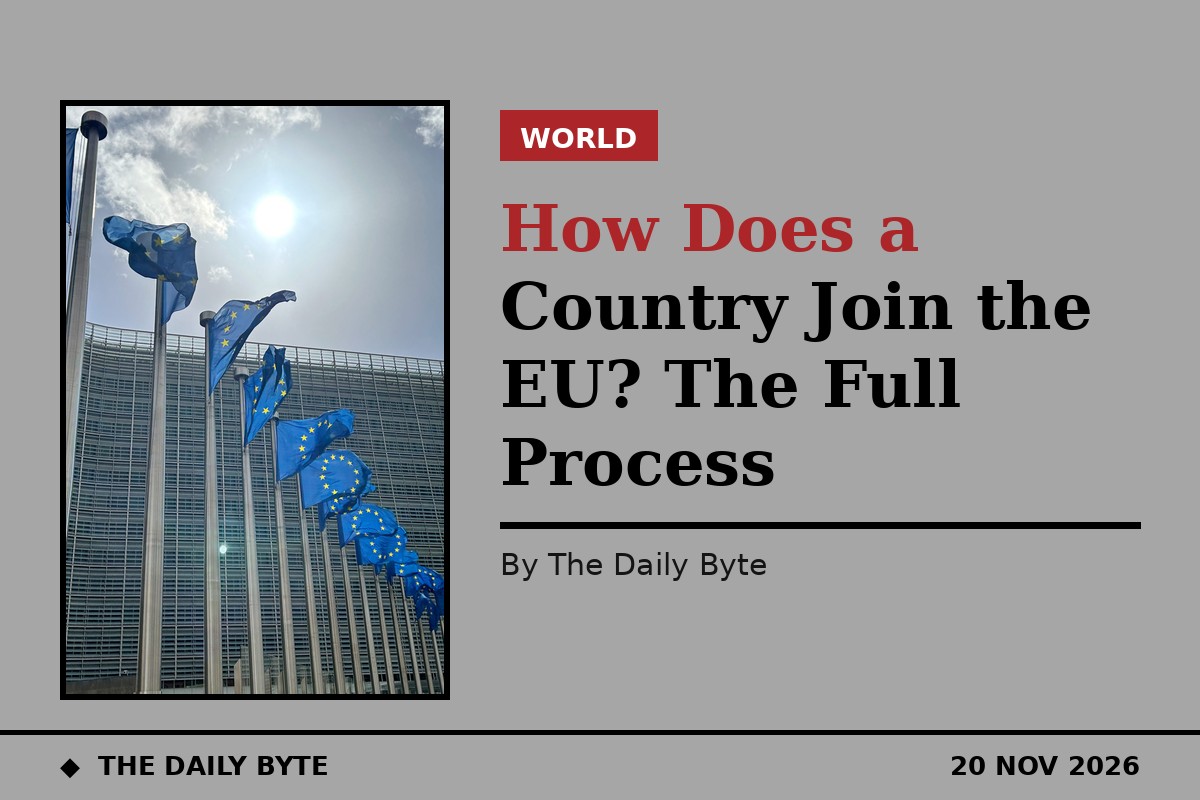
A country joins the European Union by applying to the Council of the EU, proving it meets the EU's political and economic conditions, negotiating its way through more than 30 chapters of EU law grouped into six clusters, and then signing and ratifying an accession treaty that every existing member state must also approve. There is no fixed timetable, and any member state can block progress at several stages, because the key decisions are taken unanimously.
The question is live again because of events in Brussels on 20 November 2026. Hungary lifted its veto on opening Ukraine's and Moldova's final two EU accession negotiating clusters, and EU ambassadors approved the screening results for those clusters at a meeting of the Committee of Permanent Representatives, known as Coreper. The two clusters cover the green agenda and sustainable connectivity, and resources, agriculture and cohesion, and diplomats expect at least one of them to be formally opened by the end of December.
Who can apply?
Any European state may apply to become a member of the Union if it respects the EU's common values and is committed to promoting them, under Article 49 of the Treaty on European Union. The conditions a country must meet are known as the Copenhagen criteria, established by the European Council in Copenhagen in 1993. They have three parts: a political criterion, stable institutions guaranteeing democracy, the rule of law, human rights and respect for and protection of minorities; an economic criterion, a functioning market economy and the capacity to cope with competitive pressure and market forces within the EU; and the ability to take on the obligations of membership, including the capacity to apply EU law and to take on the aims of political, economic and monetary union.
The European Parliament's factsheet on enlargement adds a further condition: the EU's own integration capacity, meaning the Union must be able to take in new members without undermining its institutions or its ability to act. That is why enlargement is as much a decision about the EU itself as it is about the applicant.
The nine steps to membership
The European Commission sets out the accession process in nine main steps. First, the country submits an application to the Council, which represents the member states. Second, the Commission submits an opinion on the application. Third, the member states decide unanimously to grant the country candidate status. Fourth, once conditions are met, the member states agree unanimously to open accession negotiations. Fifth, the Commission proposes a draft negotiating framework as the basis for the talks, and negotiations formally start once the member states agree on that framework. Sixth, during the negotiations, which begin with a screening process and are structured according to clusters and chapters, the country prepares to implement EU laws and standards. Seventh, once negotiations on all areas are finalised, the Commission gives its opinion on the readiness of the country to become a member state. Eighth, on the basis of that opinion, the member states decide unanimously on the admission of the new member state, and the European Parliament must also give its consent. Ninth, all EU member states and the candidate country sign and ratify an accession treaty, which enables the country to become an EU member state.
Two features of that list matter most. The first is unanimity: candidate status, the opening of negotiations, the opening and closing of each cluster, and final admission all require the agreement of every member state, so a single government can hold up the process. The second is that the steps are sequential but slow: screening, where the Commission examines the candidate's laws chapter by chapter against EU law, comes before real negotiation, and the fundamentals cluster, covering the judiciary, fundamental rights, justice, freedom and security, and public administration reform, is opened first and closed last.
What are the clusters and chapters?
The body of EU law that a new member must adopt is called the acquis communautaire. It is divided into more than 30 policy chapters, which since a revised methodology was introduced in February 2020 are grouped into six thematic clusters. Cluster 1 is Fundamentals. Cluster 2 is Internal Market. Cluster 3 is Competitiveness and Inclusive Growth. Cluster 4 is Green Agenda and Sustainable Connectivity, covering transport, energy, trans-European networks, environment and climate change. Cluster 5 is Resources, Agriculture and Cohesion, covering agriculture, fisheries, regional policy and budgetary provisions. Cluster 6 is External Relations.
For each chapter the Commission delivers a screening report, and on the basis of the Commission's recommendation the Council decides by unanimity whether to open the chapter or cluster. When progress is judged satisfactory the Commission may recommend provisionally closing a chapter or cluster, and the Council again decides by unanimity, taking into account overall progress on the rule of law. When negotiations on all chapters are complete, the terms, including possible safeguard clauses and transitional arrangements, are written into the accession treaty, which then needs the Parliament's consent, the Council's unanimous approval, and ratification by every contracting state in line with its own constitutional requirements, by parliament or by referendum.
Why one country can block the whole process
The veto power is not theoretical. Hungary blocked approval of the screening results for clusters 4 and 5 on 20 and 27 October and again on 10 November, without publicly giving a detailed explanation, and only lifted its objection on 20 November after an October agreement between Budapest and Kyiv on minority education rights had already helped unlock two earlier clusters. Because the 20 November Coreper decision only approves the screening results, more steps remain: Ukraine and Moldova must submit their negotiating positions, the member states must unanimously agree common positions, and an intergovernmental conference must then formally open each cluster. Diplomats expect the remaining clusters to open by December, potentially at the General Affairs Council meeting on 15 December.
That sequence also explains why the 20 November decision matters even though it is procedural. With all six clusters open, Ukraine and Moldova will be negotiating every area of membership, including the most sensitive chapters on the environment and agriculture. But Hungary, or any other member state, could still block later stages, since unanimity is required again when clusters are closed and when the accession treaty is approved.
Where Ukraine and Moldova stand
Ukraine applied for EU membership in February 2022, days after Russia's full-scale invasion, and Moldova applied shortly afterwards. Both were granted candidate status in June 2022, and accession negotiations were formally opened in June 2024. Four of the six clusters are already open for both countries, and the 20 November decision clears the way for the last two. The two countries' files have advanced in parallel throughout, and the same Coreper decision covered both.
Their progress has been fast by historical standards, driven by the war and by the EU's political decision to anchor Ukraine in Europe, but the remaining work is the hardest part. Agriculture and the green agenda touch farm subsidies, food standards, energy policy and the EU budget, and each chapter requires Ukraine and Moldova to show their laws and institutions already match EU rules, not merely promise to change them later.
How long does joining take?
There is no set time limit, and past enlargements have taken very different lengths of time. Croatia applied in 2003 and joined in 2013, a decade later. Other candidates have negotiated for far longer. The speed depends on how quickly the applicant can meet the Copenhagen criteria and adopt the acquis, and on whether any member state uses its veto along the way. A country can also be held at the candidate stage for years before negotiations even open.
Joining the EU does not automatically mean joining everything the EU does. New members commit to adopting the euro once they meet the convergence criteria, but that is a separate step with its own tests, and joining the Schengen area of passport-free travel is also decided separately. Transitional arrangements can delay full participation in some policies, such as the free movement of workers or farm payments, for years after accession.
What happens next?
The next procedural step is for Ukraine and Moldova to be invited to present their negotiating positions on clusters 4 and 5. The EU must then prepare and agree its own common negotiating positions on those clusters. If those steps are completed in time, an intergovernmental conference could formally open the clusters at the General Affairs Council on 15 December 2026, which would mean all six clusters are open before the end of the year. After that, the hard bargaining begins: each chapter must be closed one by one, with the fundamentals cluster closed last, before any accession treaty can be drafted.
Frequently asked questions
Can any country join the EU? No. Only a European state that respects the EU's common values and is committed to promoting them can apply, and it must meet the Copenhagen criteria on democracy, the rule of law, human rights, a functioning market economy and the ability to adopt EU law.
Does one member state really have a veto? Yes. Candidate status, opening negotiations, opening and closing clusters, and final admission are all decided unanimously, so any single member state can block progress at those stages.
What is the difference between a chapter and a cluster? A chapter is one policy area of EU law, such as agriculture or transport. Chapters are grouped into six thematic clusters, and clusters are opened and closed as units.
Does joining the EU mean adopting the euro straight away? No. New members commit to adopting the euro once they meet the convergence criteria, but that is a separate step. Schengen membership is also decided separately.
How far along are Ukraine and Moldova? Four of the six clusters are already open, and on 20 November 2026 the EU approved the screening results for the final two, clusters 4 and 5. The clusters still have to be formally opened at an intergovernmental conference, and then negotiated and closed chapter by chapter.
When could Ukraine join? There is no date. Even if the final clusters open in December 2026, every chapter must be negotiated and closed, the fundamentals cluster last, and an accession treaty must be signed and ratified by all member states before membership takes effect.
Sources: European Commission, The EU accession process, step by step; European Parliament, The enlargement of the Union; Rapporteur, Hungary to lift veto on Ukraine, Moldova's EU accession.