How to Drive in Fog: UK Rules, Fog Lights and Safety
Slow down, switch on your dipped headlights, and use your fog lights only when you cannot see more than 100 metres ahead. That is the short answer to driving in fog in the UK, and it matters tonight: the Met Office has a yellow fog warning in force from 6pm on Sunday 8 November until 11am on Monday 9 November, covering London and South East England, with visibility falling to around 50 metres or less in some places. Fog will form readily during Sunday evening, become extensive overnight, and thin only slowly later on Monday morning. London is forecast a foggy start on Monday, then dry, with a high of 10 degrees.
This guide explains the Highway Code rules for driving in fog, what the 100-metre rule means in practice, when fog lights must go on and off, and the mistakes that catch drivers out. The rules quoted here are Highway Code Rules 226 and 234 to 236, which apply in England, Scotland and Wales.
The fog warning in force tonight
The Met Office issued the yellow warning at 9.58am on Sunday 8 November. It covers Greater London and the wider South East, including Kent, Surrey, Essex and Hertfordshire, as part of a larger warning area across England and Wales. A yellow warning is the lowest of the Met Office's three levels, but it still means travel is likely to be disrupted: the warning notes difficult travel conditions and possible delays, with slower journey times on roads, rail and at airports, and the possibility of flight delays or cancellations where dense fog affects airports.
The fog follows a clear, calm spell that is ideal for it to form. Light winds, clear skies and moist air allow the ground to cool and water vapour to condense into low cloud at the surface. The result is patches of fog that can appear suddenly, even on a stretch of road that was clear a few hundred metres earlier. That patchiness is what makes fog dangerous: a driver can go from clear visibility to almost nothing in seconds, with no time to adjust.
The 100-metre rule
Everything in the Highway Code's fog rules turns on one distance: 100 metres, or 328 feet, roughly the length of a football pitch. Rule 226 says you must use headlights when visibility is seriously reduced, generally when you cannot see for more than 100 metres. You may also use front or rear fog lights in those conditions, but you must switch them off when visibility improves. Rule 236 states the other side of the same rule: you must not use front or rear fog lights unless visibility is seriously reduced, because they dazzle other road users and can obscure your brake lights, and you must switch them off when visibility improves.
The word must matters. In the Highway Code, rules written with must or must not reflect the law, in this case the Road Vehicles Lighting Regulations 1989, and breaking them can be a criminal offence. Misusing fog lights can also bring a fixed penalty notice from the police. The test is the visibility, not the weather label: if you can see more than 100 metres, the fog lights stay off, even if the morning still looks grey and murky.
Before you enter fog
Rule 234 says that before entering fog you should check your mirrors and then slow down. If a roadside sign shows the word fog but the road ahead looks clear, be prepared for a bank of fog or drifting patchy fog ahead. Even if conditions seem to be clearing, you can suddenly find yourself in thick fog, so do not speed back up the moment the road looks clear.
Before setting off in foggy conditions, it is worth checking the Met Office warnings for your route, clearing the windscreen inside and out, and making sure the demisters and wipers work. Once you are moving, use the wipers and demisters to keep the glass clear, and be aware that other drivers may not be using their headlights at all.
Driving in fog: what to do
Rule 235 sets out how to drive once you are in fog. Use your lights as required under Rule 226. Keep a safe distance behind the vehicle in front, and remember that the rear lights ahead can give a false sense of security, tempting you to follow too closely. Be able to pull up well within the distance you can see clearly. That matters most on motorways and dual carriageways, where vehicles travel faster and the distance you need to stop is far greater than the distance you can see.
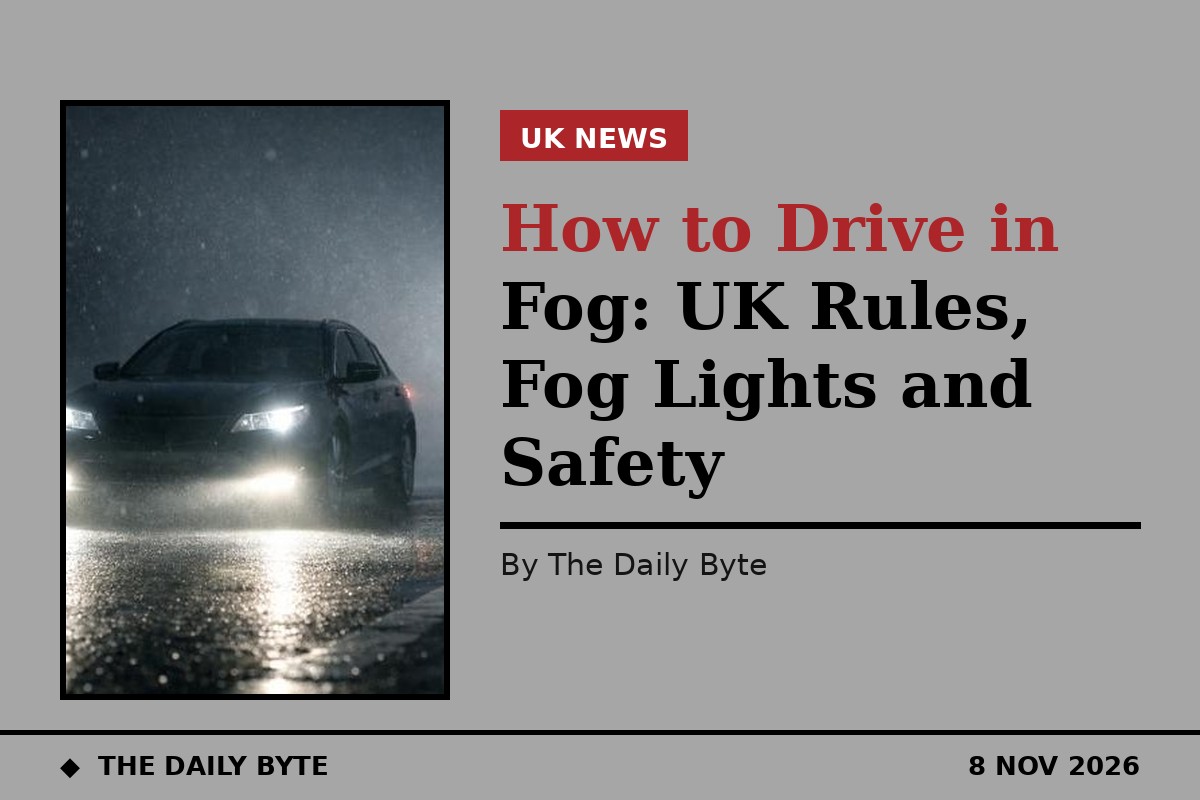
Do not use main beam in fog. Full beam reflects off the water droplets and throws a white wall back into your eyes, making visibility worse rather than better. Dipped headlights are the right choice, with fog lights added only while visibility stays below 100 metres. Do not accelerate to get away from a vehicle that is too close behind you; speeding up into fog you cannot see through only increases the risk. Check your mirrors before you slow down, then brake so your brake lights warn drivers behind that you are slowing. At a junction with limited visibility, stop in the correct position and listen for traffic before moving off, and only proceed when you are sure it is safe.
Stopping distances grow sharply in bad weather. The Highway Code notes that in wet weather, stopping distances are at least double those on dry roads, and fog often comes with wet roads. Some driving guides suggest doubling the usual two-second gap to four seconds in fog. Whatever gap you choose, the rule to remember is the one in Rule 235: you must be able to stop within the distance you can see.
Fog lights: when on, when off
Fog lights are easy to misuse, and misuse is the most common fog-driving offence. The lights are bright by design, so in clear conditions they dazzle the driver behind and can hide your brake lights, leaving the car behind with less warning when you slow down. That is why Rule 236 forbids them unless visibility is seriously reduced, and why they must go off the moment conditions improve.
The practical routine is simple. When visibility drops below 100 metres, switch on dipped headlights and then the fog lights. When you can see beyond 100 metres again, switch the fog lights off straight away, even if the road is still wet and the sky still looks dull. If the fog is patchy, expect to switch them on and off several times on the same journey. Leaving them on through a clear stretch because you expect more fog ahead is not allowed, and it is the habit that most often draws a penalty.
| Highway Code rule | What it says |
|---|---|
| Rule 226 | Must use headlights when visibility is seriously reduced, generally under 100 metres; may use fog lights then; must switch them off when visibility improves |
| Rule 234 | Before entering fog, check mirrors then slow down; be ready for a bank of fog even if the road looks clear |
| Rule 235 | Keep a safe distance; be able to stop within the distance you can see; use wipers and demisters; do not speed up to escape a tailgater |
| Rule 236 | Must not use fog lights unless visibility is seriously reduced; they dazzle others and can obscure brake lights; must switch them off when visibility improves |
Frequently asked questions
When can I use my fog lights? Only when visibility is seriously reduced, which the Highway Code generally puts at not being able to see more than 100 metres, about a football pitch. Below that distance you may use front and rear fog lights. Above it, they must stay off.
Should I use main beam in fog? No. Main beam reflects off the fog and reduces what you can see. Use dipped headlights, and add fog lights only while visibility is below 100 metres.
What if the fog clears and then comes back? Switch the fog lights off as soon as visibility improves, and be ready to switch them back on if you drive into another bank of fog. Rule 234 warns that patchy fog can appear suddenly even after a clear stretch, so stay alert rather than assuming the worst is over.
What if I cannot see far enough to drive safely? Slow right down until you can stop within the distance you can see. If conditions become so bad that you cannot continue safely, pull over somewhere safe, well away from moving traffic, and wait for the fog to lift. Check the latest Met Office warning before you set off again, and allow extra time for the journey. Warnings can change, so check the latest forecast before travelling.