How to Get a UK Provisional Driving Licence in 2026
A provisional driving licence is the first step towards driving legally in the United Kingdom. You need one before you can take driving lessons on public roads, book a theory test or sit a practical driving test. Without it, you cannot learn to drive a car, motorbike or moped on public roads at all, and you cannot book either test.
The licence is issued by the Driver and Vehicle Licensing Agency, known as the DVLA, and it covers England, Scotland and Wales. Northern Ireland runs a separate system through the Driver and Vehicle Agency, so the process described here does not apply there. Applying is straightforward, and most people do it online through GOV.UK in a matter of minutes.
You can apply for your first provisional driving licence from the age of 15 years and 9 months. That does not mean you can drive a car at that age. A car can only be driven from the age of 17, or from 16 if you receive the higher rate mobility component of Personal Independence Payment. At 16, a provisional licence allows you to start learning to ride a moped. The early application age simply means your licence can be ready and waiting for your 17th birthday.
To apply, you must be able to read a number plate from 20 metres away, with glasses or contact lenses if you normally wear them. You must have permission to live in Great Britain, and you must have lived here for at least 185 days in the last 12 months. You must also tell the DVLA about any medical condition that could affect your ability to drive safely. Failing to declare a relevant condition can lead to a fine and can invalidate your licence.
Applying online is the quickest and cheapest route. It costs £34, and you pay by MasterCard, Visa, Electron or Delta debit or credit card. The application is made on GOV.UK, where you will need to sign in or create sign-in details. You will be told during the process if you need to prove your identity, which usually involves using photo ID such as a passport. You will also need your National Insurance number if you have one, and the addresses where you have lived for the last three years.
Once you have applied online, the DVLA sends a confirmation email. Your licence should arrive within one week if no additional checks are needed. It may take longer if the DVLA needs to make further checks, for example about your identity or a medical condition, so it is worth applying well before you plan to start lessons.
If you cannot apply online, you can apply by post instead. You need form D1, titled Application for a driving licence, which is available from most Post Offices. You send the completed form to the address printed on it, together with a cheque or postal order for £43, and you must pay the correct postage. Postal applications take longer, typically up to three weeks, and you will need to send original identity documents rather than just entering a passport number online.
Only apply through the official GOV.UK service. Third-party websites sometimes charge extra to pass your details on to the DVLA, and they cannot make your application any faster. The official fee is fixed, so a dearer application is not a quicker one. If a website asks for more than £34 online or £43 by post for the licence itself, you are not on the official service.
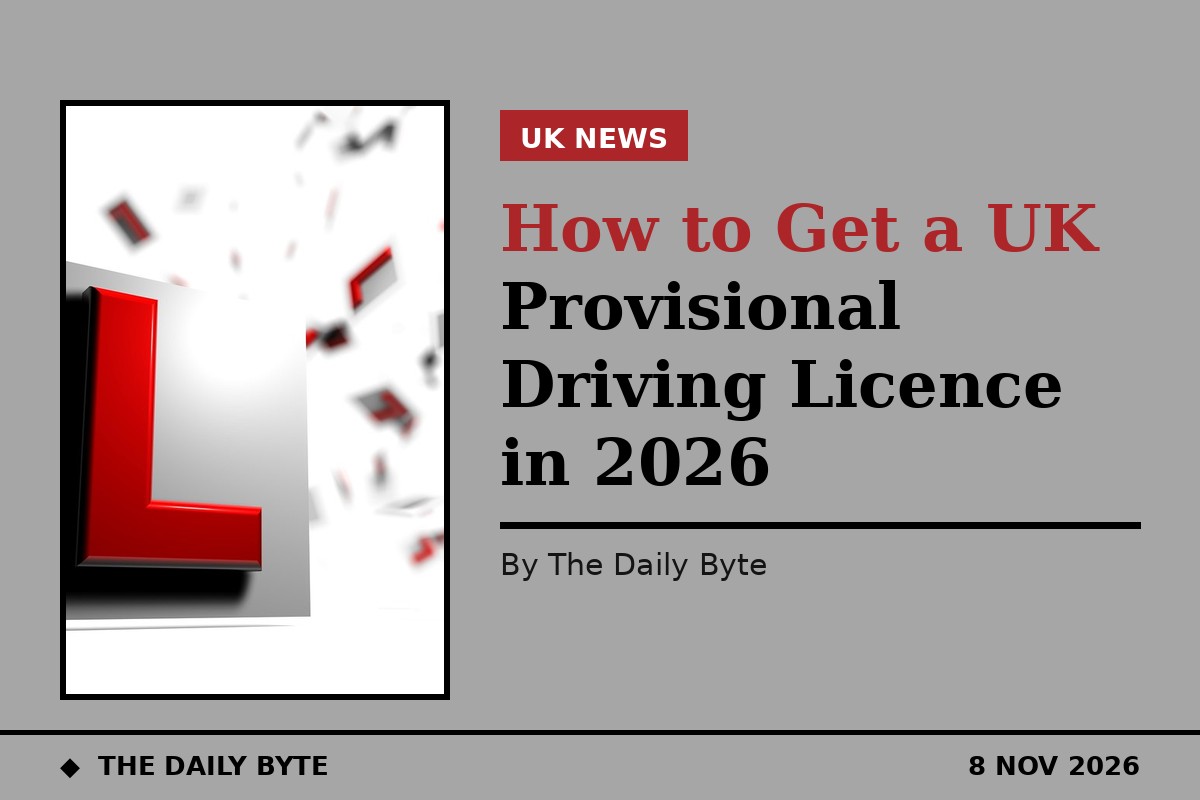
A provisional licence comes with strict rules about what you can and cannot do. You must always be supervised by a qualified driver when you drive a car. That supervisor must be at least 21 years old and must have held a full driving licence for the vehicle you are driving for at least three years. You must display L plates, or D plates in Wales, on the front and back of the vehicle, and the vehicle must be insured for you to drive it. Learner driver insurance is available either as a separate policy or added to an existing policy.
You cannot drive on a motorway unless you are with an approved driving instructor in a dual-control car displaying L plates. You cannot drive alone under any circumstances, and you cannot carry passengers for payment. Breaking these rules can lead to penalty points on a licence you have barely held, and under the new drivers rules, reaching six penalty points within two years of passing your test means your licence is revoked and you must retake both tests.
Once your provisional licence arrives, you can book your theory test. The car theory test costs £23 and covers multiple-choice questions and a hazard perception test in a single appointment. You can take the theory test from your 17th birthday, or from 16 if you receive the higher rate mobility component of Personal Independence Payment. Your theory test pass is valid for two years, so you must pass your practical test within that time or take the theory test again.
The practical driving test costs £62 on a weekday and £75 on evenings, weekends and bank holidays. You cannot usually book it until you have passed your theory test. The practical test lasts around 40 minutes and includes an eyesight check, safety questions, general driving and one reversing manoeuvre, plus about 20 minutes of independent driving following a sat nav or road signs.
Most learners need a substantial number of hours of professional instruction before they are ready for the practical test. The DVSA does not set a fixed number of lessons, but the average learner takes around 45 hours of professional tuition plus additional private practice. Lesson prices vary by area and instructor, and they are the largest part of the total cost of learning to drive, far outweighing the government fees for the licence and the tests.
When you pass your practical test, your examiner will usually arrange for your full licence to be sent to you, and you can drive as a full licence holder straight away. Your provisional licence is exchanged for a full photocard licence, which is valid for 10 years before it needs renewing. If you do not pass, you can rebook, but you will need to pay the test fee again each time.
If your provisional licence is lost, stolen, damaged or destroyed, you can apply for a replacement through GOV.UK. A replacement costs £20. You can also change the address on your provisional licence free of charge through the official service, and you must do so whenever you move house, because driving with the wrong address on your licence can lead to a fine.
People who already hold a driving licence from another country should check the rules before applying. Some foreign licences can be exchanged for a UK licence, while others only allow driving in the UK for a limited period. If you hold a licence from a European Union country, you should not apply for a provisional licence to take the test, because you can use your EU licence instead. The rules depend on where your licence was issued and how long you have lived in the UK, so check the official GOV.UK guidance for your situation.
Medical conditions deserve honest attention at the application stage. Conditions such as epilepsy, diabetes treated with insulin, certain eye conditions and some heart conditions must be declared to the DVLA. In many cases you can still drive, sometimes with a licence issued for a shorter period so your condition can be reviewed. Declaring a condition does not automatically mean refusal, but failing to declare one can lead to a fine of up to £1,000 and prosecution if you are involved in an accident.
The most common mistakes applicants make are simple ones: applying through an unofficial website and paying too much, entering an old address, or forgetting that the licence must be in hand before a theory test can be booked. Applying online through GOV.UK, with a valid passport and three years of address history ready, avoids most delays. Fees and rules can change, so always confirm the current fee and requirements on the official GOV.UK page before you pay.
A provisional driving licence is a small pink photocard, but it is the document that opens the road to independent driving. Apply early, apply through the official service, learn the rules that come with it, and the rest of the journey, from first lesson to full licence, follows in order.