Hussain Naqi, veteran journalist, dies in Lahore
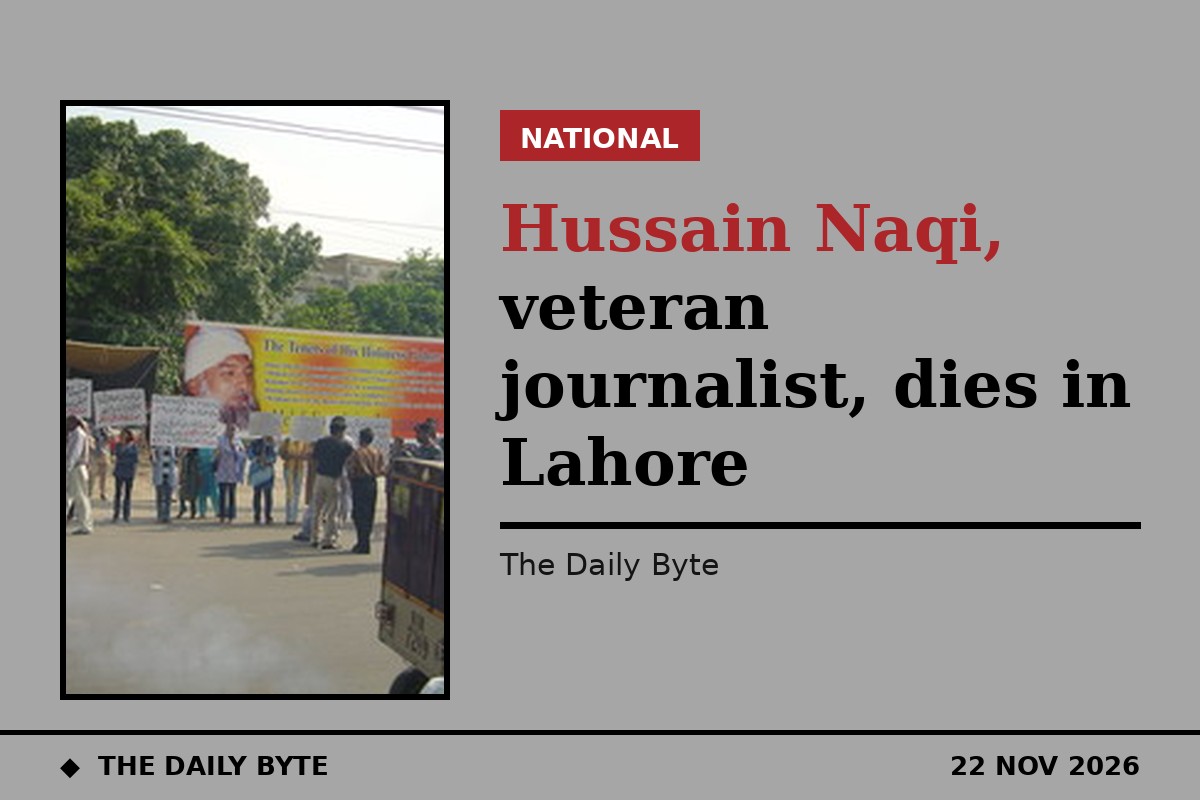
Veteran journalist and human rights activist Hussain Naqi has died in Lahore, after suffering a cardiac arrest on Saturday evening. He was taken to a private hospital and died at about 5am on Sunday, 22 November.
Funeral prayers were held at Jamia Al-Muntazir in Model Town, Lahore, where colleagues, family and friends gathered to pay their respects. He is survived by three sons.
Tributes came from across Pakistan’s political and press communities. President Asif Ali Zardari said he was profoundly grieved by the death, paying tribute to Naqi’s lifelong services to journalism, freedom of expression and the promotion of human rights, the Associated Press of Pakistan reported. Prime Minister Shehbaz Sharif also expressed grief, and the All Pakistan Newspapers Society said it was profoundly grieved by the loss.
The Human Rights Commission of Pakistan (HRCP), with which Naqi was associated for decades, said it deeply mourned his passing. In its statement, the commission said that over a career spanning more than 70 years, from student leader to newspaper editor to treasurer of the HRCP, neither repeated imprisonment nor pressure from the authorities had weakened his resolve to speak truth to power.
From student politics to the editor’s chair
Naqi was born in Lucknow in 1936 and moved to Pakistan as a young man, settling in Karachi. As a student he became a prominent campaigner for student rights and democratic values, the causes that shaped the rest of his life.
He began his journalism career with Pakistan Press International (PPI), the national news agency, and later worked with several newspapers, serving as PPI’s bureau chief and as editor of The News. Colleagues remember him as a newsroom figure who defended editorial independence and stood up for the rights of working journalists, even when it cost him his job.
He was also a strong advocate for the Punjabi language. He launched Sajjan, a daily newspaper published in Punjabi, giving the language a daily voice in a press dominated by Urdu and English.
Jail, resistance and seven decades of public service
What set Naqi apart was not only the length of his career but the price he paid for it. He was imprisoned several times for his outspoken activism. He had supported Zulfikar Ali Bhutto during Ayub Khan’s martial law, and was later sent to jail under Bhutto himself, a detail his admirers often cite as evidence that his loyalty was to principles, not personalities.
Through the HRCP, where he remained active for decades and was still a council member at the time of his death, he worked on causes that few others would touch, from the rights of the disappeared to the freedoms of religious minorities and the working press. He warned repeatedly against gagging the press, telling a Karachi Press Club gathering that suppressing the public voice would hurt the country’s integrity.
He was also a trade unionist and civil liberties campaigner, and a former co-director of the HRCP, according to the commission.
A life written down
Late in life, Naqi set down his story in an autobiography, Mujh Se Jo Ho Saka, which was celebrated at a Lahore University of Management Sciences event in October 2025 as a history of journalism and democracy in Pakistan, told through decades of struggle, censorship and dissent.
His death closes a public life that began in student politics in the 1950s and continued, through prison cells and newsrooms, into his final years. Associated Press of Pakistan (APP) | UrduPro, citing the Pakistan Observer