Standard Chartered sees SBP rate at 13% by June 2027
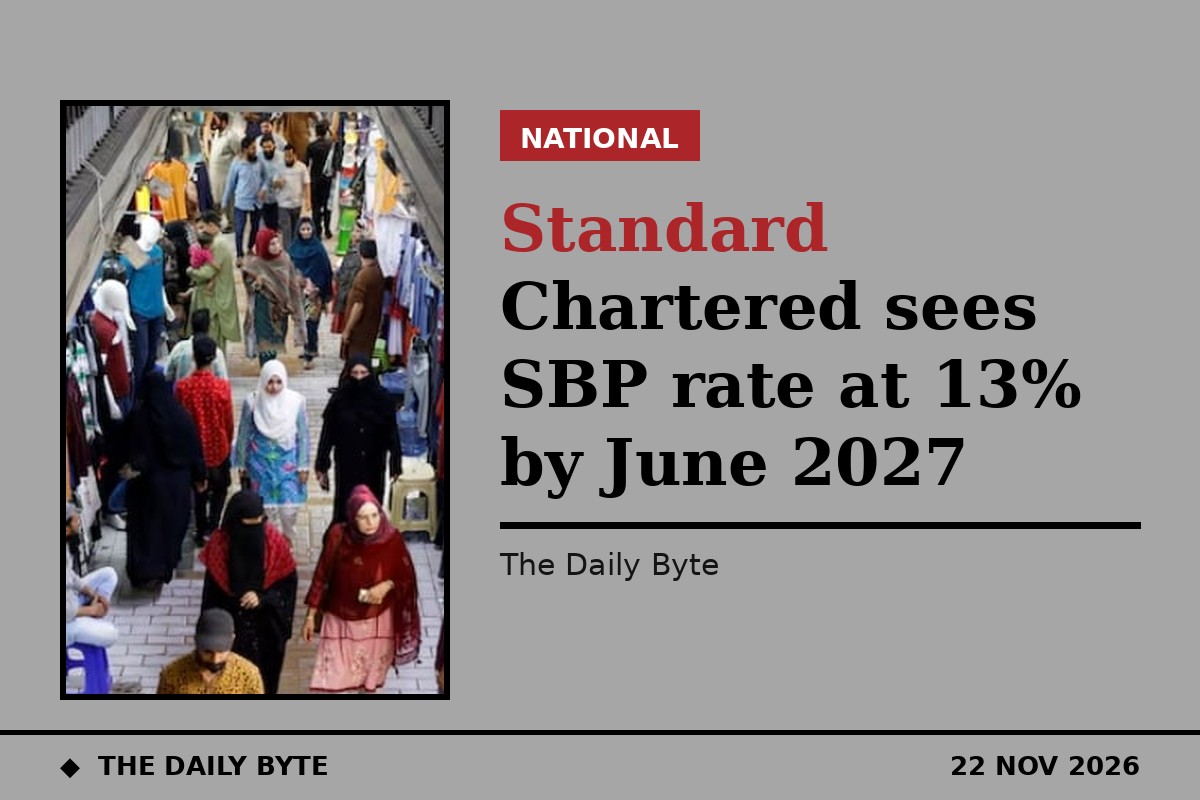
Standard Chartered expects Pakistan's economy to slow and its central bank to keep raising interest rates, forecasting growth of 3.0 per cent this fiscal year and a policy rate of 13 per cent by June 2027. The bank blamed higher oil prices linked to the Middle East conflict for the weaker outlook, with inflation forecast at 10 per cent.
The forecast was set out by Talha Nadeem, the bank's economist for the Middle East and North Africa, at a media roundtable in Karachi. He said growth would ease from 3.7 per cent a year earlier, and that the State Bank of Pakistan (SBP) would need to lift its policy rate by a further 100 basis points from its current level of 12 per cent.
Why rates are expected to rise
Higher energy prices are the main driver. Standard Chartered forecasts Brent crude at $101 a barrel in the current quarter of 2026 and about $89.5 in 2027. Nadeem said inflation was unlikely to return to the SBP's 5 to 7 per cent medium-term target range in FY27, noting that the central bank's own expectation was as high as 7.5 per cent. The International Monetary Fund has also revised its forecast for Pakistan's inflation upward to around 9.9 per cent, linked to its revised assumption on oil prices.
Inflation has been in double digits for six to seven months, Nadeem said. He credited the SBP for acting relatively early by raising rates in April, when many central banks were still waiting to see whether the supply shock would pass, saying the move helped anchor inflation expectations.
What is holding the economy up
The external account has been the most resilient part of the economy, Nadeem said, largely because remittances have held up better than expected. Around 44 to 45 per cent of Pakistan's remittances come from the United Arab Emirates and Saudi Arabia, and the bank had expected flows from those corridors to come under pressure. That has not happened in the data so far.
Before the Middle East conflict, Pakistan had built buffers that cushioned the shock, including rebuilt foreign exchange reserves, record remittances, a stable exchange rate and fiscal consolidation, with three years of primary surpluses that Nadeem described as unprecedented in at least two decades. With oil prices elevated, he said, some of that picture has changed, and energy is a clear transmission channel for the shock.
Investors want discipline to continue
Adil Salahuddin, chief executive and head of coverage at Standard Chartered Pakistan, said geopolitics was now the highest risk event for Pakistan and the industry, citing the Middle East conflict, the US-China rivalry and oil price shocks. He said the current IMF loan programme ends in 2027 and that 2028 is an election year, so retaining discipline is key.
Most foreign investors surveyed by the bank said they would prefer Pakistan to stay in an IMF programme after the current one ends, seeing it as a guarantee of policy discipline. Salahuddin also said the formal sector was struggling under the tax burden and that the tax net needed to be broadened to release what he called a stranglehold on documented businesses.
Philippe Dauba-Pantanacce, the bank's global head and geopolitical strategist, warned that the energy market would remain a problem for many countries in 2027, whether or not geopolitical tensions ease, because damage to physical infrastructure and depleted stocks would keep a floor under oil prices.
FAQ
What is Pakistan's policy rate now? The State Bank of Pakistan raised its benchmark policy rate to 12.0 per cent at its meeting on 26 October 2026. Standard Chartered expects a further 100 basis points of increases, taking it to 13 per cent by June 2027.
Why does Standard Chartered expect growth to slow? The bank points to elevated oil prices from the Middle East conflict, which push up inflation and force higher interest rates, and higher borrowing costs then squeeze economic growth.
What inflation rate does the bank forecast? Standard Chartered forecasts average inflation of around 10 per cent in FY27, above the State Bank's 5 to 7 per cent medium-term target range.
Sources: The News; The Boardroom PK. Reported on 22 November 2026.