Ibero-American Leaders Adopt Madrid Declaration
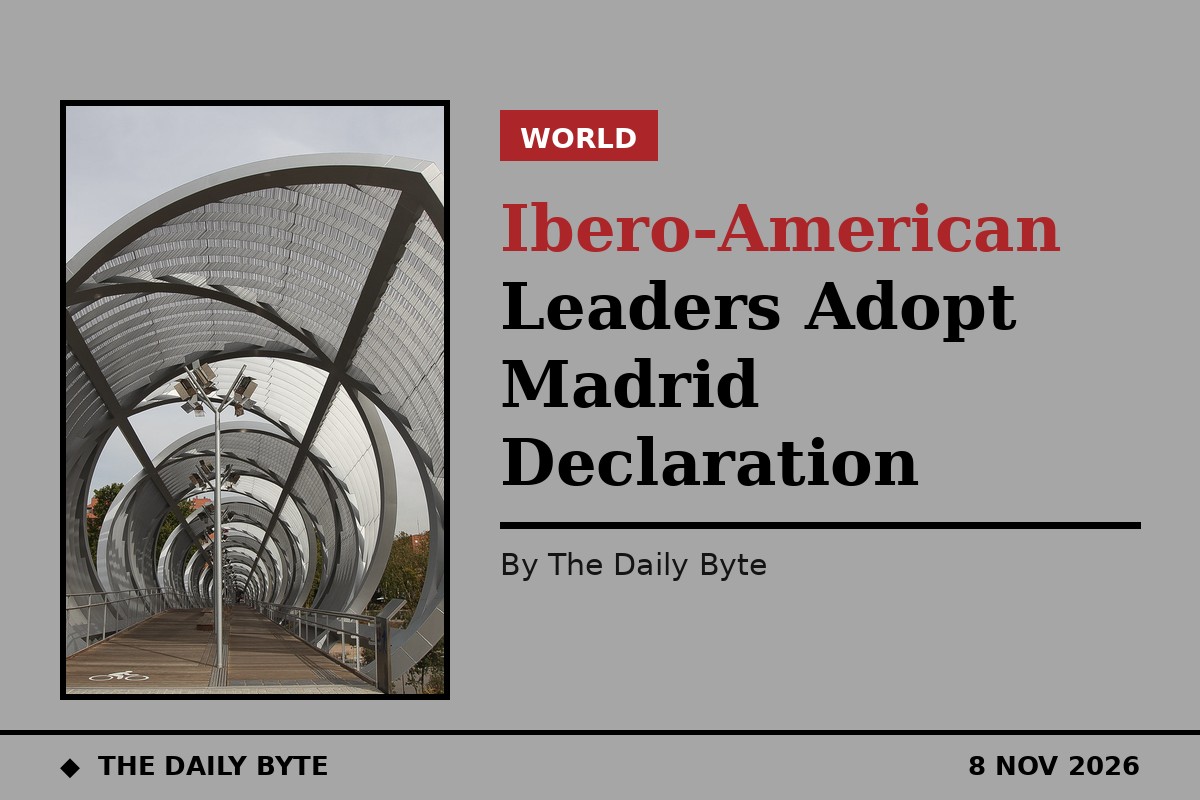
Leaders of the 22-member Ibero-American Community have adopted the Madrid Declaration at the close of the 30th Ibero-American Summit in Spain, reaffirming their support for multilateralism, international law and closer regional cooperation.
The declaration was adopted on Thursday 5 November in Madrid, two years after the previous summit in Cuenca, Ecuador, ended without an agreed text. It sets shared priorities on sustainable development, democracy, education, technology and disaster resilience for the community of Spanish and Portuguese speaking nations.
The summit approved the creation of an Ibero-American Artificial Intelligence Alliance, a voluntary body intended to coordinate cooperation on access to quality data, artificial intelligence models built for Ibero-American languages and needs, and shared computing capacity. Leaders also approved a regional network for disaster risk reduction and civil protection, an academic mobility charter to expand student exchanges and the recognition of university studies, and a charter on care and support.
The declaration welcomed Angola, India and Turkiye as Associated Observers of the community, while the Association of Caribbean States became a Consultative Observer. Leaders confirmed that Honduras will host the 31st Ibero-American Summit in 2028, with the pro tempore secretariat passing from Spain to the Central American country to prepare the next gathering.
Unity was not complete. Argentina dissociated itself from the paragraphs on coercive measures and from the artificial intelligence alliance, the academic mobility charter and the care and support charter, and said references to gender should be read as referring to the female and male sexes. Colombia and Costa Rica dissociated themselves from the paragraph rejecting coercive measures contrary to international law, while Paraguay recorded reservations on the coercive measures provisions and the artificial intelligence alliance, and said its interpretation of gender is based on its national constitution.
King Felipe VI, who chaired the summit as head of state of the host nation, used a ceremony in Madrid on Friday to praise the agreements reached and to urge governments to turn them into tangible results. Prime Minister Pedro Sanchez said the community speaks for more than 700 million people and called for stronger international cooperation and dialogue, arguing that the Madrid outcome shows the summit system can still deliver consensus after the disappointment of Cuenca in 2024.
The summit brought together delegations from all 22 Ibero-American countries, although with uneven participation from their top leaders, with about a dozen heads of state and government attending in person. Sanchez had asked member states for ambition in a divided world at the opening of the plenary session.
The Madrid Declaration also recorded the community's backing for a new approach to relations between governments and the private sector, with business leaders presenting their own declaration calling for a predictable, investment-friendly environment grounded in legal certainty. The summit's final communique will now pass to Honduras, which takes over the rotating presidency ahead of the 2028 meeting.


