IBM Unveils Nighthawk r3 Quantum Processor
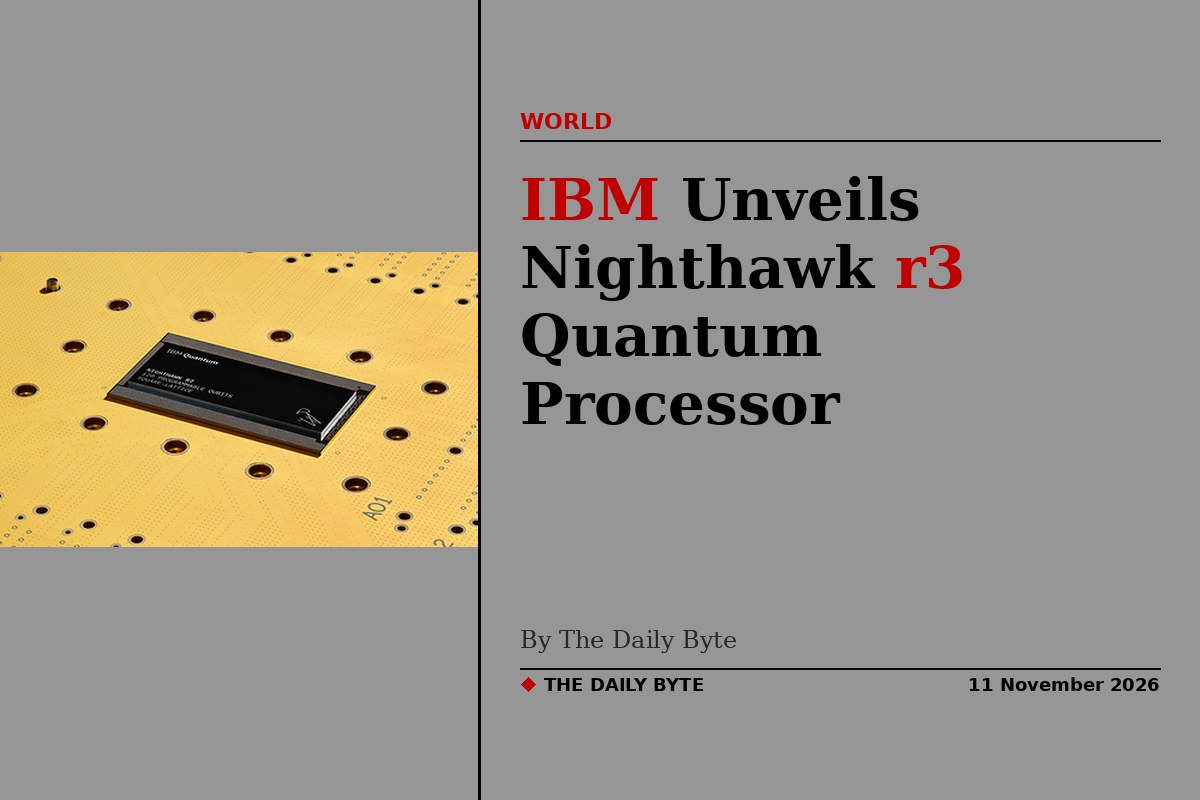
IBM has announced its next-generation quantum processor, Nighthawk r3, designed to run 10,000 quantum operations across 520 programmable qubits, as it pushes its quantum roadmap past 1,000 qubits in 2027.
The company announced the processor on Tuesday, 11 November, in Yorktown Heights, New York. Nighthawk r3 will be built to execute 10,000 quantum operations accurately, using 520 programmable qubits out of 2,034 total physical qubits on the chip. In 2027, IBM plans to link two Nighthawk r3 processors into a single system with 1,040 qubits.
The announcement is a design and roadmap step rather than a product launch. IBM has not said when a single r3 processor will be generally available, and it has given no price. What it has set out is the scale it is aiming for, and the engineering it says will get it there.
Building on Nighthawk r2
Nighthawk r3 builds on the current Nighthawk r2 processor, introduced in September. IBM says r2 delivers up to 100,000 samples per second while supporting accurate computations with more than 7,500 quantum operations on 120 qubits. Its high-speed qubit reset technology cuts the time between circuit executions, helping applications collect the millions or billions of samples needed for complex work.
Clients and partners including E.ON, Algorithmiq and Q-CTRL have run more than 34 billion circuits on Nighthawk r2, IBM said, reporting performance improvements of up to 19 times over previous IBM quantum processors. E.ON reported a 15-times speedup on r2 in quantum machine learning for energy grid optimisation, while IBM reported a 12-times speedup in an experiment with Oak Ridge National Laboratory simulating real magnetic materials, with results consistent with neutron scattering experiments. Both speedups were measured against earlier work on IBM Quantum Heron.
An experiment with Algorithmiq to simulate a heterogeneous quantum material has now been extended to Nighthawk r2, running eight times faster than the original experiment on Heron, while using circuits that IBM says would need about 240 times more memory for a leading classical method to match with comparable accuracy.
Linking chips together
The key change in r3 is modularity. The processor keeps r2's square-lattice connectivity and fast operations, but adds 10 chip-to-chip interconnects, called l-couplers, designed to connect processors into larger systems. That is how IBM plans to reach 1,040 qubits in 2027: by joining two r3 chips, rather than building one chip of that size.
IBM says it has already demonstrated two technologies that make that approach possible. This year it connected Nighthawk r1 processors using four l-couplers, achieving 99.3 per cent quantum state transfer fidelity, against a target of 99.9 per cent. It also connected two cryogenic modules into a single system for the first time, reaching operating temperature in under five days and cooling below 15 millikelvin.
Quantum meets classical computing
Alongside the processor, IBM announced enhancements to the IBM Quantum Platform, bringing high-performance classical computing and quantum computing together in a single managed environment. Users can now integrate quantum workflows directly with classical resources, from a laptop to a supercomputer, or with high-performance resources newly available on the platform.
IBM and RIKEN scientists used the new environment to run a sample-based quantum diagonalisation workflow about five times faster while performing 100 times more computations than in the original study. Cleveland Clinic and RIKEN used the platform to process 608 million samples automatically for modelling biologically relevant structures, 33 times faster than without workflow automation.
IBM also recently launched a co-design platform for quantum error correction with Oak Ridge National Laboratory and AMD, physically co-locating Nighthawk with the laboratory's Umbra high-performance computing system, powered by AMD Instinct MI355X graphics processors and fifth-generation AMD EPYC processors.
Jay Gambetta, director of IBM Research, said useful quantum computing depends on delivering results with both accuracy and speed. Nighthawk r3 is the next step in that plan, IBM said, as it works towards fault-tolerant quantum computers that can correct their own errors.


