IMF tells Pakistan to end petrol subsidy for bikes and small cars
By aminah
·18 Nov 2026
·5 min read
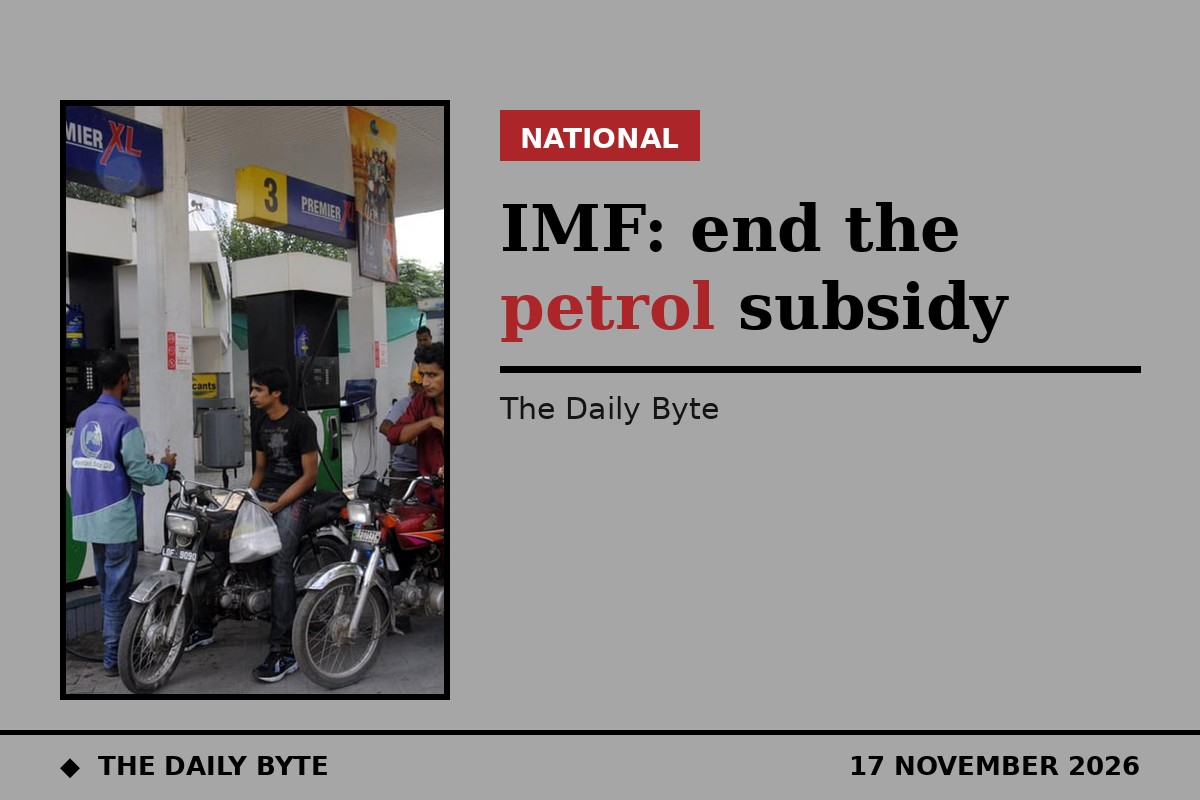
The International Monetary Fund (IMF) has told Pakistan to phase out its petrol subsidy for motorcyclists, rickshaw drivers and owners of small cars, saying the scheme is too broadly targeted and too costly to continue.
An IMF spokesperson told Arab News on Saturday, 14 November, that the fuel support scheme "should be phased out, given its broad targeting". Any future fuel support, the spokesperson said, should oil prices rise again, should be "limited, timebound, targeted using established social assistance programs, and accommodated within the FY27 budget envelope".
The message repeats a position the IMF set out in its staff-level agreement with Pakistan on 7 October, which called for the scheme to end promptly because of its high cost and broad coverage. The Fund's latest comments were reported by Arab News and by Pakistan Today on 15 November.
## What the subsidy gives motorists
Pakistan launched the fuel subsidy scheme in September 2026 to shield lower-income motorists from rising petrol prices during the war between the United States and Iran. The scheme gives motorcycle and rickshaw users a weekly petrol token worth Rs500. Owners of cars with engines of up to 800cc receive a discount of Rs100 a litre on up to 10 litres every 10 days.
The government approved the Rs75 billion digital fuel subsidy programme through the Economic Coordination Committee in September and recently extended it until December. The government has described it as a three-month programme, so it was due to run to about mid-December in any case.
As of 15 November, the government had not announced any change in response to the IMF's latest comments, and the subsidy continued, according to reporting of the Fund's position. Pakistan's Finance Minister Muhammad Aurangzeb, State Minister for Finance Bilal Azhar Kayani and Finance Adviser Khurram Schehzad did not respond to Arab News' requests for comment, the report said.
## Why the IMF objects
The IMF's concern is not only the cost. The Fund says the scheme reaches far more people than the vulnerable households it was designed to protect, because it is based on the type of vehicle rather than on household income. That, in the Fund's view, makes it an expensive way to deliver help, and it argues that any future support should instead go through established social assistance programmes that can target the people most in need.
The Fund also links the issue to Pakistan's wider programme. Under the $7 billion Extended Fund Facility, the Pakistani authorities have committed to allow domestic fuel prices to align with international fuel rates, while protecting the most vulnerable. The IMF says the war in the Middle East "remains a significant headwind for Pakistan, given its reliance on oil and gas imports from the Gulf countries".
## Petrol prices and inflation
Petrol prices reached a record Rs458.41 a litre on 3 April 2026, as the US-Iran war pushed up oil prices. Prices have since eased as tensions have receded, to about Rs330 a litre by mid-November, according to the Arab News report. Pakistan's consumer prices rose 9.6 per cent in October, down from 10.3 per cent a month earlier, according to the Pakistan Bureau of Statistics.
The IMF spokesperson warned that sustained volatility in oil prices could weigh on Pakistan's economic outlook, and said the country's policy priorities should remain centred on macroeconomic stability, reforms to strengthen public finances, and improving the viability of the energy sector.
## What happens next
The staff-level agreement reached on 7 October still awaits approval from the IMF's Executive Board. The Board meeting on Pakistan's Extended Fund Facility and Resilience and Sustainability Facility reviews, and the 2026 Article IV consultation, is expected to take place in December, subject to Pakistan meeting the programme's requirements.
Upon approval, Pakistan would receive about $1 billion under the Extended Fund Facility and $210 million under the Resilience and Sustainability Facility, taking total disbursements to about $5.7 billion, according to the IMF spokesperson.
Whether the government ends the subsidy in December, when the current extension runs out, or keeps some form of targeted support in place, has not been decided publicly. For motorists who rely on the weekly token or the small-car discount, the next decision will matter directly at the pump.
## Frequently asked questions
**What has the IMF asked Pakistan to do?**
Phase out the petrol subsidy scheme for motorcycles, rickshaws and cars up to 800cc, because it is broadly targeted and costly.
**What does the subsidy give now?**
A weekly petrol token worth Rs500 for motorcycle and rickshaw users, and Rs100 a litre off up to 10 litres every 10 days for cars up to 800cc.
**Has the government ended the scheme?**
No. As of 15 November, the government had not announced any change, and the subsidy continued. The scheme was extended until December.
*Sources: Arab News, as reported by Europe Says, "IMF reiterates Pakistan should phase out fuel subsidy, says future support should be 'limited'", 14 November 2026; Feature Pakistan, "IMF Tells Pakistan to End Petrol Subsidy", 15 November 2026.*
Source
Arab News — https://www.europesays.com/3375315/