India, Canada Push CEPA Trade Deal Forward
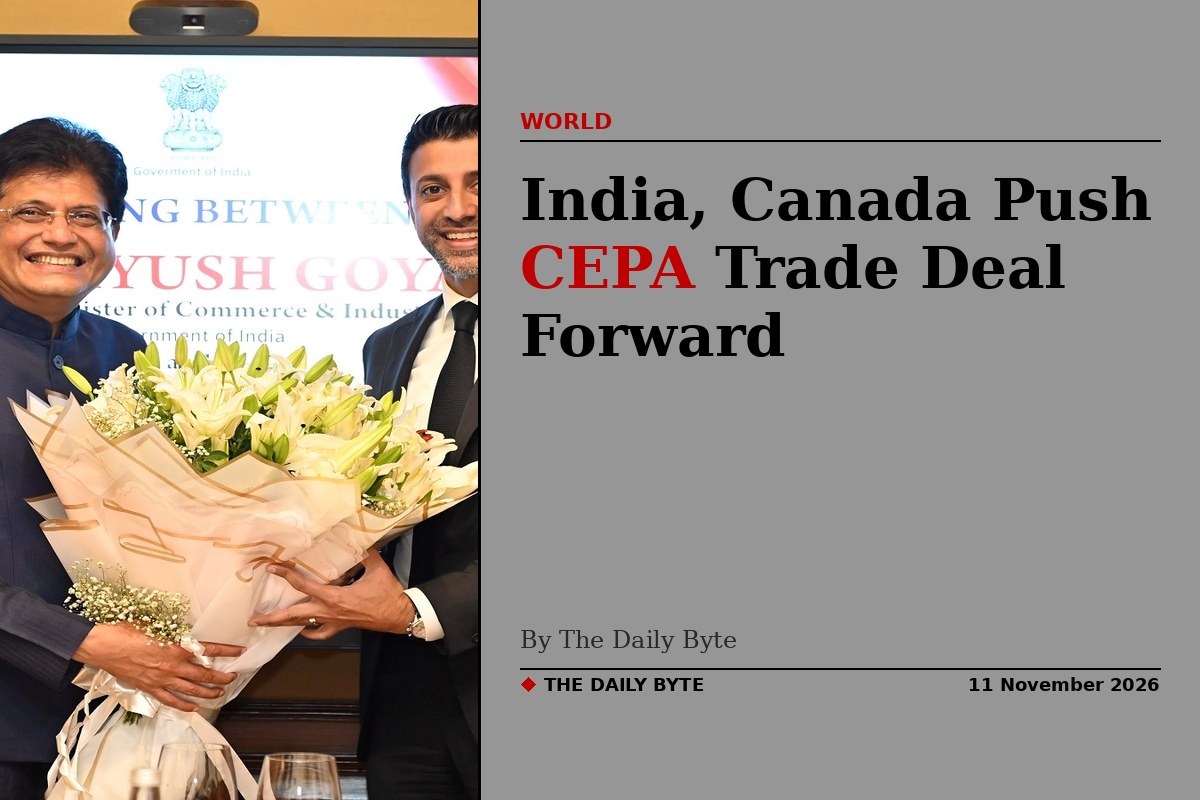
India and Canada have reaffirmed their commitment to taking their economic partnership to new heights, with the proposed Comprehensive Economic Partnership Agreement (CEPA) expected to drive deeper trade ties between the two countries. Union Commerce and Industry Minister Piyush Goyal said on Wednesday that the agreement would act as a catalyst for greater commercial engagement, market access and shared prosperity.
Goyal was speaking after a breakfast meeting in New Delhi with Maninder Sidhu, Canada's Minister of International Trade, and the accompanying Canadian delegation. The two sides discussed ways to accelerate negotiations on the India-Canada CEPA and deepen bilateral economic engagement.
"Had a warm and engaging breakfast meeting with Maninder Sidhu, Minister of International Trade of Canada, and the accompanying Canadian delegation to discuss advancing negotiations on the India-Canada Comprehensive Economic Partnership Agreement (CEPA) and strengthening our bilateral economic ties," Goyal said in a post on X.
A deal both sides want finished this year
The talks focused on concluding a balanced and mutually beneficial agreement that delivers meaningful market access to businesses in both countries, while making use of the complementary strengths of the two economies to boost trade, investment and commercial cooperation.
Negotiations on the CEPA began in March 2026, when Prime Minister Narendra Modi and Canadian Prime Minister Mark Carney set the process in motion during Carney's visit to New Delhi and the two trade ministers signed the agreement's terms of reference. Five rounds of talks have since taken place, and both governments are aiming to conclude the deal by the end of 2026, ahead of Modi's expected visit to Canada on 11 and 12 December.
"Reaffirmed our shared commitment to taking the India-Canada economic partnership to new heights, with CEPA serving as a catalyst for deeper commercial engagement and shared prosperity," Goyal said. The two sides are targeting two-way trade in goods and services of C$70 billion by 2030.
Energy and critical minerals in the mix
Energy has become a central pillar of the widening relationship. The two countries are exploring cooperation covering crude oil, natural gas, liquefied petroleum gas, uranium, potash and refined petroleum products, alongside a bilateral memorandum of understanding on critical-minerals value chains signed in March 2026.
Canadian uranium producer Cameco has already signed a long-term supply agreement worth $2.6 billion to deliver nearly 22 million pounds of uranium to India through 2035, underpinning India's nuclear energy expansion. India has identified 30 critical minerals, including lithium, cobalt, nickel, graphite and copper, where Canadian supply and processing capacity could fill gaps in India's industrial plans.
The trade figures behind the talks
India-Canada trade in goods stood at $8.66 billion in 2024-25, with India's exports to Canada reaching $4.22 billion. Major Indian exports include pharmaceutical products, machinery parts and mechanical appliances, iron and steel articles, electronic goods, organic chemicals, jewellery, gems and precious stones, garments and textiles, seafood and engineering goods.
India's main imports from Canada include pulses, fertilisers, mineral fuels, wood pulp, gems and precious stones, aircraft parts, machinery parts and iron and aluminium scrap. India's information technology sector is the main contributor to services exports to Canada.
What happens next
Sidhu is in India for a series of engagements this week, including the CII Partnership Summit in Visakhapatnam, as negotiators prepare for further rounds of talks. A comprehensive agreement would cover trade in goods and services, investment, rules of origin and regulatory alignment, replacing a limited trade deal with a full economic partnership.
The CEPA talks are part of a broader reset in India-Canada relations since the March meeting between Modi and Carney, which also agreed deeper cooperation on energy and critical minerals. For businesses on both sides, the test will be whether the political momentum of the past eight months can be converted into a signed agreement before the end of the year.