India gives Sri Lanka 100 ambulances in $5.28m grant
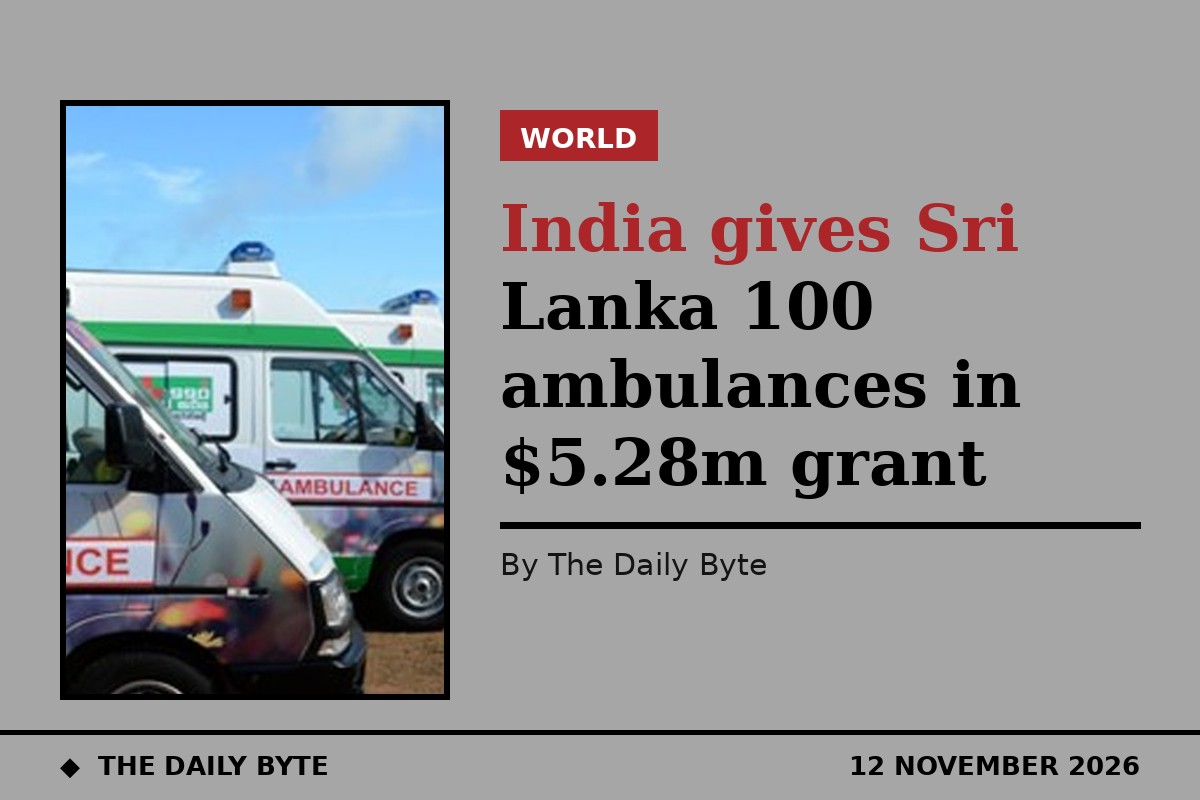
India will fund 100 more ambulances for Sri Lanka’s free national emergency service, lifting its fleet from 322 to 422 vehicles under a grant of about $5.28 million signed in Colombo on 11 November 2026.
The grant agreement was signed and a memorandum of understanding exchanged in the presence of India’s Health Minister, J. P. Nadda, who was in Colombo for the first BIMSTEC Health Ministers’ Meeting, and Sri Lanka’s Health Minister, Nalinda Jayatissa. The Indian High Commission in Colombo said the pact would further expand the island’s free emergency medical response service, known as 1990 Suwa Seriya.
The funding, worth 1,725.73 million Sri Lankan rupees, is a grant, not a loan. Sri Lanka’s cabinet had approved entering into the agreement on 10 November, and the vehicles will be bought through competitive tender rather than direct purchase, according to Sri Lanka’s cabinet spokesman.
A free service handling up to 1,200 calls a day
The 1990 Suwa Seriya service provides free emergency medical transport around the clock in every district of Sri Lanka, and is estimated to respond to about 1,000 to 1,200 patient-transfer calls every day. The additional ambulances are fully equipped, and are expected to strengthen response times and ease pressure on the existing fleet.
India also announced support for 50 medical kiosks, known as Health ATMs, to strengthen primary healthcare in Sri Lanka. The kiosks, backed by grant assistance of up to 225 million Sri Lankan rupees, will be deployed at Arogya Primary Health Centres. The support forms part of a $450 million rehabilitation package announced by India after Cyclone Ditwah, which affected Sri Lanka in November and December 2025.
A decade of Indian support for the service
The ambulance service began after a request from the Sri Lankan government during Prime Minister Narendra Modi’s visit to the island in March 2015. It was launched in July 2016 in Sri Lanka’s Western and Southern Provinces with Indian grant assistance of $7.5 million, covering 88 ambulances, a year of operating costs and an emergency response centre.
It was expanded nationwide in July 2018, when a second phase backed by $15.02 million in Indian grant assistance added 209 ambulances, along with operating expenses and training. Since then it has grown into a nationwide network that charges patients nothing for emergency transport.
The Indian High Commission described the ambulance programme as a “shining example of India–Sri Lanka development partnership delivering tangible benefits to people”. Nadda’s visit also coincided with the first meeting of health ministers from BIMSTEC, the seven-member Bay of Bengal grouping of Bangladesh, Bhutan, India, Myanmar, Nepal, Sri Lanka and Thailand, which adopted a revised plan of action on public health for 2026 to 2030.
For patients across Sri Lanka, the practical test of the new agreement will be how quickly the 100 ambulances reach the road. With the fleet rising by almost a third, the service should be able to answer more calls, reach patients faster and cover gaps in districts where a single vehicle can currently be the difference between timely treatment and a long wait. Fact News reported the agreement, with the Indian High Commission confirming the details.


