Infrastructure cess struck down in Sindh and KP
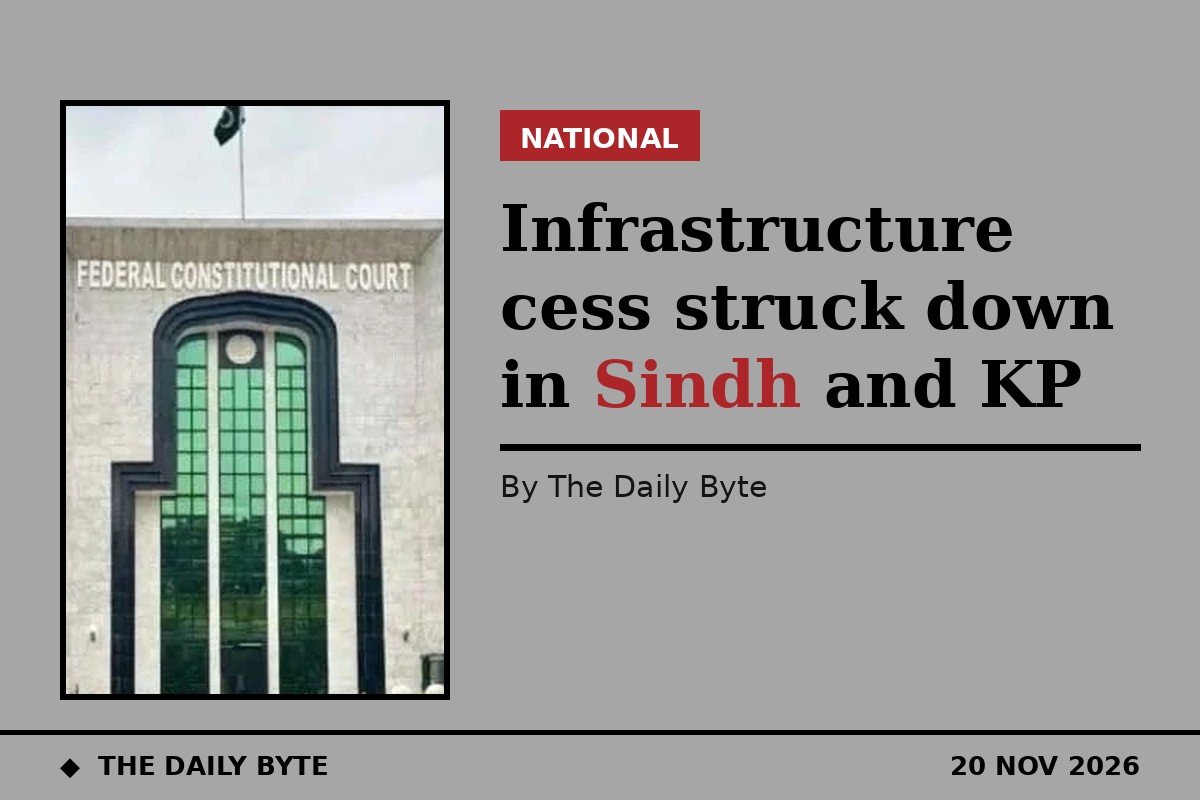
ISLAMABAD: The Federal Constitutional Court has declared the infrastructure cess charged by the governments of Sindh and Khyber Pakhtunkhwa unconstitutional, ruling that the provinces had no power to impose it.
A two-member bench headed by Chief Justice Amin-ud-Din Khan, with Justice Aamer Farooq, announced the reserved judgement on Thursday in 568 appeals brought by importers, exporters and industrialists. The court set aside the rulings of the Sindh High Court and the Peshawar High Court, which had both upheld the levy.
The judges held that a cess of this kind falls outside the constitutional powers of a provincial government. The businesses challenging the levy had argued that it was, in effect, an export duty, and that taxing imports and exports belongs exclusively to the federal government.
The dispute in Sindh goes back to 1994, when the province first imposed a levy on goods moving through its ports and airports. It was later given statutory cover by the Sindh Development and Maintenance of Infrastructure Cess Act, 2017, which charged the cess on goods entering or leaving Sindh from abroad by air or sea. When businesses challenged the law, the Sindh High Court upheld it in a judgement dated 4 June 2021.
Khyber Pakhtunkhwa followed with its own law, the Khyber Pakhtunkhwa Infrastructure Development Cess Act, 2022, which placed a cess on the transportation of goods within the province. The rate was later raised from one per cent to two per cent under Section 14 of the Finance Act, 2024, and the scope of the levy was widened. The Peshawar High Court dismissed 157 petitions against the law on 14 November 2025 and upheld the tax, prompting the appeals now decided by the Constitutional Court.
During the hearings, the Attorney General for Pakistan argued that the power to legislate on imports and exports across customs frontiers, and to impose customs duties, rests exclusively with Parliament under Article 142(a), read with Entries 27 and 43 of Part I of the Federal Legislative List in the Fourth Schedule. Counsel for the Federal Board of Revenue supported that position, arguing that a levy must be judged by its true nature and operation rather than its name, and that a charge collected on goods at the point of export operates as an export duty.
The ruling is a significant win for the businesses that have paid the cess for years, and it removes a long-running source of uncertainty for importers, exporters and manufacturers trading through Karachi and across Khyber Pakhtunkhwa.
The court has so far announced only its short order. A detailed judgement will follow, and it is expected to address what happens to the money already collected and whether either province will seek a review of the decision. The ruling does not automatically decide the position of other provinces, although the constitutional principles it sets out are likely to shape any future litigation over similar levies.
Sources: The News; Khabr.