Iran clerics call NPT exit review 'inevitable'
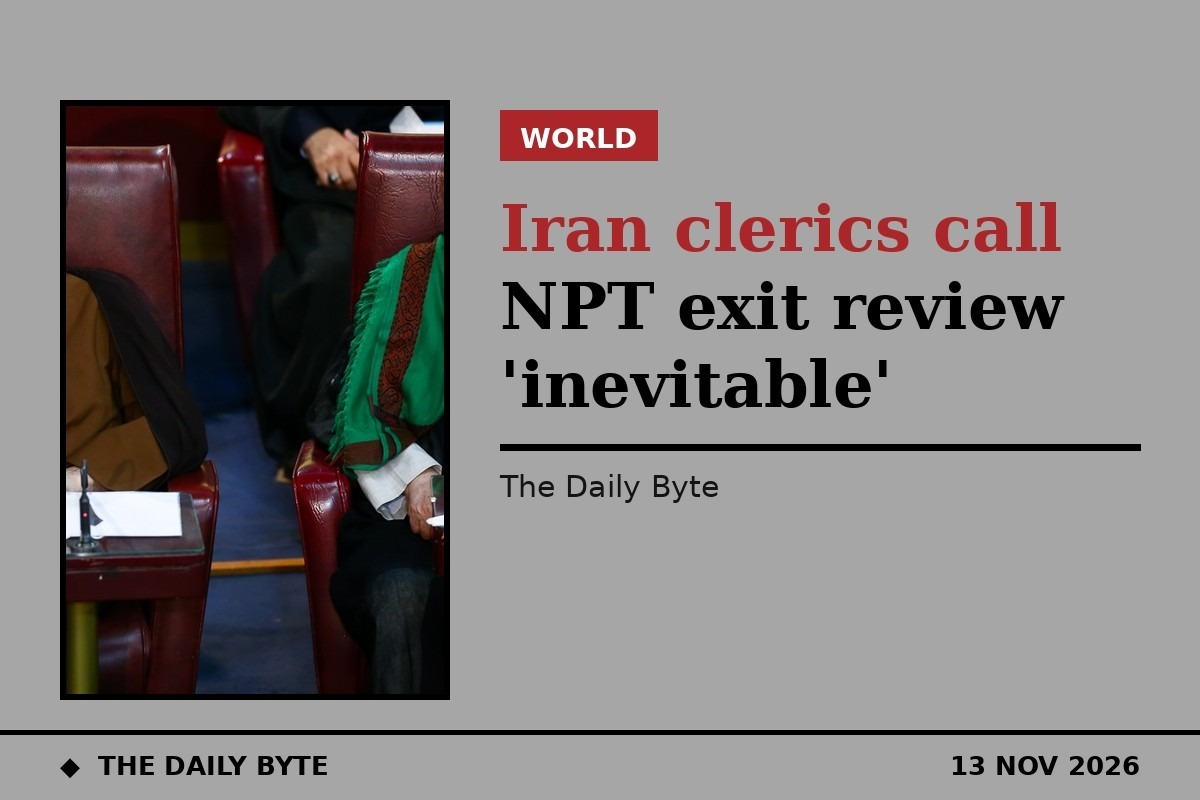
Iran’s Assembly of Experts has said that reviewing the country’s withdrawal from the Nuclear Non-Proliferation Treaty (NPT) has become an “unavoidable necessity” and a “public and national demand,” in the most senior clerical intervention yet in Tehran’s nuclear debate.
In a ten-point statement issued on Thursday, the 88-member body, which elects and supervises Iran’s Supreme Leader, called for consideration of leaving the NPT, a revision of the country’s defence doctrine and the creation of what it called the necessary deterrence.
“Therefore, the review of the issue of withdrawal from the NPT, a revision of the country’s defense doctrine, and the creation of the necessary deterrence have become an unavoidable necessity and have turned into a public and national demand,” the statement said, according to Iran’s Tasnim news agency.
Statement stops short of withdrawal
The Assembly stopped short of announcing a withdrawal. It asked officials, guided by Supreme Leader Ayatollah Seyyed Mojtaba Khamenei, to take up what it called a public demand, and the statement made clear that any final decision would rest with the Supreme Leader.
The body said repeated threats by the “aggressor enemy,” especially against Iran’s nuclear knowledge, showed that “there can be no hope in the international bodies responsible for this matter.” It also warned that any renewed attack on Iran would meet an immediate and effective response without geographical limitations.
Iran remains a party to the NPT, which it signed in 1968 and ratified in 1970. Under Article X of the treaty, a member can withdraw by giving three months’ notice to the other parties and the UN Security Council. No such notice has been given.
Debate has built for months
The Assembly’s intervention follows months of growing pressure inside Iran to reconsider NPT membership after US and Israeli strikes on Iranian nuclear facilities this year, including the Natanz enrichment plant, despite extensive inspections by the International Atomic Energy Agency.
In September, lawmaker Hossein-Ali Haji Deligani said a triple-urgency motion calling for withdrawal had been submitted to parliament’s presiding board, after about 130 lawmakers urged an exit under Article X. On 30 October, presiding board member Alireza Salimi said a withdrawal bill had been drafted, and on 1 November Ayatollah Mohsen Araki, a member of the Assembly’s own presidium, called on officials to reconsider NPT membership.
Other senior officials have urged caution. Supreme National Security Council Secretary Mohsen Rezaei said on 31 October that no new decision had been made on changing Iran’s nuclear doctrine, and Foreign Ministry spokesman Esmaeil Baghaei said on 2 November that Iran remained an NPT member and considered itself bound by the treaty. Rezaei has also said Iran continues to adhere to the late Supreme Leader’s religious ruling against nuclear weapons.
Why the Assembly matters
The Assembly of Experts is the only body in Iran that can appoint or remove the Supreme Leader. It elected Mojtaba Khamenei on 8 March 2026, after his father, Ali Khamenei, was killed in the US-Israeli strikes of 28 February that began the war.
That makes its statement significant even though the Assembly has no say over nuclear policy itself: it lifts the NPT question from individual lawmakers to the body that chose the country’s leader. The Revolutionary Guards have also signalled they are preparing for a possible change. Their spokesman, Brigadier General Hossein Mohebbi, said in an interview on 7 November that the force would make the necessary preparations “if the country’s leadership decides to revise its nuclear doctrine.”
For now, Iran has not left the treaty, and no formal withdrawal process has begun. But with the Assembly of Experts now framing an NPT review as a national demand, the debate in Tehran has moved to a new level, and any decision will be watched closely in Washington, Tel Aviv and at the IAEA in Vienna.
Sources: Tasnim News Agency and Clash Report


