Iran: Hormuz Will Never Return to Pre-War Status, Ghalibaf Says
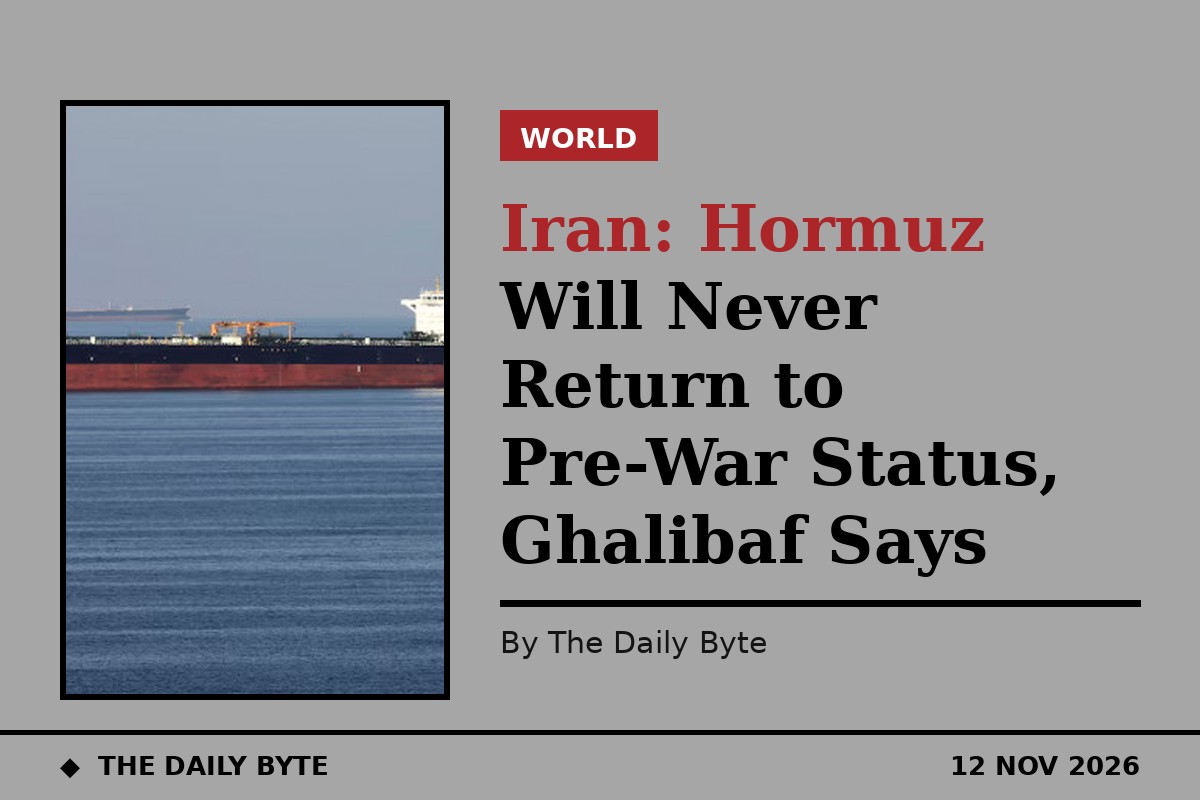
Iran's parliament speaker and chief negotiator has said the Strait of Hormuz will never return to its pre-war status, putting the future of the world's most important oil waterway at the centre of Tehran's conditions for talks with the United States.
Mohammad Bagher Ghalibaf told Al Jazeera in an interview published on 11 November that Iran and Oman had reached an understanding to oversee the strait as part of Tehran's seven-point proposal to end the eight-month conflict. He said Iran had sent Washington a clear response through a Qatari mediator and was still waiting for an official reply.
"The ball is now in the American court," Ghalibaf said, adding that the strait would never return to the arrangements that applied before the war between the United States, Israel and Iran began in February.
What Iran is demanding
Ghalibaf said Tehran's conditions include lifting the US naval blockade and sanctions, releasing frozen Iranian funds, ending fighting on all fronts and an explicit declaration that the war is over. He described the naval blockade as "a brutal act of war under international law", saying it had obstructed food supplies, trade and healthcare.
He said the demands were part of a memorandum of understanding signed in Islamabad in June, and that they must be implemented before formal negotiations with Washington can begin. The full text of the seven-point proposal has not been publicly released, and the reports of its contents are based on the demands Ghalibaf and other Iranian officials have named in public statements.
Ghalibaf also set out Tehran's view of the waterway's legal status. "There are no 'free waters' there, and the 1982 Convention on the Law of the Sea does not apply to the strait," he said. "The regulations within the Strait of Hormuz are governed by the laws of the two littoral states that border it." Most maritime states regard Hormuz as an international strait open to transit passage.
Strait stays shut for now
Iran's armed forces have made clear the waterway will not reopen on Washington's timetable. Brigadier General Kioumars Heidari, deputy chief of staff of the Iranian armed forces, said Tehran had closed the strait and would not open it except on the order of the leader of the revolution, Al Jazeera reported on Wednesday.
The remarks came on the same day Iran's Revolutionary Guards Navy said two oil supertankers had been disabled by explosions in the strait after using what it called an unauthorised route, underlining how far the waterway is from normal operation.
The stakes extend well beyond the region. The US Energy Information Administration has estimated average oil flows through the strait at about 20 million barrels a day in 2024, roughly a fifth of global petroleum liquids consumption, and flows have contracted during 2026 as the war has dragged on.
Ghalibaf identified the lack of trust in the United States as the main obstacle to any agreement, pointing to Washington's record of hostility and what he called its repeated failure to honour commitments. He said Tehran remained ready to reach an agreement if Washington honoured its previous commitments and dropped what he called its excessive demands.