Iran Inflation Tops 100 Percent in Eight Provinces
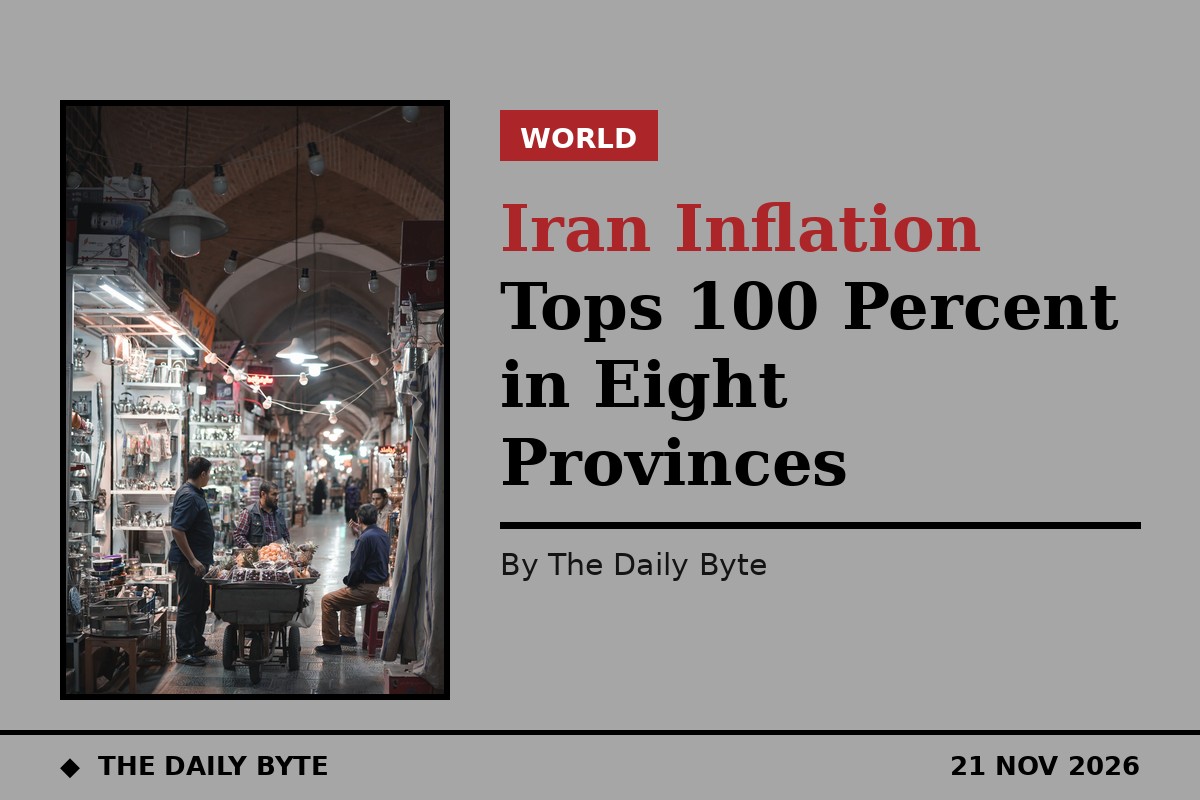
Year-on-year inflation topped 100 percent in eight Iranian provinces in the month to 22 October, according to the Statistical Center of Iran, as the war and the naval blockade deepen a cost-of-living crisis for households across the country.
Hormozgan recorded the highest rate, at 113.7 percent, followed by Ilam at 111.9 percent and West Azerbaijan at 107.5 percent. Tehran had the lowest rate, at 72.9 percent, IranWire reported in its daily brief on 20 November.
IranWire notes that the war and the naval blockade have disrupted the transport of goods and the supply of raw materials, feeding through to prices in the shops. The figures cover the Iranian month that ended on 22 October.
Food eats three-quarters of a minimum wage
The clearest evidence of the squeeze is at household level. Donya-ye Eghtesad calculates that a four-person family’s monthly food basket now costs 23.5 million tomans, about 88 dollars, up from 10.1 million tomans a year ago, according to a review of the Iranian economic press published on 18 November.
A minimum-wage family’s income, including a food credit of 1.5 million tomans, totals 31.65 million tomans, about 119 dollars. Food therefore consumes 74 percent of that income, up from 69 percent last year, and the measure excludes rent, transport, utilities, medicine and education.
Food inflation stood at 111.2 percent year on year in Mehr 1405, the month from September to October 2026, down from a peak of 132.6 percent in Khordad, from May to June. Even at the lower rate, prices are more than doubling within a year.
Bread quotas and fuel strain
Bread, the most sensitive subsidy, is now rationed in practice in parts of the country. The review describes a pilot quota in Khuzestan and Zanjan of about eight kilograms of subsidised flour per person each month, with flour priced at 2,300 tomans within the limit and 12,650 tomans beyond it.
A provincial trade official says the mechanism is meant to deter bulk commercial buying and disputes its description as household bread rationing. Even so, the debate shows how quickly administrative measures can frighten low-income families, the review notes.
Fuel is another flashpoint. Drivers have objected to reduced quotas, the authorities have restricted fuel-station cards in several border provinces, and an officially estimated 25 to 30 million litres of fuel is smuggled every day, according to the review.
Protests and a budget with no oil income
Discontent is taking more varied forms. In Abdanan, in Ilam Province, a bus crash that killed 13 oil-sector workers set off street protests on 17 November, with demonstrators accusing officials of negligence. Human-rights groups reported arrests, and at least six people were detained, according to the review.
Meanwhile, budget planners are preparing a fiscal plan for 1406, the year from 2027 to 2028, that assumes no direct petroleum income. In the current plan, direct oil and gas export allocations stood at about 260 to 263 trillion tomans, down 56 to 57 percent from 604 trillion tomans in the previous plan.
With maritime oil sales severely curtailed, new financing will depend more heavily on ordinary taxes, debt auctions, reprioritised spending, sales of state property and spending restraint, the review says. For households already spending almost three-quarters of a minimum wage on food, there is little room left to absorb more.