Iran-Pakistan trade hits $6bn as FTA nears finish
Trade between Iran and Pakistan, counting both formal and informal flows, now stands at about $6 billion and could rise to more than $10 billion, an Iranian trade official has said, as a long-discussed free trade agreement (FTA) between the two neighbours nears its final stage. The assessment was reported by the Tehran Times on 20 November 2026.
The Deputy Director of the East Asia and Subcontinent Office at the Iran Trade Promotion Organization said the current volume of formal and informal trade between the two countries was about $6 billion, and that given the capacities and needs of both sides it could be increased to more than $10 billion.
A long road to a deal
The two countries have been working towards a free trade agreement for years, and the goal of lifting bilateral trade to $10 billion has been restated repeatedly by leaders on both sides. In June 2026, during Iranian President Masoud Pezeshkian’s visit to Islamabad, Pakistan and Iran agreed to increase bilateral trade to $10 billion and to expedite work on the agreement.
In August 2026 the two sides signed a memorandum of understanding on trade cooperation in Islamabad, and Iran’s industry, mine and trade minister said at the time that negotiations on the FTA were progressing well and could be concluded in the near future. The latest statement from Tehran suggests that process is now approaching its end, although no signing date has been announced.
Border trade in focus
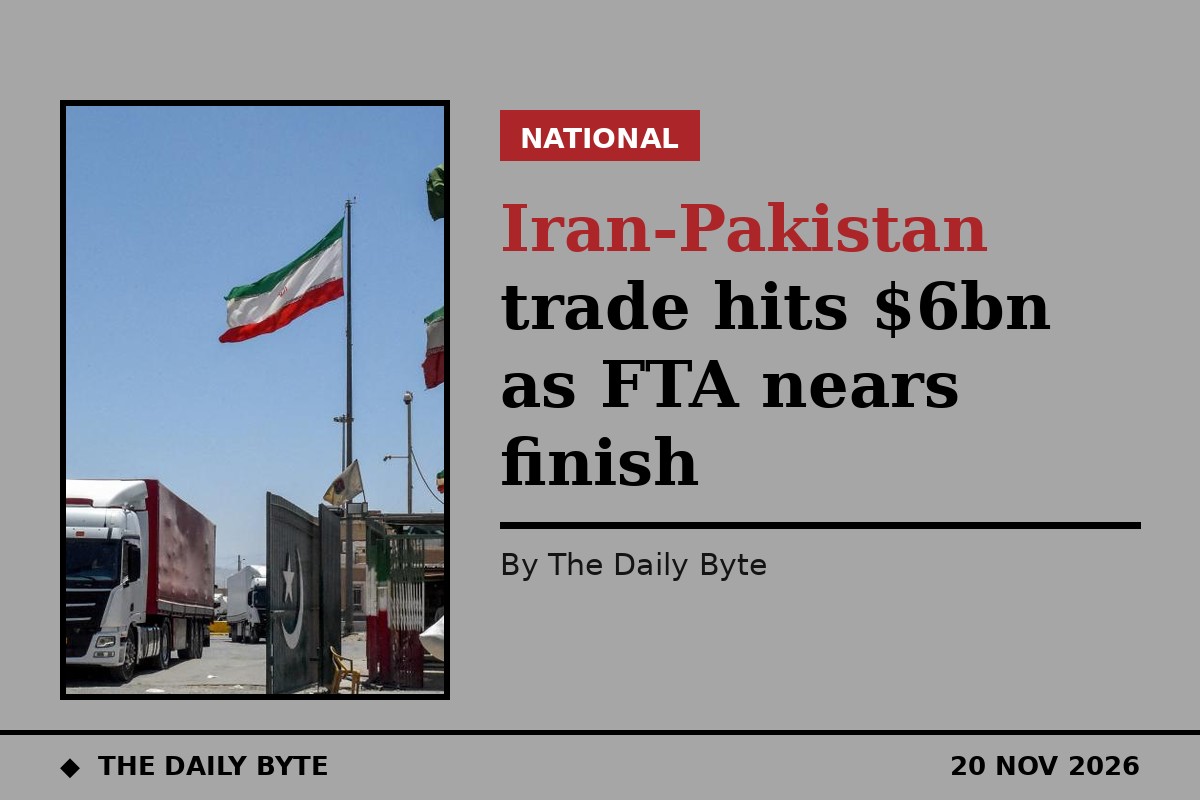
Much of the practical work has centred on the shared border, where trucks, traders and customs posts determine how much trade actually moves. On 2 November, Iranian Minister of Economic Affairs and Finance Seyyed Ali Madanizadeh and Pakistani Commerce Minister Jam Kamal Khan met on the sidelines of a meeting of the Organisation of Islamic Cooperation’s economic committee in Istanbul to discuss expanding trade, easing freight movement and removing transit bottlenecks along the border.
The ministers discussed difficulties faced by trucks at the Rimdan border crossing, making more effective use of the Mirjaveh crossing and improving the flow of freight between the two countries. Iran has also proposed establishing a joint free zone with Pakistan at the Rimdan-Gabd border crossing, focused on logistics, industrial development and trade.
The trade figures point in the same direction. Iran’s exports to Pakistan jumped 45 percent to $520 million in the four months through June 2026, according to figures from Pakistan’s Ministry of Commerce, while shipments for the first half of the year reached $750 million, nearly 30 percent up on the same period of 2025.
The obstacles that remain
Even so, the path to $10 billion is far from clear. There are no formal banking channels between the two countries, and barter remains the only official payment alternative, a rigidity that has already sunk deals: a recent rice export contract worth €18.675 million collapsed because payments could not be settled. Trade researchers also note that Pakistan withdrew an E-form waiver in mid-October 2026, halting trade at the Taftan and Gabd crossings until Gabd partially reopened on 24 October.
The long-delayed Iran-Pakistan gas pipeline, which could eventually supply up to 750 million cubic feet of gas per day, also remains uncertain, with progress dependent on sanctions easing and agreement on pricing. Whether the near-final FTA can cut through those obstacles will be the real test of the $10 billion ambition. For now, the $6 billion figure shows how much trade already flows between the neighbours, much of it outside formal channels, and how much room remains if the agreement is finally signed.
Sources: Tehran Times; MEFA (Iran Ministry of Economic Affairs and Finance).