Iran Refuses to Let Enriched Uranium Leave Country
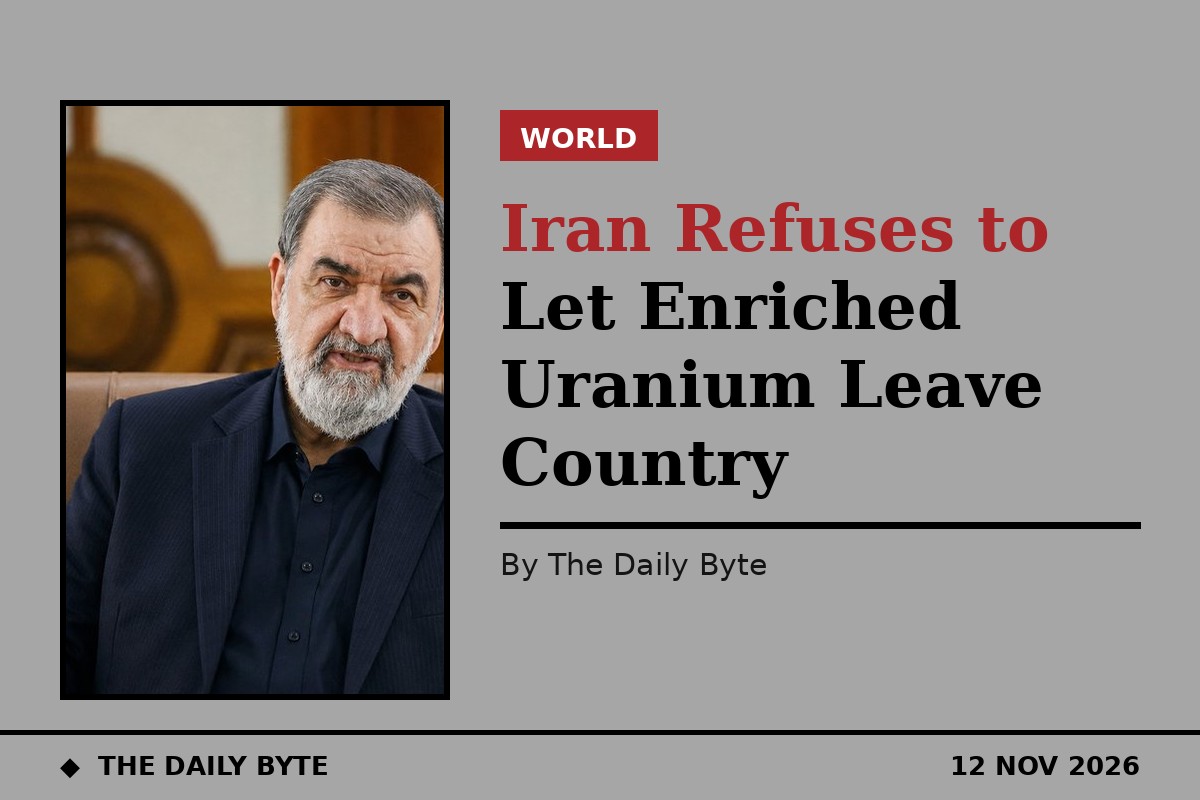
Iran will not allow any of its enriched nuclear material to leave the country, the country's security chief Mohsen Rezaei said on 11 November, ruling out a transfer of the stockpile abroad as part of any settlement with the United States.
Rezaei, secretary of Iran's Supreme National Security Council, made the remarks in televised comments to Lebanon's Al Mayadeen television. "We will not remove a single particle of enriched material from Iran," he said, adding that Tehran had told Moscow the material would remain in the country and that Iran would use it itself.
He said Iran needed the enriched material to design nuclear-powered ships and submarines, and eventually small modular reactors. The argument matters because Washington has made the removal of Iran's enriched uranium a central demand in any deal to end the conflict, which has now run for eight months since the United States and Israel attacked Iran on 28 February.
No talks under way, Rezaei says
Rezaei said there were currently no negotiations taking place between Tehran and Washington. He said Iran was waiting for a clear response from the United States to seven conditions it had set out, and that the nuclear file would stay outside any talks until fighting halted on all fronts, including in Lebanon.
He also warned there would be consequences in the event of any new American strikes on Iran. The remarks came after United States officials played down the need for further military action against Iran, with analysts noting a more conciliatory tone from President Donald Trump since the Republican Party's defeat in the 3 November midterm elections.
What is at stake
The International Atomic Energy Agency estimated that Iran held 440.9 kilograms of uranium enriched to 60 percent when Israel and the United States attacked Iranian nuclear facilities in June 2025. That level is far higher than needed for civilian power generation and a short step below weapons grade.
Iran's Supreme Leader has issued a directive that the country's near-weapons-grade uranium should not be sent abroad, two senior Iranian sources said in May, according to Reuters. Rezaei's comments now put that position on the public record in the bluntest terms yet.
The refusal leaves one of Washington's central demands unmet before any talks can resume. At the same time, the naval-propulsion argument points to a possible legal route for Tehran: under the Nuclear Non-Proliferation Treaty, a non-nuclear state may withdraw nuclear material from IAEA safeguards for naval propulsion. Whether other governments accept that reading is a separate question, and it is likely to be tested in any future negotiation.
For now, the two sides remain in a stalemate. Iran says it is waiting for an American answer to its conditions, while the United States has given no public sign of accepting them.
Sources: Reuters via The Business Standard and SOFX.