Iran Warns It Will Not Wait for US Attack First
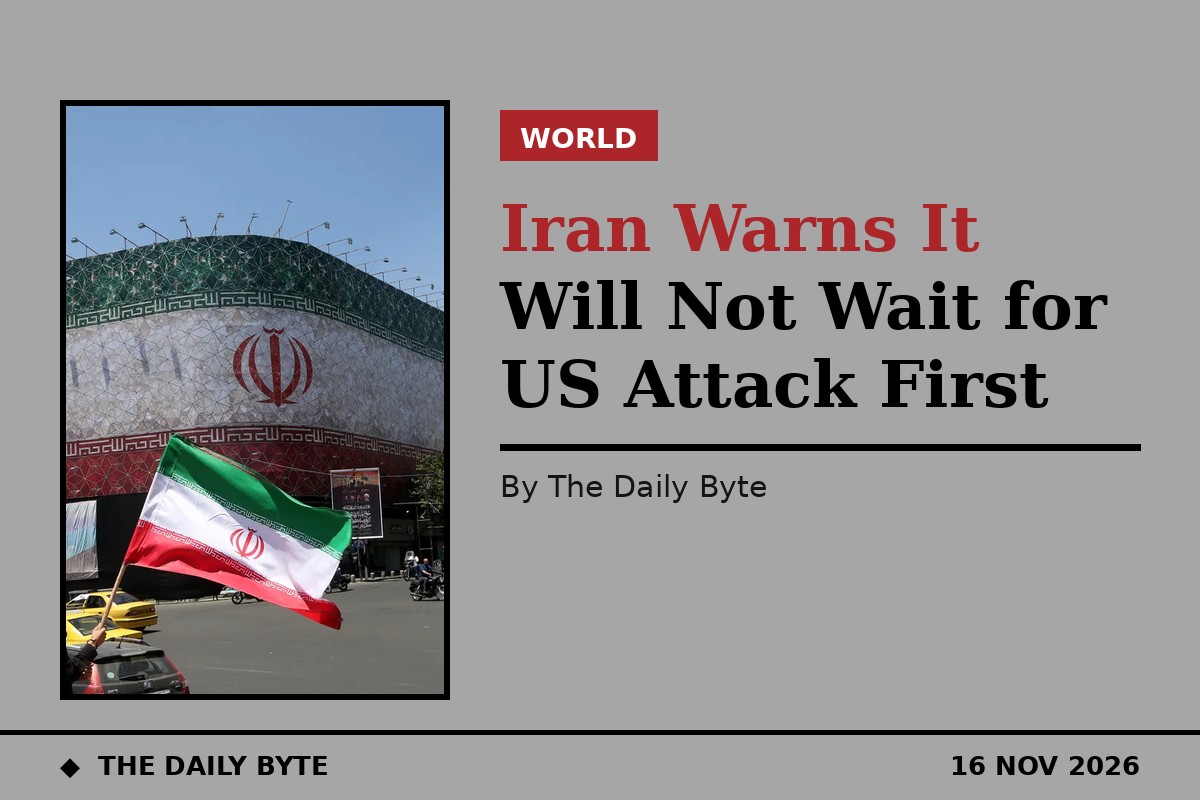
Iran has warned that it will not wait for the United States to launch an attack before responding, as tensions rise again across the Middle East and a third American aircraft carrier moves into the region.
Deputy Foreign Minister Kazem Gharibabadi gave the warning in an interview on Iranian state television on Sunday, carried by the Fars news agency. He accused Washington of using diplomacy to buy time for another military operation, saying the United States “may be seeking to buy time by abusing diplomacy, in order to prepare the ground for another attack”.
Gharibabadi said Tehran was preparing for three possible scenarios in its dealings with Washington: diplomacy, an economic blockade and military aggression. “Iran is not Cuba that you can blockade, nor is it Venezuela that you can force to surrender,” he said, adding that American forces had so far failed to achieve success through either an air or land blockade. He also claimed that Iran’s Islamic Revolutionary Guard Corps (IRGC) was producing missiles with “new ranges”.
The deputy foreign minister, who previously served as Iran’s ambassador to the International Atomic Energy Agency (IAEA), said the IRGC would not allow the agency’s inspectors into Iran’s nuclear facilities until Tehran’s conditions were met and the war had permanently ended. The IAEA had called on Iran to restore access for inspectors to its nuclear sites, including facilities damaged during the conflict. Gharibabadi suggested the agency’s request to visit the damaged sites was “likely an assessment of the effectiveness of American weaponry”, and said Washington would first have to provide guarantees that all of Iran’s conditions would be observed.
Iran’s conditions for an agreement include a permanent end to the war on all fronts, the lifting of the American economic blockade and certain sanctions, including those targeting the oil sector, and a resolution of the issue of Iranian assets frozen abroad. Tehran also wants Washington to address the new military equipment and forces deployed in the region after the previous understanding between the two sides.
Gharibabadi said Iran had proposed a seven-day timeline for ending the war and reopening the Strait of Hormuz, which was subsequently reduced to two days following consultations with mediators over the past two months. “This means the measures could be carried out within two days and ultimately lead to the reopening of the Strait of Hormuz,” he said, adding that the proposal remained on the table. He said differences over the implementation of commitments continued to prevent an agreement, and that the United States would have to rebuild Tehran’s trust if it wanted to pursue diplomacy.
In a separate televised interview with the official IRNA news agency, Gharibabadi said the United States had repeatedly undermined Tehran’s trust in negotiations. “The US has shown its bad faith at least three times over the past year and a half,” he said, citing a 12-day war and a 40-day war which he said had taken place while negotiations were under way, as well as a 14-point memorandum of understanding that lasted less than two weeks.
Parliament Speaker Mohammad-Baqer Qalibaf struck a similar note on Sunday, saying Iran would not remain in a state of “neither war nor peace” and was prepared for either negotiations or war with the United States. “If America accepts the seven reasonable conditions we have put forward, the path to an agreement remains open,” he told lawmakers.
The warnings came as the USS Theodore Roosevelt entered the area overseen by US Central Command on Sunday, joining the USS George Washington and the USS George H.W. Bush, according to a US official cited by Al Jazeera. It is the third American carrier group now operating in the region.
Separately, Iran’s Revolutionary Guard claimed early on Sunday that it had struck a radar system at an American helicopter base in Bahrain. The US military’s Central Command did not immediately comment on the claim. On Friday, Centcom said it had intercepted two Iranian drones heading towards Bahrain and denied an earlier Iranian claim that its forces had struck a US early-warning radar system there. Bahrain’s military said on Sunday that its air defence systems had intercepted several Iranian projectiles before they reached their targets.
The United States and Israel launched strikes against Iran on 28 February, beginning a conflict that has continued in fits and starts for more than eight months. Washington and Tehran signed a memorandum of understanding in June aimed at ending the war, but fighting and mutual accusations have continued since.
Gharibabadi also called Washington’s maximum-pressure sanctions policy a failed approach. He acknowledged sanctions affected ordinary Iranians, but argued their consequences for the global economy, energy and financial markets were greater.
Whether the warnings lead to renewed fighting or a return to talks remains unclear. Both sides are now publicly preparing for either outcome.