Ireland to Lead EU Negotiations at COP31 in Antalya
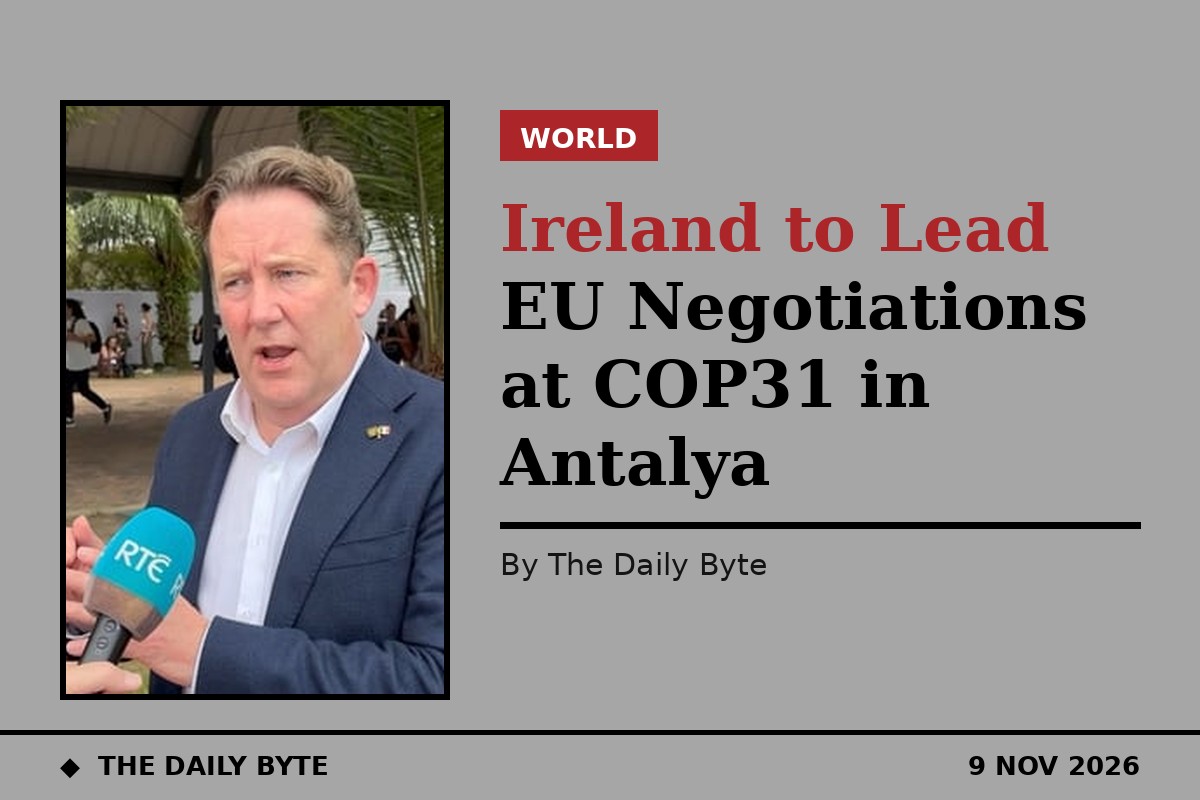
Ireland will help lead the European Union's negotiating efforts at the COP31 climate summit, which opens in Antalya, Türkiye, on Monday, as nearly 200 countries gather for talks on cutting greenhouse gas emissions and financing climate action. The conference runs until 20 November.
Ireland holds the rotating presidency of the Council of the European Union and will coordinate the bloc's negotiating efforts alongside the European Commission. Minister for Climate, Energy and the Environment Darragh O'Brien will serve as head of the EU delegation at the summit, where the EU will press for past climate promises to be turned into practical action.
A first for Ireland
For the first time, Ireland will also have its own national pavilion at a UN climate conference. The pavilion, run in partnership with the European Commission, will showcase Irish and European climate action and host events throughout the summit. The Irish government has said the pavilion is a central part of its presence at the conference, which takes place while Ireland holds the EU presidency. The Department of Climate, Energy and the Environment confirmed the pavilion in October, saying Ireland would lead negotiations for Europe at the summit.
The Council of the EU set out the bloc's negotiating position in October, calling for rapid, science-based action to limit global warming and for the transition away from fossil fuels to accelerate. Ireland took over the six-month presidency of the Council on 1 July, putting it at the centre of EU decision-making for laws and policies affecting around 450 million people.
Finance first
Speaking ahead of the conference, Mr O'Brien said the EU needed to approach developing countries with greater understanding and a willingness to listen, following difficult divisions at last year's summit in Brazil. He said a central priority must be delivering commitments already made, particularly the financial assistance promised to vulnerable countries, many of which have struggled to obtain the funding needed to protect their populations.
Mr O'Brien said Ireland wanted to help rebuild trust and ensure that commitments resulted in investment and action. Irish environmental and development organisations have warned that progress will also depend on how much funding is provided and on what terms. Karol Balfe, chief executive of ActionAid Ireland and chair of Stop Climate Chaos, has called for grants-based public finance rather than loans that add to poorer countries' debts, and for greater support for communities suffering losses and damage that cannot be prevented.
Electrification on the agenda
Australia's Climate Change and Energy Minister Chris Bowen, who will lead the negotiations, is seeking practical progress on electrification, replacing direct fossil fuel use in transport, heating and industry with electricity. The summit presidency is promoting a voluntary pledge to increase electricity's share of global final energy consumption to 35 percent by 2035. The EU supports faster clean electrification alongside delivery of the commitment to move away from fossil fuels, although Mr Bowen has declined to say in advance whether explicit fossil-fuel language will appear in the final agreement.
The talks come as the United Nations Environment Programme warns that current policies put the world on course for around 2.8 degrees of warming this century. Although warming is expected to exceed 1.5 degrees, scientists stress that limiting every additional fraction of a degree can reduce future harm. The outcome of the summit will be judged on whether governments can agree measures that accelerate emissions cuts and deliver accessible support to the countries facing the greatest risks.