IRGC says Iran building underground missile city
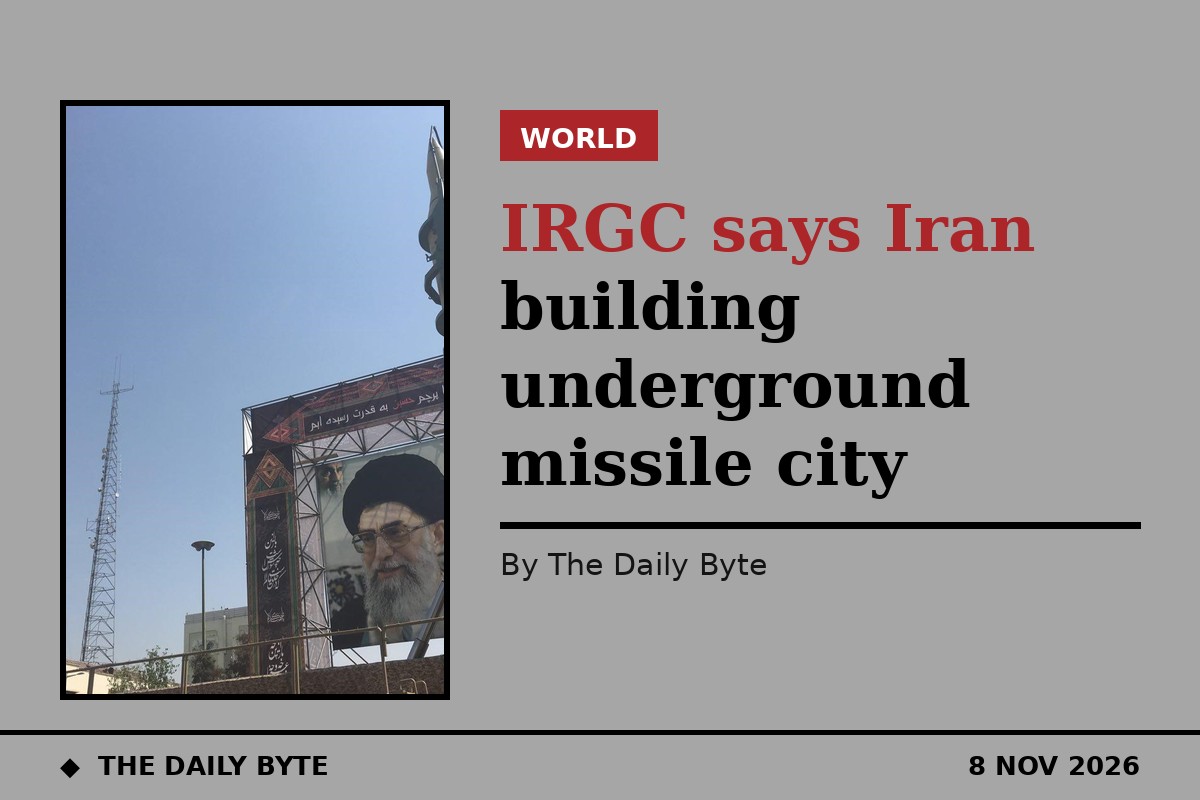
Iran is building underground military complexes able to sustain weapons production and storage even under heavy bombardment, according to the country's Islamic Revolutionary Guard Corps (IRGC).
IRGC spokesperson Hossein Mohebbi made the announcement on Saturday at a news conference in Tehran, Iranian media reported. Among the achievements he listed was an "underground missile city" that is set to be unveiled, the semi-official Tasnim news agency reported.
Mr Mohebbi said the IRGC had rapidly transferred its missile and drone production lines from the surface to underground facilities. The move, he explained, allows Iran to continue producing missiles while its adversaries assume its stockpiles are running low.
Production moved below ground
The underground complexes are designed so that weapons production and storage can continue even if surface sites are hit. Iran has long displayed underground missile bases in state media footage, but the latest announcement presents the subterranean programme as a central part of its wartime posture rather than a reserve capability.
Mr Mohebbi also outlined advances in stealth technology. He maintained that such improvements had allowed Iran's missiles and drones to pierce air defence systems and strike targets accurately during previous rounds of fighting with the United States and Israel.
"Today, every weapon used by the IRGC Aerospace Force is manufactured using homegrown knowledge and expertise. Moreover, our products are not even derived from reverse-engineering captured enemy war material," Iran's IRNA news agency quoted Mr Mohebbi as saying.
Same briefing lifted missile range limit
The underground complexes were announced at the same briefing at which Mr Mohebbi said restrictions on the range of Iranian missiles had been lifted. That warning followed a statement from Supreme Leader Mojtaba Khamenei, who said there would be "no geographical limits" to Iran's response if it were attacked again by the United States and Israel.
The announcements come during a war that began on 28 February, when the United States and Israel launched strikes on Iran. Tehran responded by closing the Strait of Hormuz, the waterway through which about a fifth of the world's traded oil and gas passed before the war, triggering a global energy crisis.
On Friday, President Donald Trump said the US military had launched limited strikes on Iran's Qeshm Island, while also claiming Washington had made "a lot of progress" in talks with Iran. On Saturday, US Central Command announced it was establishing a new task force to support efforts to prevent Iran from using land routes to transport advanced weapons and other materials. The United States has also imposed a naval blockade on Iran to prevent it from exporting oil.
Tehran has repeatedly warned that it will target Gulf energy infrastructure if the fighting resumes, a step that would be likely to push energy prices even higher. Washington has meanwhile imposed additional sanctions on Iran as it seeks to force Tehran to concede to its demands, further straining the country's economy.
Mediation efforts have stepped up recently, as regional countries hope to bring the war to an end. Iran has formally submitted a seven-day roadmap to end the war, but the White House has so far rejected the proposal, according to reports. No date has been given for the unveiling of the underground missile city, and no independent verification of the facilities has been published.