Iron Ore Near Four-Year Low as China Steel Slumps
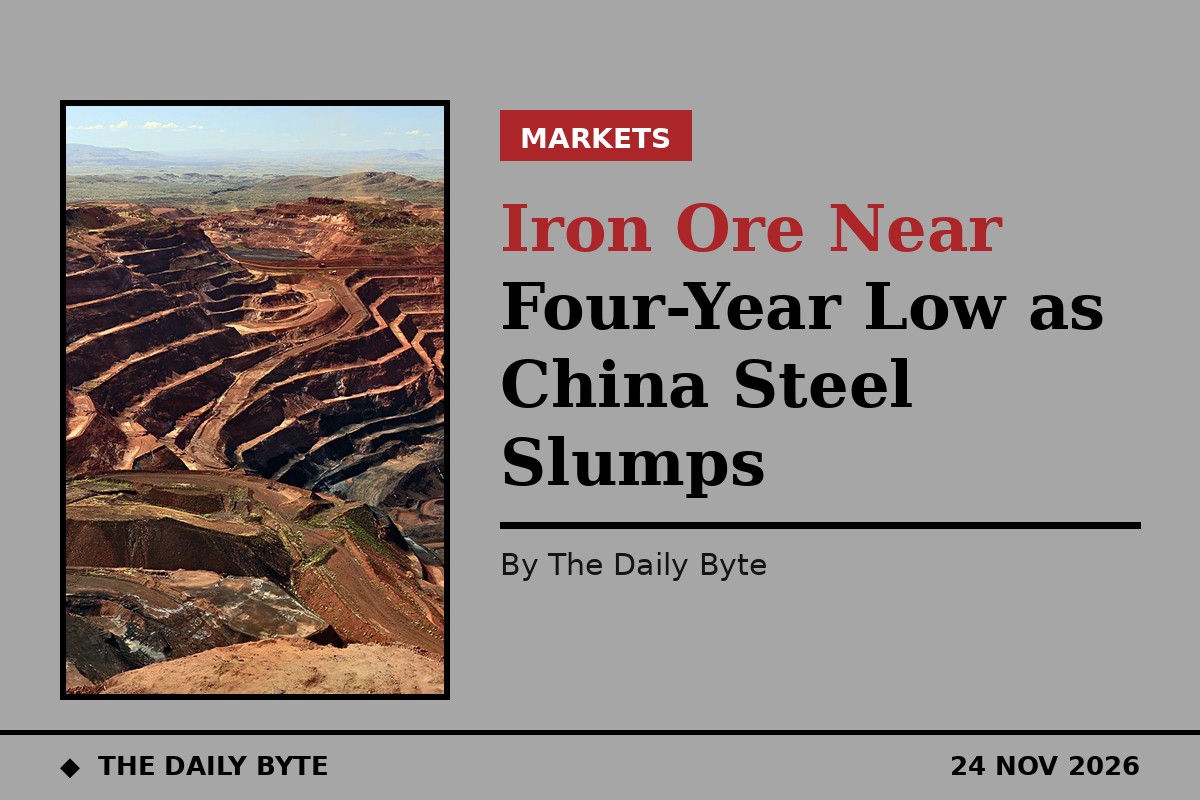
Iron ore prices hovered near a four-year low on Monday as weak Chinese steel demand and falling hot-metal output kept the steelmaking ingredient under pressure. The most-traded iron ore contract on China's Dalian Commodity Exchange slipped 0.3 percent to 654 yuan, or about $98.02, a tonne.
The benchmark December contract on the Singapore Exchange edged up 0.43 percent to $88.85 a tonne by 07:10 GMT, but that still left it below $90 for a fifth consecutive session. Prices had touched a near four-year low of $86.90 on 17 November, and the market has yet to find a floor.
The weakness reflects a steel industry under strain. Hot-metal output in China, a key gauge of iron ore consumption, stood at 2.3 million tonnes a day as of 19 November, an eight-month low after six consecutive weekly declines, according to industry data provider Mysteel. With mills cutting production, demand for ore has faded.
Profitability across the Chinese steel sector is thin. Only about 10 percent of Chinese steelmakers are currently profitable, a measure of how far margins have been squeezed by weak construction demand and overcapacity. Mills have little incentive to restock ore while their own order books remain weak.
Analysts are divided on how much further prices can fall. Some, including analysts at Mysteel and the China Mineral Resources Group, see a floor near $80 a tonne, the level at which higher-cost mines would start to cut output and tighten supply. Others warn that any recovery will be limited. China Minmetals Futures said a recovery was possible but that resistance to higher prices remained large.
The scale of the decline is striking. Iron ore has fallen more than 20 percent from its peak in May, and it has spent much of the past two years trading above $100 a tonne. The move below $90, and the approach to the four-year low, marks a clear break from that range.
China's property downturn remains the central drag. Construction steel demand has not recovered, and government efforts to curb excess capacity in the steel industry have added to the pressure on mills. Seasonal factors are also at work: winter production curbs in northern China typically reduce hot-metal output at this time of year.
The two exchanges told different stories on Monday. While Dalian's most-traded contract slipped, the Singapore benchmark edged higher, a split that reflects the two markets' different drivers: Dalian tracks domestic Chinese sentiment and mill buying, while Singapore's contract is used more by international traders and miners. Neither, however, was strong enough to lift prices back above $90 a tonne.
For miners, the price slide is a direct hit to earnings, particularly for producers with higher costs. The large Australian and Brazilian miners can still operate profitably at current prices, but smaller and higher-cost operations face a harder choice if prices test the $80 level that analysts have identified as a possible floor.
Traders will now watch the next round of Chinese steel output data and any sign of restocking by mills ahead of the winter. Until demand stabilises, the market looks set to stay close to its recent lows, with $90 a tonne acting as a ceiling rather than a floor.