Dar: Pakistan will defend Indus Waters Treaty rights
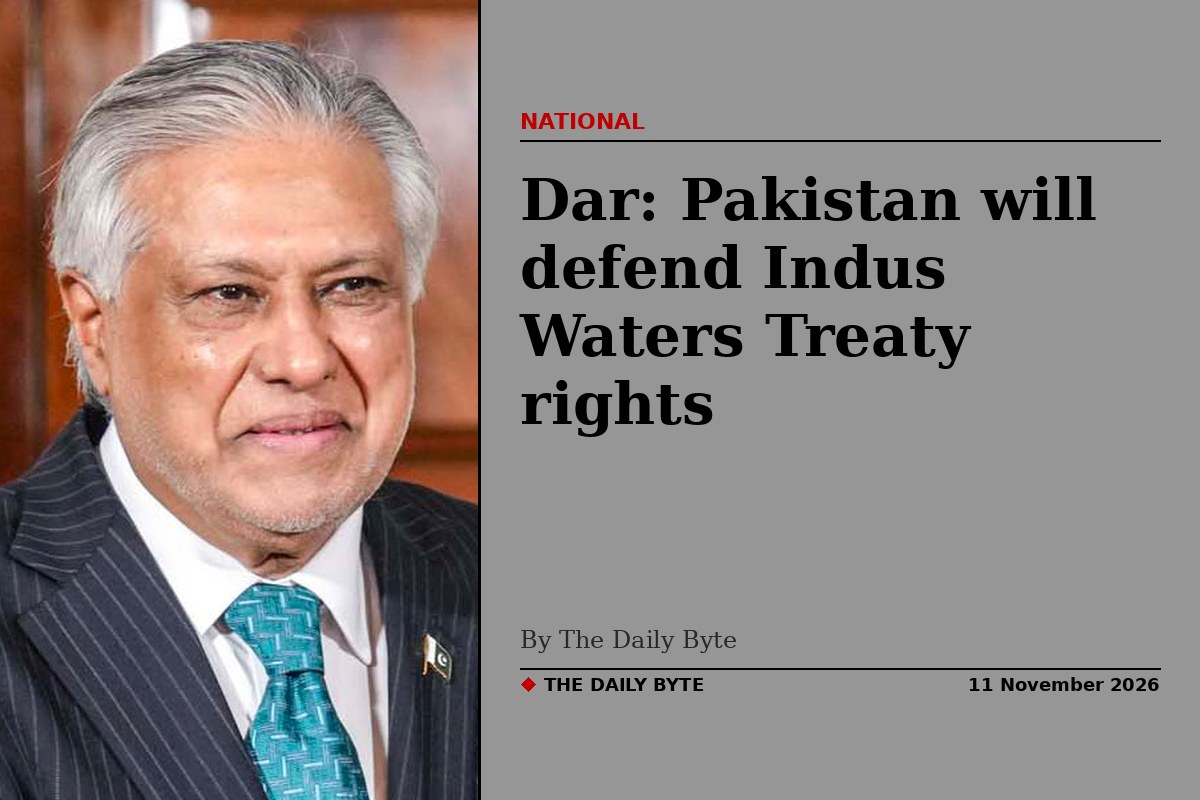
Pakistan will firmly safeguard its legitimate rights under the Indus Waters Treaty and oppose any attempt to weaponise water, Deputy Prime Minister and Foreign Minister Ishaq Dar said on Tuesday. Dar was addressing the inaugural session of the Margalla Dialogue 2026 in Islamabad, where he said regional stability depends on respect for treaty obligations. Sabah News reported his remarks from the dialogue, and Pakistan TV reported that Dar reiterated Pakistan's commitment to defending its sovereignty while pursuing a peaceful resolution of the Jammu and Kashmir dispute.
The seventh Margalla Dialogue, convened by the Islamabad Policy Research Institute, is a two-day gathering of Pakistani officials and international experts held under the theme "Global Order in Transition: Navigating Strategic Uncertainty". Dar told the opening session that Pakistan's ability to navigate global uncertainty depended on domestic strength and effective diplomacy, and he called for a stronger role for diplomacy, dialogue and multilateral cooperation in addressing growing global tensions.
Water and regional stability
Dar's warning on water was the sharpest part of his address. He said Pakistan would firmly safeguard its legitimate rights under the Indus Waters Treaty and oppose any attempt to weaponise water, adding that regional stability depends on respect for the treaty's obligations. He also said a just resolution of the Jammu and Kashmir dispute in accordance with United Nations Security Council resolutions remains indispensable for lasting peace in South Asia.
The Indus Waters Treaty, signed in 1960 after negotiations facilitated by the World Bank, divided the rivers of the Indus basin between Pakistan and India and created mechanisms for resolving disputes. India placed the treaty in abeyance in April 2025, a move Pakistan says has no basis in the agreement, which contains no provision permitting either party to suspend it unilaterally. Pakistan maintains that the treaty remains valid, binding and fully in force.
Diplomacy first, sovereignty non-negotiable
Dar framed Pakistan's approach as peace through strength. He said Pakistan sought peace but would firmly defend its sovereignty, and pointed to the country's response to India's aggression in May 2025 through Operation Bunyan-un-Marsoos as evidence of its determination and capability to defend national sovereignty. He warned that unresolved disputes, military asymmetries and unilateral actions continued to threaten regional stability.
He also said Pakistan remained committed to an equitable international order anchored in the UN Charter, sovereign equality, territorial integrity and the peaceful settlement of disputes. The dialogue's special sessions are examining Pakistan's economic bottlenecks, including taxation, macroeconomic stabilisation and investor confidence, as well as international law and South Asian security dynamics, with particular focus on Jammu and Kashmir and the Indus Waters Treaty.
Pakistan's mediation role
Dar also spoke about Pakistan's continuing mediation role, saying Islamabad will keep working to revive diplomacy between the United States and Iran. He emphasised that the Islamabad Memorandum of Understanding provides an important foundation for further negotiations, and said the dialogue platform itself showed the value of sustained diplomacy, mediation and engagement even during active hostilities.
For Islamabad, the message from the Margalla Dialogue was consistent: disputes should be settled through the mechanisms treaties provide, not through unilateral action. On water, on Kashmir and on the wider region, Dar's position was that Pakistan will talk, but will not concede rights it regards as settled under international law.