Dar: Makkah defence pact targets no country
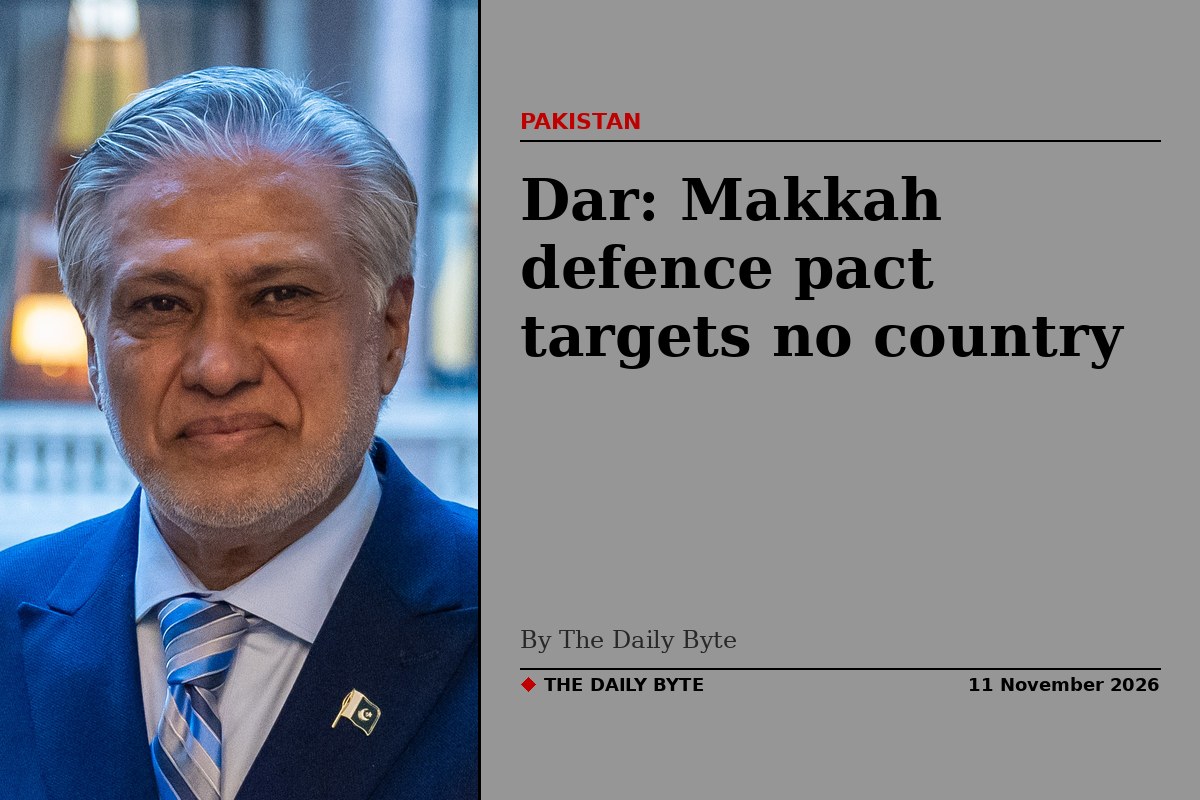
Deputy Prime Minister and Foreign Minister Ishaq Dar has said Pakistan's Makkah Joint Defence Agreement with Saudi Arabia and Turkiye is a defensive arrangement directed against no country and aimed at promoting regional peace and stability.
Dar was addressing the inaugural session of the Margalla Dialogue 2026 in Islamabad on Tuesday, 10 November. The two-day dialogue, organised by the Islamabad Policy Research Institute, is being held under the theme "Changing Global Order — How to Navigate Strategic Uncertainty".
A defensive pact, Dar says
Dar said the agreement reflected Pakistan's commitment to collective security and credible deterrence, describing it as "directed against no country" and "intended to contribute to regional peace and stability".
The pact, signed in Makkah in August by Prime Minister Shehbaz Sharif, Saudi Crown Prince Mohammed bin Salman and Turkish President Recep Tayyip Erdogan, provides for the three countries to treat an armed attack on one as an attack on all, with the nature of any assistance to be decided collectively.
South Asia and the Indus Waters Treaty
Turning to South Asia, Dar said unresolved disputes, military asymmetries and unilateral actions continued to undermine strategic stability, and called for restraint and responsible statecraft. He warned that strategic uncertainty should not become a justification for adventurism.
Referring to India's military action in May 2025, Dar said Pakistan's response through Operation Bunyanun-Marsoos had demonstrated its resolve and capability to defend its sovereignty. He paid tribute to the armed forces for their professionalism and determination, adding: "We will defend our sovereignty with determination and pursue peace with equal commitment."
The foreign minister also restated Pakistan's position on the Indus Waters Treaty, saying the country would firmly safeguard its legitimate rights under the agreement and oppose any attempt to weaponise water. Respect for treaty obligations, he said, was essential to regional stability, human security and confidence between states, particularly where millions of people depended on shared water resources.
Gaza, the UN and regional diplomacy
On Palestine, Dar said the notion that might was right was gaining ground as the use of force increasingly displaced respect for international law. He pointed to the suffering in Gaza, the continued occupation and the expansion of illegal settlements as evidence of the human cost of impunity.
Dar said Pakistan had used its 2025–26 membership of the United Nations Security Council to promote the peaceful settlement of disputes. During Pakistan's presidency of the council in July 2025, he said, it had unanimously adopted Pakistan-initiated Resolution 2788 on strengthening mechanisms for the peaceful settlement of disputes, and a further Pakistan-initiated presidential statement had been adopted by consensus on 5 November.
He also highlighted Pakistan's diplomatic efforts in the region, including its facilitation of talks between the United States and Iran in Islamabad in April 2026 and the Islamabad memorandum of understanding signed on 18 June. He said Prime Minister Shehbaz Sharif, Chief of Defence Forces and Chief of Army Staff Field Marshal Syed Asim Munir and the Foreign Office had remained closely engaged in those efforts.
Dar added that Pakistan and China had jointly issued a five-point initiative in Beijing on 31 March 2026 aimed at restoring peace and stability in the Gulf and Middle East through dialogue and diplomacy, including the free movement of vessels through maritime routes. He said Pakistan remained engaged with regional partners, including Qatar and the foreign ministers of Saudi Arabia, Turkiye and Egypt, through the Regional Four framework.
Afghanistan and the global economy
Addressing Afghanistan, Dar said terrorism emanating from Afghan territory remained a security challenge for Pakistan, and that progress towards a peaceful and stable Afghanistan required effective action to ensure its territory was not used for terrorism against other countries, particularly Pakistan.
On the global economy, he said geopolitics, trade, technology, energy and access to capital were becoming increasingly interconnected and shaped by strategic competition, while instability in the Gulf and the Red Sea showed how quickly regional crises could disrupt trade and energy supplies. He warned that security crises could quickly turn into economic shocks, driving up food and fuel prices and threatening livelihoods.
Dar said Pakistan's ability to navigate global uncertainty depended on its domestic strength, and described economic diplomacy as central to his responsibilities as foreign minister. He thanked the Islamabad Policy Research Institute for organising the dialogue.
The Express Tribune and Khabarwalay reported Dar's address.