Dar: Pakistan Still Mediating Between US and Iran
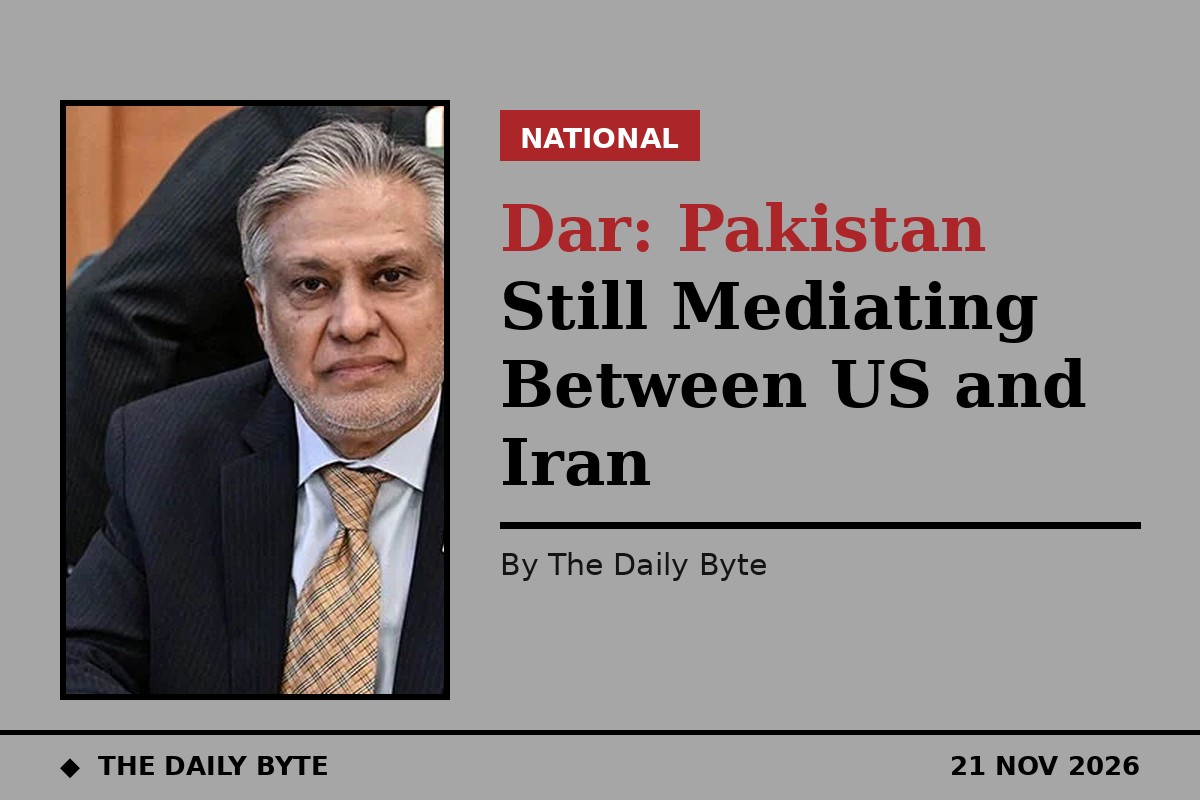
Deputy Prime Minister and Foreign Minister Ishaq Dar has said Pakistan has not given up on its efforts to mediate between the United States and Iran, insisting that diplomacy remains the only way to end a conflict that has disrupted energy supplies and pushed up prices around the world.
Speaking in an interview with Euronews, broadcast by PTV News on Saturday, Dar said Islamabad was still pressing both sides to honour the agreement they signed in June. “Pakistan hasn’t given up. We are still working hard. We continue to persuade both parties to respect and honour what they signed on June 18,” he said.
Dar said he remained optimistic that Washington and Tehran would eventually reach a deal. “I’m a born optimist. I think I would certainly expect that sooner or later, I hope it’s sooner, that we will achieve that objective,” he said, warning that the world could not afford a prolonged conflict in the Middle East.
How Pakistan became the mediator
Dar traced Pakistan’s mediating role back to the first day of the war, on 28 February, when Israel attacked Iran. He said Pakistan was the first country to condemn the strike and that he telephoned his Iranian counterpart, Abbas Araghchi, the following morning to urge restraint and to advise Tehran against targeting Gulf countries.
That early intervention, he said, led to direct negotiations between the United States and Iran in Islamabad on 10 and 11 April, the first face-to-face talks between the two countries in 47 years. The 21-hour marathon session brought the two sides close to an agreement before one delegation sought further consultations with its leadership.
Pakistan’s efforts eventually produced the Islamabad Memorandum of Understanding on 18 June, signed remotely by US President Donald Trump, who was attending the G7 summit in Europe, and the Iranian president. Dar said both sides had since violated parts of the understanding, but that Pakistan was still urging them to respect what they signed.
A new regional security framework
The foreign minister used the interview to argue for a new regional security architecture, saying countries in the region needed to work collectively to protect the global economy and prevent further escalation. He pointed to the Regional 4 group — Pakistan, Saudi Arabia, Turkiye and Egypt — which has been working to promote restraint, and to talks with the European 4 — the United Kingdom, France, Germany and Italy — in Istanbul on 23 October. Germany has now invited both groups for further consultations in December.
Dar also recalled a five-point Middle East peace initiative he developed during a visit to China on 31 March, where he held discussions with Chinese Foreign Minister Wang Yi. He said Pakistan’s foreign policy was independent and firmly rooted in multilateralism. “We believe in multilateralism,” he said. “Bloc politics or unilateral politics will not work.”
Afghanistan, India and the economy
On Afghanistan, Dar said Pakistan wanted a peaceful, stable and prosperous neighbour but stressed that Islamabad’s security concerns must be addressed. He said he had made three visits to Kabul in 2025 in an effort to overcome a four-year diplomatic stalemate, and that Pakistan had shared evidence with international institutions linking major terrorist attacks in October to groups operating from Afghan soil, including the Tehreek-e-Taliban Pakistan, the Balochistan Liberation Army and Islamic State Khorasan Province.
He said Pakistan had lost around 100,000 lives and suffered approximately $150 billion in economic losses in its fight against terrorism, and that rebuilding confidence required verifiable action against terrorist organisations rather than verbal assurances.
On India, Dar said the resumption of bilateral dialogue depended on New Delhi, citing the constitutional changes of 5 August 2019 in Jammu and Kashmir and the May 2025 military confrontation that followed the Pahalgam incident. He said Prime Minister Shehbaz Sharif had immediately proposed an independent investigation into that attack, but India declined. He also criticised India’s decision to place the 1960 Indus Waters Treaty in abeyance, saying water security was directly linked to the agriculture, livelihoods and food security of Pakistan’s 260 million people.
On the economy, Dar said Pakistan’s external debt stood at around $130 billion, while the country’s largely untapped mineral and rare-earth resources represented an estimated potential of $6 trillion to $10 trillion. He urged European institutions to extend Pakistan’s GSP+ trade preferences, which are due to expire at the end of this year, and said Islamabad was prepared to fulfil all 32 international conventions required under the new framework scheduled to take effect on 1 January 2029.