Islamabad Local Polls: 3,505 Vie for 1,125 Seats
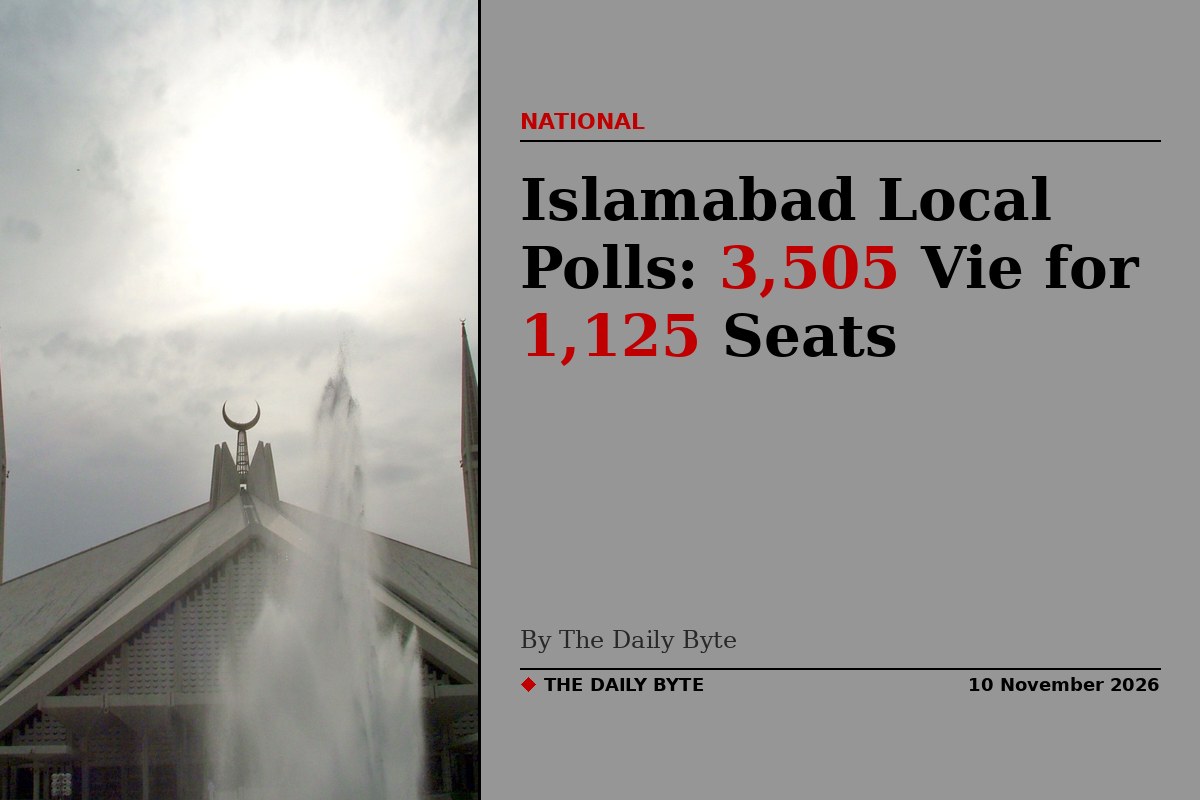
Islamabad will vote in local government elections on Sunday, 20 December 2026, after 3,505 candidates filed nomination papers for 1,125 general councillor seats in the federal capital.
The Election Commission of Pakistan (ECP) announced the election schedule in October, setting polling for 20 December. Nomination papers could be filed from 2 to 6 November, and the commission says 6,568 nomination papers were issued in total. Among the 3,505 candidates who submitted papers are 110 women candidates.
The elections are being held on a non-party basis, and they come after a gap of around five and a half years. The tenure of Islamabad's previous local government institutions expired in February 2021, and repeated attempts to hold fresh polls since then have been postponed.
The election timetable
Under the schedule announced by the commission, scrutiny of nomination papers runs from 9 to 13 November. Candidates can file appeals against the rejection of their papers from 14 to 18 November, and the appellate authority will decide those appeals between 19 and 23 November.
The deadline for withdrawing nominations is 25 November, and election symbols will be allotted to candidates on 26 November. Consolidation of the election results is scheduled for 21 to 24 December.
How the capital's local government will work
Under the Islamabad Capital Territory Local Government Act 2015 and its 2024 amendment, the capital's local government will have two tiers. At the first tier there will be 125 union councils, each with 13 members. Nine general councillors in each council will be directly elected by voters, and four reserved-seat members — one woman, one youth representative, one farmer or labourer, and one non-Muslim member — will be elected by secret ballot.
Each 13-member union council will then elect its chairman and vice chairman, giving Islamabad 125 union council chairmen and the same number of vice chairmen.
The second tier will be the Metropolitan Corporation Islamabad, with 187 members. The 125 union council chairmen will serve as its general members, alongside 41 reserved seats for women, six for youth, six for non-Muslims, six for farmers and labourers, and three for technocrats. The mayor of Islamabad and three deputy mayors will be elected from among the elected representatives, rather than directly by voters.
Why the polls took so long to reach this point
The schedule follows an order by a five-member commission headed by Chief Election Commissioner Sikandar Sultan Raja, directing that the elections be held under the 2015 Act. The commission heard that constituency delimitation had been carried out six times and election schedules issued four times.
An earlier schedule had set polling for February 2026, but the process was disrupted after the federal government introduced an amendment ordinance. Officials told the commission that the ordinance expired on 6 September, while the final delimitation of constituencies was published on 14 October.
The chief election commissioner observed during the hearing that it seemed the government did not want to hold local body elections in Islamabad, adding that the commission was issuing the order under compulsion. With nomination papers now filed and scrutiny under way, the December date is the next test of whether the long-delayed polls will finally go ahead.