Israel Count Puts Netanyahu Bloc Ahead, Short of 61
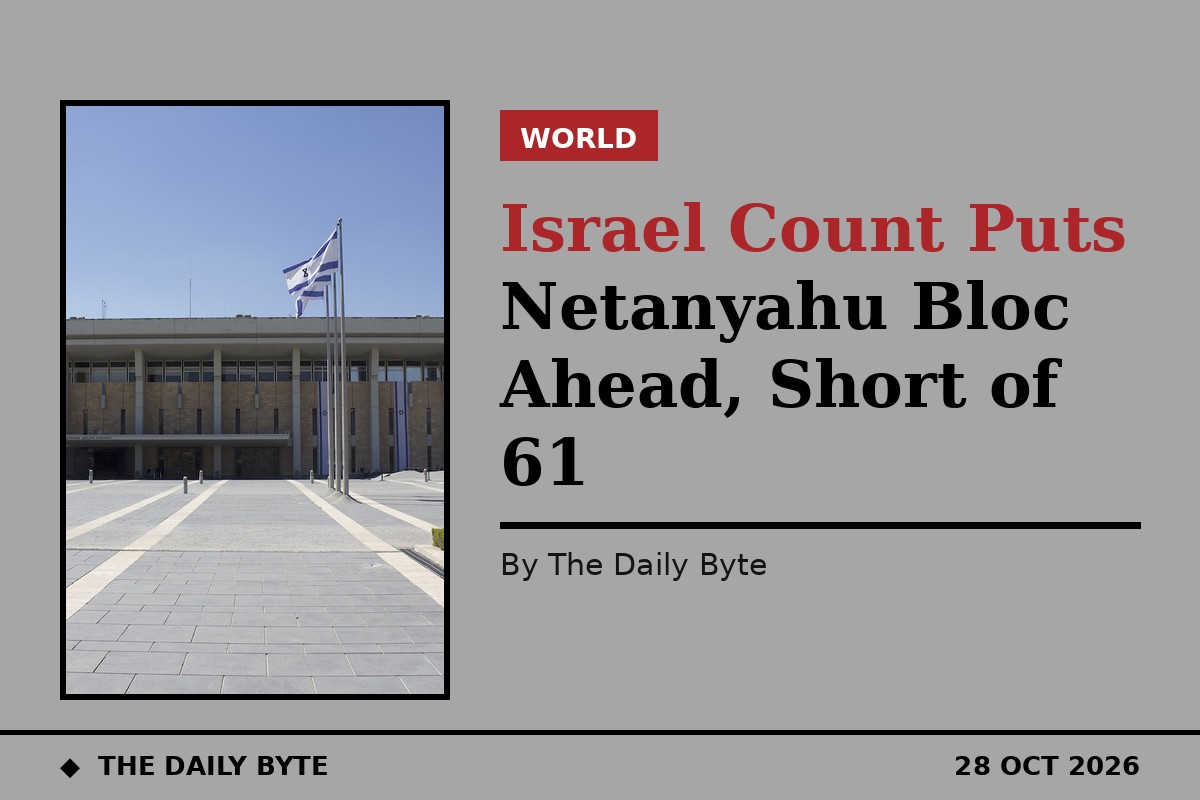
Partial counting in Israel's election has put Prime Minister Benjamin Netanyahu's bloc ahead of challenger Gadi Eisenkot's bloc, but still short of the 61 seats needed for a majority in the 120-seat Knesset, according to projections published on the morning of 28 October 2026. The figures are partial and will move as more ballots are counted.
With about 42% of votes counted, one projection put Netanyahu's bloc on 57 seats against 47 for the opposition, with Arab parties on 16 to 19 seats. With just over half counted, another projection put the Netanyahu bloc on 55 and the opposition on 49, with Arab-led parties holding 16. Exit polls on election night had given a tighter picture, with the two blocs tied or close at 51 to 52 seats each.
Turnout and what counts next
Turnout reached 77.7% by the close of polls on Tuesday, the highest recorded by that hour since 1999, according to Israel's Central Elections Committee. Likud remained the largest single party, projected at about 27 to 28 seats, ahead of Eisenkot's Yashar party. Double-envelope ballots, including votes from soldiers and citizens abroad, are due to be counted on 29 October, with official results due on 4 November.
Coalition talks still to come
Neither bloc can govern alone on the partial figures, and both Netanyahu and Eisenkot have ruled out partnering with the Arab parties, which could hold the balance of power. Until a new coalition is formed, Netanyahu remains in office as caretaker prime minister during what could be prolonged negotiations.