Japan Minister to Attend AZEC Summit in Philippines
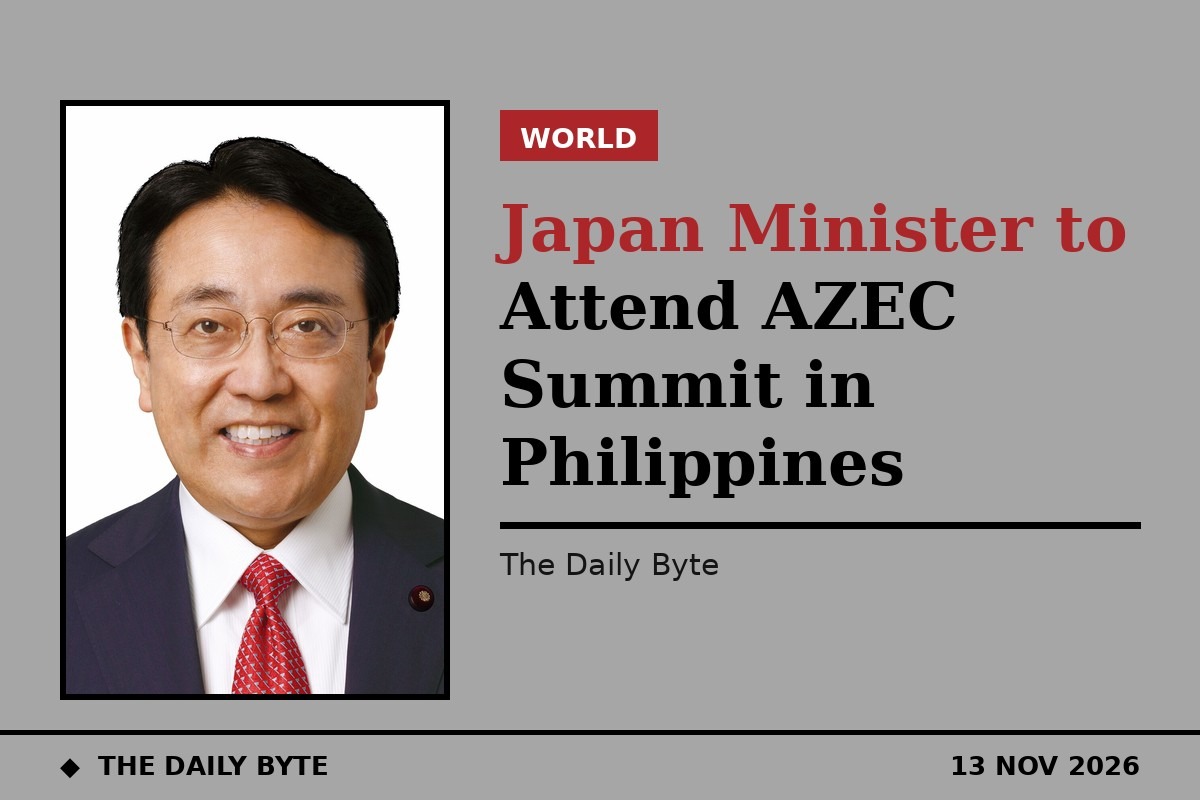
Japan's industry minister Ryosei Akazawa will attend an Asia Zero Emission Community (AZEC) summit in the Philippines next week, as Tokyo pushes to strengthen Asia's energy resilience amid disruption to Middle East energy shipments.
Akazawa told reporters on Friday that he would visit the Philippines on 16 and 17 November and report on the outcomes of an AZEC ministerial meeting held in Manila last month.
The summit is expected to build on that October ministerial meeting, although Akazawa declined to give details, saying they require coordination with other countries.
Energy security moves up the agenda
Energy security and energy resilience have risen sharply in importance as the conflict in the Middle East affects energy shipments, Akazawa said.
The warning reflects Asia's heavy dependence on Middle Eastern crude. Akazawa told the Manila ministerial meeting in a video address that around 90 per cent of the crude oil transported through the Strait of Hormuz goes to Asia, underlining how exposed the region's economies are to any disruption at the choke point.
"The fact that around ninety percent of the crude oil transported through the Strait of Hormuz goes to Asia clearly shows that main Asian countries continuously depend heavily on energy from the Middle East," Akazawa said at the time.
Joint oil stockpiling plan takes shape
ASEAN countries will launch a joint oil product stockpiling scheme as early as 2027, with storage sites planned in Indonesia and Thailand, to allow member states to share supplies during emergencies, the Nikkei business daily reported on Thursday.
The plan builds on work agreed at the fourth AZEC ministerial meeting, held at the Philippine International Convention Center in Pasay City on 8 October. The meeting brought together ministers and representatives from Australia, Brunei Darussalam, Cambodia, Indonesia, Japan, Laos, Malaysia, the Philippines, Singapore, Thailand and Vietnam.
Member nations agreed on new work plans to increase regional oil reserves, improve stockpile infrastructure and design a coordinated emergency release mechanism, building on Japan's $10-billion Partnership on Wide Energy and Resources Resilience (POWERR) Asia initiative.
The Philippines plans to create a national oil reserve by the end of 2027 and is working with Japanese agencies to study the feasibility of a regional stockpiling location in the country, Energy Secretary Sharon Garin said during the meeting.
Japan's stockpiling cooperation directly complements the regional fuel reserve vision championed by President Ferdinand Marcos Jr within ASEAN, Akazawa said.
Nuclear cooperation and 600 projects
On the sidelines of the Manila meeting, Garin and Akazawa signed a memorandum of cooperation on nuclear power, under which both countries will establish a working group to identify priority activities, monitor progress and facilitate technical exchanges.
"As we prepare to introduce nuclear energy into our power mix, Japan's experience will help us strengthen our technical capabilities, regulatory preparedness, and public confidence in the safe and responsible development of nuclear energy," Garin said.
Akazawa announced that partner nations concluded about 70 commercial and technical agreements during the Manila gathering, expanding AZEC's regional portfolio to more than 600 active projects spanning oil stockpiling, liquefied natural gas, nuclear development, ammonia and biofuels.
The Philippines and Japan are also set to co-host the fourth AZEC leaders' meeting in November, a step welcomed by Philippine think tank Stratbase Institute as recognition of Manila's growing strategic role in the Indo-Pacific.
Billions set aside for household energy costs
Akazawa also said Japan would spend 521.9 billion yen ($3.3 billion) from a reserve fund to subsidise electricity and gas bills from December through February, and allocate an additional 130 billion yen in grants to local governments to support users of high-voltage electricity, liquefied petroleum gas and kerosene.
The measures form part of Tokyo's response to energy costs that remain elevated while the Middle East conflict continues to unsettle fuel markets.
Sources: Reuters and The Manila Times


