Japan funds water supply for 6,000 in Mansehra village
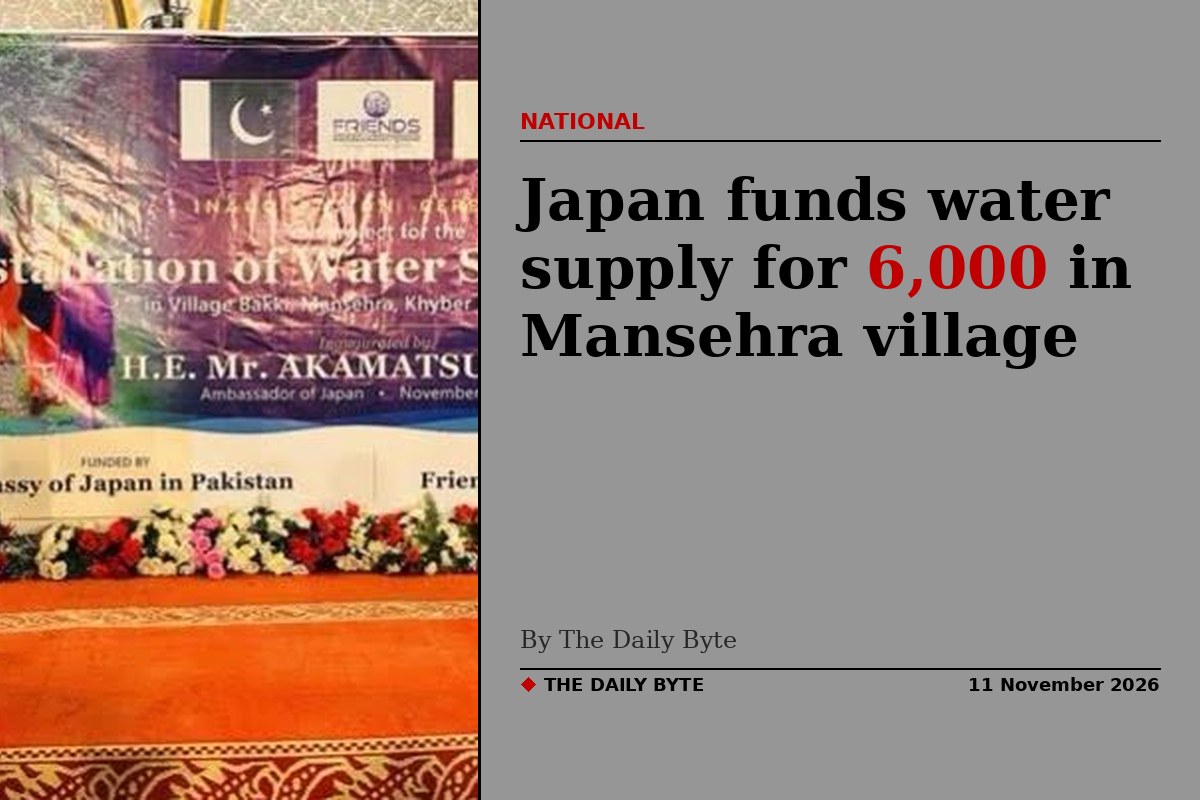
Japan's ambassador to Pakistan has inaugurated a Japanese-funded water supply system in a village in Mansehra district, bringing safe drinking water to more than 6,000 people who previously had to collect water each day from distant sources.
Akamatsu Shuichi, Ambassador of Japan to Pakistan, attended the inauguration ceremony on Wednesday for the project for the installation of a water supply system in Village Bakki, Mansehra, in Khyber Pakhtunkhwa. The project was implemented by Friends Welfare Association Pakistan, a non-governmental organisation working on education, healthcare, water and sanitation and community development.
The Government of Japan provided financial assistance of 59,764 US dollars for the project through its Grant Assistance for Grassroots Human Security Projects programme, known as GGP. The ceremony was also attended by Sardar Shahjehan Yousaf, a member of the Khyber Pakhtunkhwa Provincial Assembly, Asad Mehmood Lodhi, Additional Deputy Commissioner of Mansehra, officials of the Embassy of Japan, representatives of Friends Welfare Association, members of the local water, sanitation and hygiene committee, and community members.
A gravity-flow system for Bakki
Friends Welfare Association has completed construction of a gravity-flow water supply system, including 6,013 metres of galvanised iron main supply pipes and a water intake tank. The association and the local community also contributed additional resources for excavation work, local transportation of materials and water quality testing, to make sure the supply is safe and reliable.
To support the long-term sustainability of the project, the association established a 20-member water, sanitation and hygiene committee and trained its members in water quality management, hygiene promotion and the operation and maintenance of the system.
The system now provides safe drinking water to more than 6,000 residents of Village Bakki. For a community that has long struggled with water supply, the change is practical as well as symbolic: water now arrives through pipes rather than being carried home by hand.
Why the project matters for women and girls
The project was designed around a problem that falls hardest on women and girls. In Village Bakki, residents, especially women and girls, had faced significant daily hardship in collecting water, a burden that consumed hours each day and limited opportunities for schooling and other work.
Speaking at the ceremony, Ambassador Akamatsu congratulated Friends Welfare Association on completing the project and emphasised that access to safe water is essential to improving people's lives and supporting the sustainable development of society. He said improved access to safe water would reduce the daily burden of water collection, particularly for women and girls, create greater educational opportunities for children, improve quality of life and contribute to better health for the entire community.
He also stressed the importance of proper maintenance to ensure the long-term sustainability of the water supply system, a point echoed in the training given to the local committee that will now look after it.
A grant agreed in 2024, completed in 2026
The Bakki project is one of three grassroots grants agreed by the Government of Japan in November 2024, when the Embassy of Japan in Islamabad signed grant contracts worth a total of 194,493 US dollars with three local non-governmental organisations. Friends Welfare Association received 59,764 US dollars to build the water scheme in one of the most underdeveloped areas of Mansehra district, then expected to benefit around 6,000 people in about 895 households.
Two years on, that scheme is built, tested and running. Ambassador Akamatsu reaffirmed Japan's commitment to supporting the sustainable development of Pakistan and expressed his hope that the water supply system would serve as a lasting symbol of friendship between Japan and Pakistan.
Japan has funded more than 400 grassroots human security projects in Pakistan over the years, covering healthcare, education, water supply and sanitation. The Bakki inauguration is a small part of that record, but for the 6,000 people it serves, it is the difference between carrying water each day and turning on a tap.
Sources: Centreline and Sub News.