Judge Blocks Connecticut Law on Masked ICE Agents
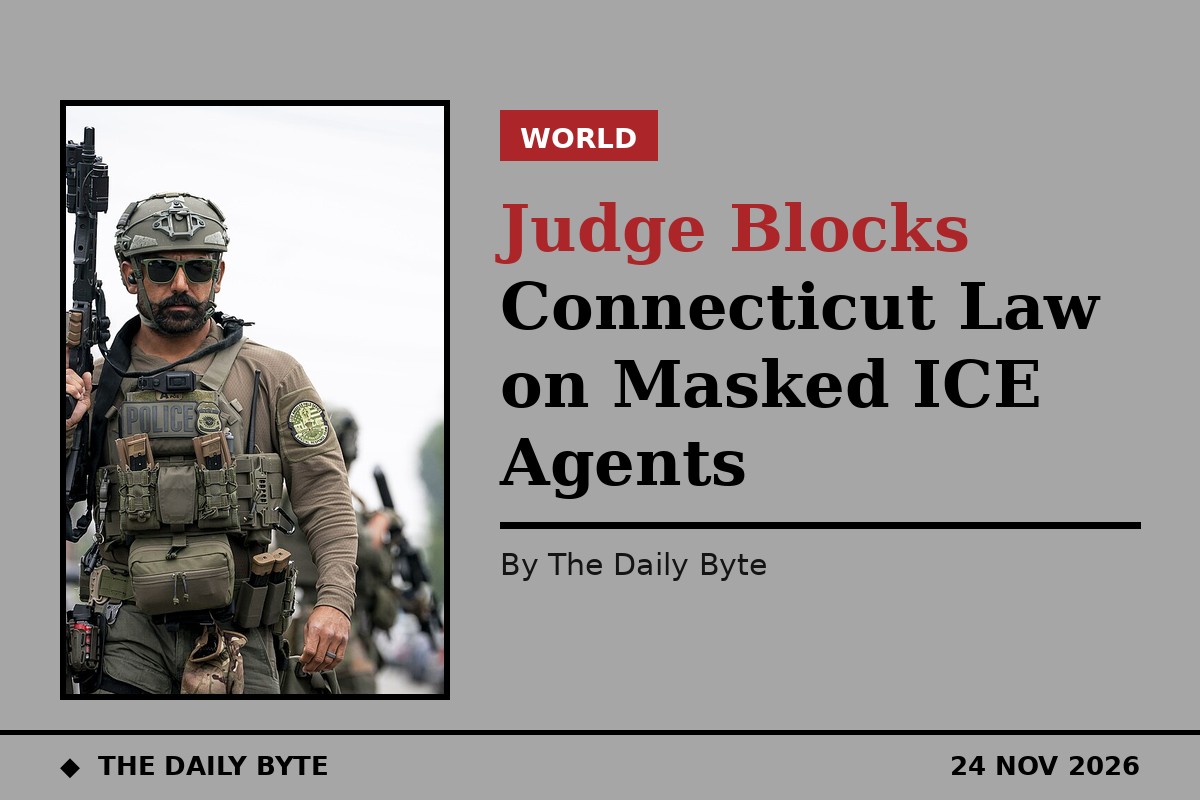
A federal judge in Connecticut has temporarily blocked the state from enforcing new rules on federal immigration officers, including a ban on face coverings, in a ruling that turns on one of the oldest questions in American law: how far a state can go in regulating federal officers working inside its borders.
Judge Vernon D. Oliver of the United States District Court for the District of Connecticut granted a preliminary injunction on Friday, 20 November, in a case brought by the United States against the State of Connecticut. The order stops the state from applying key parts of Substitute Senate Bill 397, enacted as Public Act 26-14, to federal officers while the lawsuit continues. It is a preliminary ruling, not a final judgment, and the case will still go to trial.
What the blocked law would have done
Connecticut passed the law in May 2026, and Governor Ned Lamont signed it shortly afterwards. The Justice Department sued on 15 May, days after the signing. The challenged sections, numbered 3 to 6, would have applied the state's use-of-force standards to federal officers, given state officials the power to investigate and in some cases prosecute federal officers over uses of force, barred officers from wearing face coverings while dealing with the public, and required officers making planned arrests to show a badge and name tag.
Supporters of the law in the state legislature said it was a response to the escalation of immigration enforcement and to public concern about masked officers carrying out arrests. State Senator Matt Lesser, responding to the ruling, noted that most of the law survives: section 1, which lets residents sue in state court when they say their constitutional rights have been violated, was not part of the federal government's challenge and remains in effect.
Why the judge sided with Washington
Judge Oliver found that the challenged sections likely violate the Supremacy Clause of the United States Constitution, which stops states from interfering with or controlling the operations of the federal government. In his written order, he wrote that the federal government's sovereignty is supreme, and that no state government can exclude the federal government from exercising authority given to it by the Constitution, or obstruct its authorised officers against its will.
He warned that if states could each set their own rules for federal officers, federal law enforcement would break down nationally under conflicting requirements across the states. The court also found that the United States had standing to bring the challenge and that the balance of harms favoured an injunction while the case is decided.
The ruling does not give the federal government everything it asked for. Judge Oliver dismissed the case against Attorney General William Tong, finding that the attorney general holds only civil authority and could not have prosecuted the law's criminal provisions. The injunction applies to federal officers only; the same provisions still apply to Connecticut's own state and local police.
A wider fight over state limits
Connecticut is not the only state to have tried to set rules for federal immigration officers. Several states have passed laws seeking to regulate how Immigration and Customs Enforcement officers operate, including limits on masks and identification, and the Justice Department has challenged more than one of them. The Connecticut decision is the latest in a run of federal court rulings against such state laws, and it is likely to be cited in the other disputes.
For now, the practical effect in Connecticut is straightforward: while the injunction stands, ICE and other federal officers may wear face coverings and operate without displaying name tags during enforcement work in the state. The underlying question, whether a state can impose its own standards on federal officers at all, will be decided at trial. Fox News reported the ruling, and the full court order is published by Justia.