Dozens of JUI-F workers held as protests spread in KP
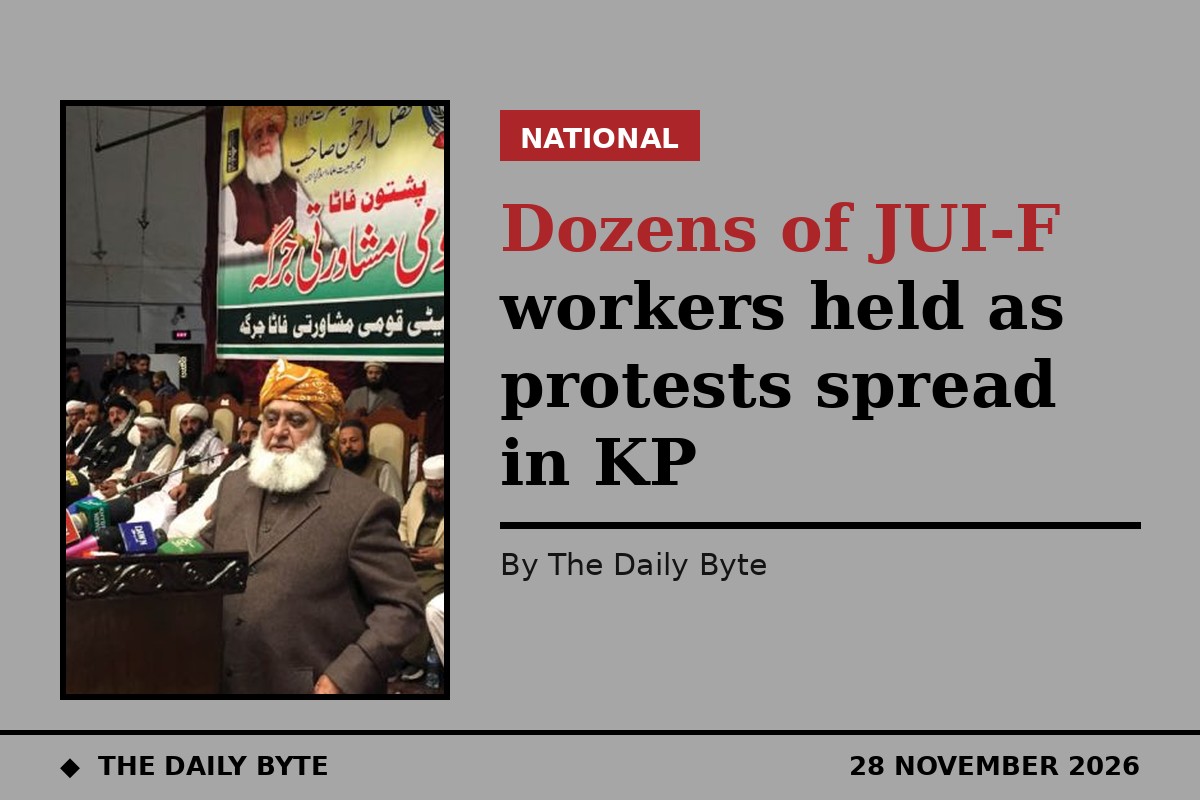
Police arrested dozens of workers of the Jamiat Ulema-i-Islam-Fazl (JUI-F) in Khyber Pakhtunkhwa and Sindh on Friday as the party staged protests against the government over the alleged detention of its chief, Maulana Fazlur Rehman.
Khyber Pakhtunkhwa police arrested more than 60 JUI-F workers during the protests, with detentions reported in several districts and security placed on high alert across the province. Cases were also registered against hundreds of workers and leaders.
In Peshawar, JUI-F workers and leaders marched from the Mufti Mahmood Markaz onto Ring Road, where a heavy contingent of police was deployed. Workers blocked the M-1 Motorway at the Peshawar toll plaza and near the Wali Interchange between Mardan and Swabi, burning tyres and bringing traffic to a standstill in both directions.
Police registered a case at Chamkani police station naming 16 local leaders and workers, and more than 22 workers and leaders were arrested over the motorway blockade. Khyber Pakhtunkhwa's Adviser on Information, Samar Haroon Bilour, said 22 workers had been arrested for blocking the motorway overnight, and that no one would be permitted to take the law into their own hands.
The crackdown spread well beyond Peshawar. Thirty-two workers were arrested at Chakdara Bridge, while police detained the party emirs of Lower and Upper Chitral. Near the Chashma checkpost, police booked 19 leaders and 200 workers for blocking a road despite a ban on gatherings. The party's Malakand chapter said 38 of its workers had been detained, and leaders in Shangla said their district emir was arrested on the Karakoram Highway at Bisham.
Protests or attempted demonstrations were also reported in Charsadda, Bajaur, Lower Dir and Malakand. In Sargodha itself, seven more activists were arrested on Friday, days after more than two dozen local leaders were taken in, and police sealed the city's entry points.
In Sindh, JUI-F workers staged a sit-in on the national highway at the Baberloi bypass in Khairpur, with office-bearers from all seven districts of the region taking part, and held protest demonstrations in Karachi, Larkana, Thatta and other cities. Police in some areas resorted to baton charges and tear gas to disperse workers.
What triggered the protests
The immediate trigger was the detention of senior JUI-F leaders in Sargodha and neighbouring Khushab ahead of a planned public gathering. Regional Police Officer Sohail Sukhera told Dawn that secretary-general Maulana Abdul Ghafoor Haideri, JUI-F Punjab chief Maulana Amjad Khan and Jamiat Talaba-i-Islam central president Malik Awais were detained at a house in Sargodha.
The Sargodha district administration had already moved against the party leadership. The deputy commissioner barred Mr Rehman and eight other party leaders from entering, residing in or remaining in the district for 30 days, and imposed a separate 30-day gag order on 19 people, including religious scholars, over concerns that their speeches could disturb public peace. Both orders were issued on 25 November.
Mr Rehman claimed in Lahore that police had arrested him, saying he was in their custody. Lahore police chief Bilal Siddique Kamyana denied this, telling Dawn: “We did not arrest the JUI-F chief.” He said Mr Rehman had been stuck in traffic when reports of his arrest surfaced and had since been allowed to return to his Lahore residence, and that his movement had not been restricted.
In a video message, Mr Rehman asked party workers and supporters to postpone protests and sit-ins, announcing that demonstrations would instead be held across the country after Friday prayers. The party has also approached the Lahore High Court against the alleged restrictions on its chief's movement in Lahore.
A standoff in its third day
The protests are the latest chapter in a steadily worsening relationship between Mr Rehman and the Shehbaz Sharif government. The party says the action against its leaders amounts to an attempt to stop it holding a public gathering in Sargodha, while the authorities say the restrictions and detentions are needed to maintain public order, with Section 144 in force in the affected areas.
The district administrations maintain that no public gathering was allowed because of the ban, while JUI-F workers say they were protesting against the arrest of their leaders and colleagues. The standoff has now run for three days, with protests reported across Khyber Pakhtunkhwa, Balochistan and parts of Punjab and Sindh.
Whether the demonstrations escalate further will depend on what the party leadership decides next. Mr Rehman has told workers the protest will continue and that arrests will not block their way, while the police have made clear that road blockades will be met with cases and arrests. For now, the motorways and highways at the centre of the dispute have been reopened, but dozens of workers remain in custody and hundreds more face cases.