Justice Mandokhail retires after 17 years on bench
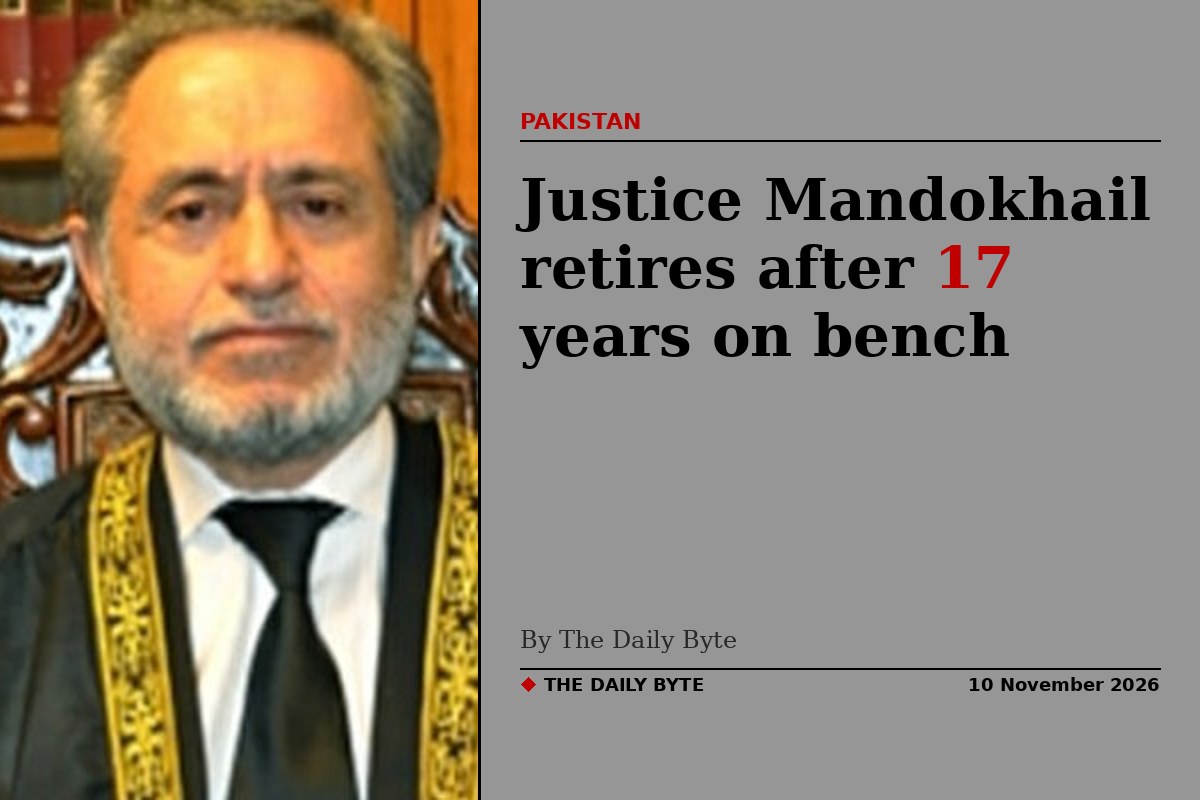
Supreme Court Justice Jamal Khan Mandokhail will retire on Wednesday, bringing to a close a judicial career spanning nearly 17 years and marked by several consequential rulings on constitutional, political and legal matters.
Justice Mandokhail began his judicial career on 7 September 2009, when he was appointed a judge of the Balochistan High Court. He later served as chief justice of that court from October 2019 until his elevation to the Supreme Court in August 2021.
Landmark rulings on the bench
During his time at the Balochistan High Court, Justice Mandokhail authored several significant judgements, including a ruling that the province's unsettled land belonged to the indigenous tribes who had inhabited its plains and mountains for centuries, rather than the provincial government.
In another major judgement, he declared several provisions of the Defence Housing Authority Act, 2015, unconstitutional, holding that the authority functioned like a non-government agency and that its acquisition of property would violate the constitutional right to property. The Supreme Court later suspended that ruling, and appeals against both judgements are now pending before the Federal Constitutional Court.
At the Supreme Court, Justice Mandokhail sat on the bench that set aside former deputy speaker Qasim Suri's ruling rejecting the no-confidence motion against then prime minister Imran Khan under Article 95 of the Constitution. He was also among the minority judges who held that the votes of defecting lawmakers should be counted under Article 63A.
Constitutional bench and military trials
The judge was among those who opposed suo motu proceedings to hold elections to the Punjab and Khyber Pakhtunkhwa provincial assemblies within 90 days. Along with Justice Syed Mansoor Ali Shah, he maintained that the Lahore High Court should first be allowed to proceed with the matter.
Following the 26th Constitutional Amendment, Justice Mandokhail was nominated to the constitutional benches and served on the committee responsible for constituting benches. He was also a member of the constitutional bench that ruled the trial of civilians in military courts unconstitutional.
He served as a member of the Judicial Commission of Pakistan and was among its members who did not support the appointment of Justice Sardar Muhammad Sarfraz Dogar as chief justice of the Islamabad High Court.
Mixed assessments from the bar
Assessments of his tenure from the legal fraternity have been mixed. Supreme Court advocate Faisal Siddiqi described him as a polite judge with some prominent dissenting judgements, but criticised his overall judicial approach, saying his jurisprudence of balancing executive interests against citizens' rights had ended up confused.
Waqas Ahmed, an advocate who worked as a law clerk with Justice Mandokhail, offered a warmer assessment, describing him as a humble and gracious human being who listened to lawyers with patience and respect. “His legacy is not confined to his judgments; it also lives in the dignity, humility and kindness with which he treated the legal fraternity,” he said.
Justice Mandokhail, who was born on 12 November 1961, was closely associated during his career with former chief justice Qazi Faez Isa and with incumbent Chief Justice Yahya Afridi. Some of his positions drew criticism from sections of the legal fraternity and supporters of the Pakistan Tehreek-e-Insaf.