Rallies Across Sindh Reject Any Division of Province
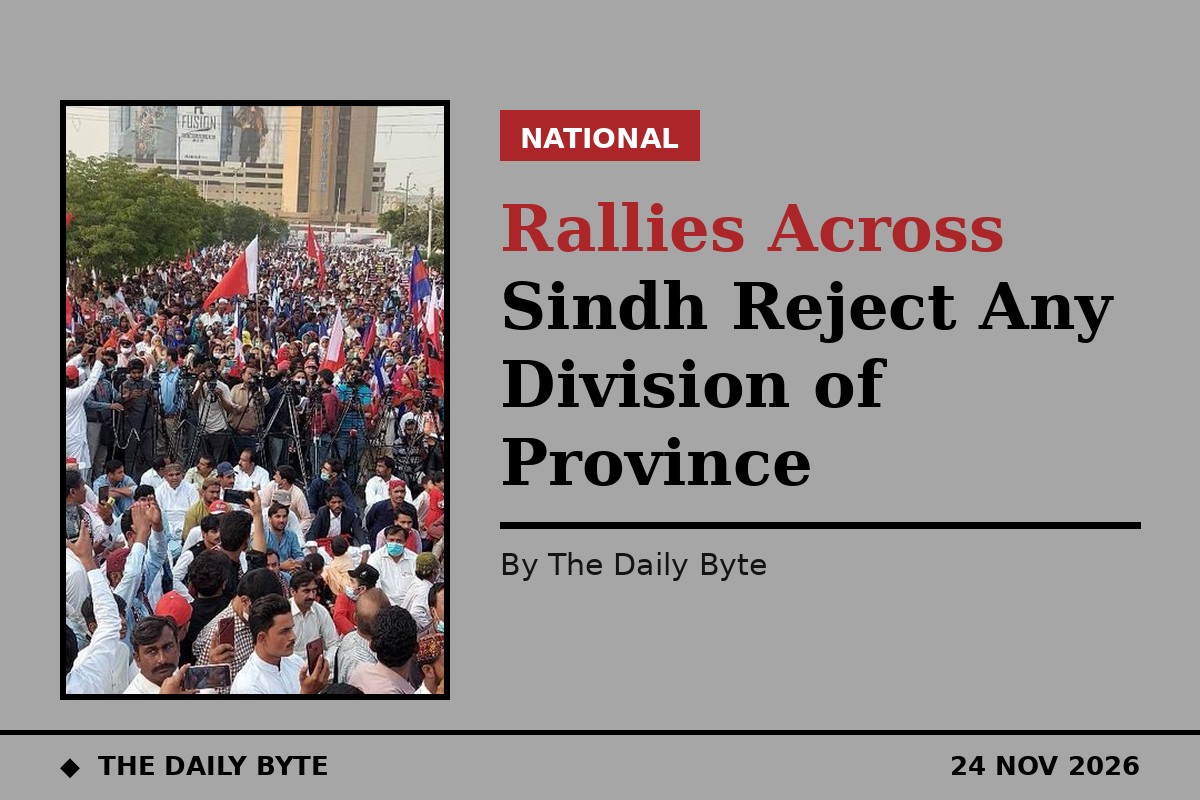
Demonstrators rallied in Karachi and in district centres across Sindh on Sunday, 22 November, to oppose proposals to divide the province or create new provinces or administrative units, declaring that Karachi is an inseparable part of Sindh. The protests brought together the Jamiat Ulema-e-Islam-Fazl (JUI-F) and Sindhi nationalist groups, in the most visible street response so far to the renewed debate in Islamabad over redrawing Pakistan's provincial map.
In Karachi, JUI-F held its gathering at Guru Mandir, while the Jeay Sindh Rehbar Committee (JSRC), a coalition of Sindhi nationalist parties and Jeay Sindh factions, led a march from Empress Market to the Karachi Press Club. JUI-F also held demonstrations at district headquarters elsewhere in the province, including in Sukkur and Jacobabad. Reports of the day described crowds of party workers, activists and lawyers, with participants chanting slogans against the division of the province and in defence of what they called Sindh's historical, geographical and cultural unity.
Who led the protests
The JSRC march was led by its convener, Riaz Ali Chandio, who chairs the Jeay Sindh Mahaz, alongside Dr Niaz Kalani, Advocate Haseeb Jamali and other organisers. JUI-F's Sindh secretary general, Rashid Mehmood Soomro, addressed his party's gathering, rejecting any move to divide Sindh and saying Karachi was integral to the province. Nationalist leaders, lawyers' representatives and activists from different parts of Sindh took part, in what organisers presented as a show of unity across the province's nationalist factions.
The speakers at the Karachi gatherings rejected the idea of a public referendum on creating new administrative units or provinces, arguing that public opinion should not be used to legitimise what they described as a predetermined agenda. They said no decision about the province's geographical or administrative status could be acceptable without taking its people into confidence, and warned the federal government against imposing any such decision.
What the protesters demanded
The central demand was straightforward: an end to proposals to separate Karachi or any other part of Sindh. Demonstrators said creating new provinces or administrative units would threaten the province's unity, and called for decisions about the province to be made through Parliament instead. The rallies also raised wider concerns about lawlessness, governance and public accountability, with speakers saying the province's needs were being overlooked while its future was debated in Islamabad.
One of the groups involved, the Jeay Sindh Muttahida Mahaz, announced after a meeting of its central leadership that it would step up its campaign, including what it called an economic blockade of Punjab aimed at disrupting supply lines and highways passing through Sindh. The announcement was made in a press release from the organisers reported after the rally; no blockade had been put in place, and the announcement itself, rather than any disruption, was what was reported.
Why the protests happened now
The demonstrations came as proposals for new provinces or administrative units, attributed to federal figures and the Muttahida Qaumi Movement (MQM), returned to the centre of political debate in Islamabad. Defence Minister Khawaja Asif said on 23 November that the process for a referendum on the creation of new provinces was likely to move forward early next year, expressing confidence that the continuing discussions would produce results. The MQM-Pakistan had earlier demanded a referendum in December, and the question of whether Sindh in particular could be divided has been the most contested part of the debate.
Opposition to any division of Sindh has also been voiced inside the province's institutions. Sindh Chief Minister Murad Ali Shah said on 12 November that there would be no division of Sindh, and the Sindh Assembly has passed a resolution against any division of the province. The street protests on Sunday added a public dimension to that opposition, taking the argument out of assembly halls and television studios and onto the streets of Karachi and the district towns.
What happens next
No response from the federal government or the MQM to the demonstrations was reported in the accounts of the protests. The speakers at the Karachi gatherings vowed to launch province-wide protests and to pursue constitutional, legal, political and democratic avenues if attempts were made to divide Sindh. For now, the debate remains where it was: a proposal discussed in Islamabad, opposed in Karachi, and with no decision announced. The rallies showed that any move to act on it would meet organised resistance in Sindh itself. Pakistan PM, drawing on Business Recorder, and Daily Meezan, reporting the Karachi rally, both covered the protests on 23 November.