Kayani: Amendments Sparked Dispute Between Top Courts
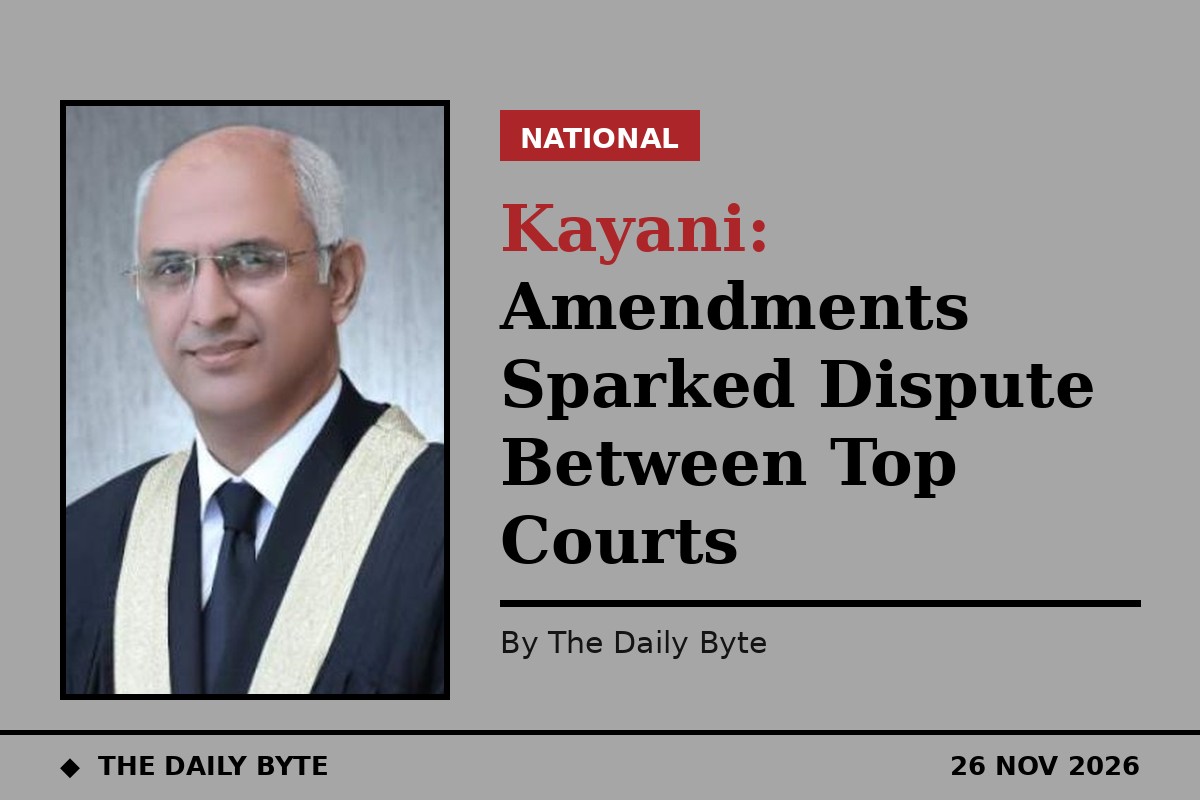
Retired Justice Mohsin Akhtar Kayani has said the 26th and 27th constitutional amendments triggered a dispute between two superior courts, pushing all other matters into the background, in his first public speech since resigning from the Lahore High Court.
Addressing a seminar titled “Personal Safety and Justice in the Digital World”, organised by the Institute of Regional Studies (IRS) in Islamabad on Thursday, Justice Kayani said the current state of the Constitution and the way it was being used showed that the entire system had collapsed. He said Parliament could resolve the dispute between the superior courts, but questioned the nature of representation in the Parliament responsible for legislation.
What Kayani said at the seminar
“Everyone knows the truth, but we are all just watching and not speaking, as if we have become deaf and mute,” he said. He added that those enforcing the rule of law had adopted a biased lens, and that the people whose problems were supposed to be addressed had not even been asked what those problems were.
Justice Kayani said laws were made to provide protection before a crime occurred, but the 26th and 27th amendments had created a dispute between two superior courts. He said the resulting conflict meant some judicial decisions were being ignored, while the public was troubled by the dispute. “We are ignoring a body of judicial decisions and creating new legal precedents,” he said.
He said the judiciary’s role was not to legislate, as legislation was Parliament’s responsibility, and that which Parliament should legislate was a separate debate: either the current Parliament or a public-representative parliament with a valid mandate through the people’s votes. The key issue, he said, was the intent behind legislation, which might become apparent much later.
Criticism of the PECA law
Justice Kayani also criticised the Prevention of Electronic Crimes Act (PECA), saying journalists, lawmakers and lawyers were suffering under it. He said many terms concerning harassment lacked clear meanings, and many people did not even know what stalking and spoofing meant. He added that an agency was created and the same officers were given new uniforms, and that lawyers who had merely tweeted and then faced punishment could see the impact of such laws.
He cited the 1979 Hudood laws, saying it took 23 years for the law to end and thousands of people had suffered under it by then. Understanding the justice system, he said, required examining how legislation was enacted and considering the intent behind any law.
Why Kayani resigned
Justice Kayani tendered his resignation to President Asif Ali Zardari on 28 October 2026, saying the changes introduced through the 26th and 27th amendments had compromised the independence and institutional integrity of the high courts. He became the fourth judge of the superior judiciary reported to have resigned following the amendments.
The 26th Constitutional Amendment, enacted in October 2024, changed how senior judges are appointed, while the 27th Amendment, signed into law in 2025, established a Federal Constitutional Court and changed how judges are transferred between high courts. Justice Kayani had been transferred from the Islamabad High Court to the Lahore High Court in April 2026, a move he and four fellow Islamabad judges challenged in court.