Khalifa University Opens RFGPT AI Model to Telecoms
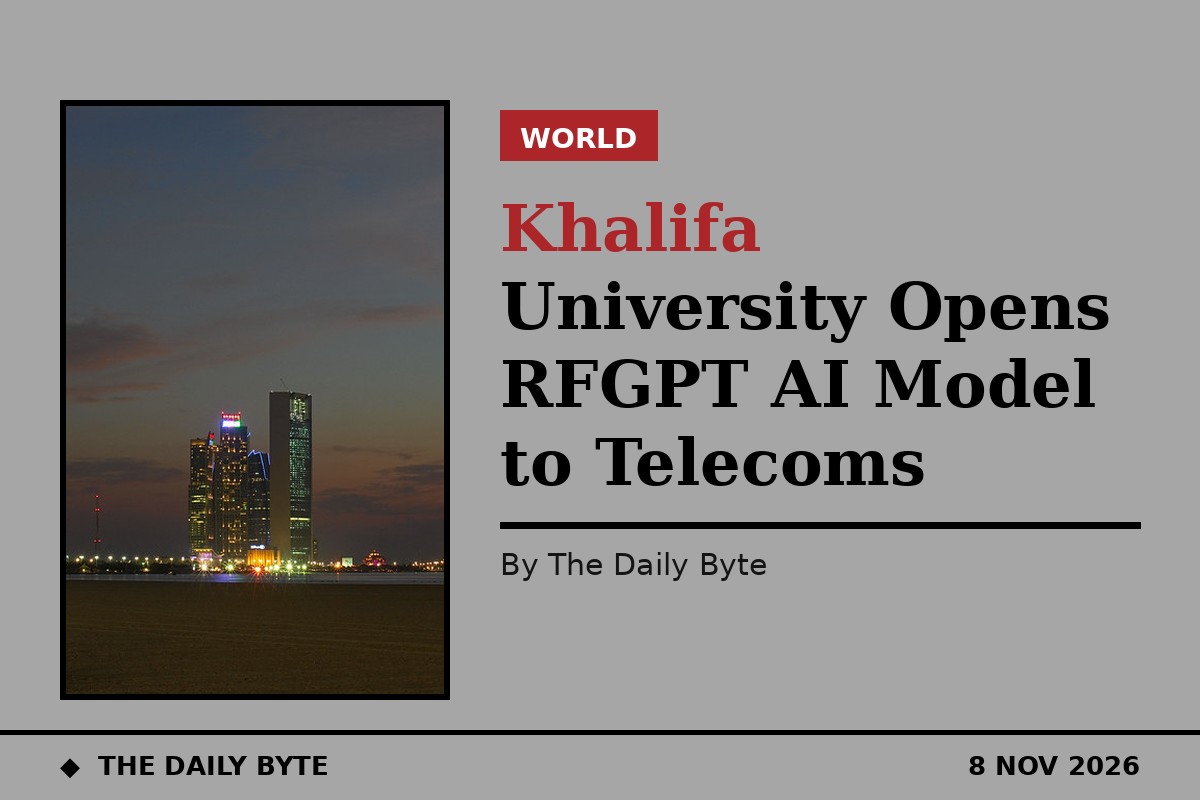
Telecom operators can now test an artificial intelligence model that reads radio signals and answers questions about them in plain language, after Khalifa University of Science and Technology, the GSMA and chipmaker AMD launched a trial of the model, known as RFGPT, at MWC Doha 2026 on Sunday 8 November 2026.
RFGPT is a radio frequency foundation model developed by Khalifa University's Digital Future Institute in Abu Dhabi. It is described by its creators as the first radio-frequency language model to feed RF spectrograms, visual representations of wireless signals, into a multimodal AI model.
Asking a network a question
Radio frequency data normally needs specialist engineers to interpret it. RFGPT is designed to change that by letting operators query what a network is seeing in ordinary language, and receive answers about the signals present, what technology they belong to and how they are behaving.
Under the trial, operators can apply for two weeks of access to the model through an application programming interface, known as an API. They submit a use case to the research team, which then agrees the evaluation scope, access arrangements and trial dates with each operator.
The trial is aimed at testing uses in network planning, spectrum management and interference analysis, as well as radio access network optimisation and wider network operations and performance management.
What the model can identify
RFGPT can identify wireless technologies including Wi-Fi, Bluetooth, LTE, 5G New Radio, UMTS and DVB-S2, and can tell uplink transmissions apart from downlink transmissions where that applies. It recognises modulation schemes and can analyse wideband environments in which several signals are present at once.
For coexistence analysis, the model finds where transmissions overlap in time and frequency and estimates the strength of interference between them, which operators could use to support decisions on interference mitigation and spectrum management.
It can also estimate wireless activity by analysing Wi-Fi and 5G user densities within a given observation window, giving operators a view of how heavily a network is being used that could feed into capacity planning. It interprets key 5G parameters too, including subcarrier spacing, synchronisation signal block patterns and reference signal configurations, all of which engineers can ask about in plain language.
How it was built
Khalifa University first announced RFGPT in February. The team trained it on about 625,000 synthetic instruction examples drawn from roughly 12,000 simulated scenes covering six wireless technologies, with no manual labelling needed.
In benchmark tests, the researchers say RFGPT outperformed OpenAI's GPT-4 and Alibaba's Qwen 2.5 on tasks including modulation classification and 5G information extraction. Those are the research team's own reported results, and the operator trial is designed to test whether the model holds up on real network data.
The GSMA's innovation arm, GSMA Foundry, and Khalifa University began a strategic partnership in November 2025 aimed at producing open telecom AI assets and benchmarking tools. Participating operators will be asked to feed back on the model's performance, usability and relevance to their own work, with the GSMA saying the results will show where the model adds value and what it needs to go further.
AMD provides the computing power
The model runs on AMD computing infrastructure, and the trial also gives operators a chance to test AMD's AI computing platform. AMD reported last week that its data centre revenue rose 97 per cent in the third quarter of 2026, driven by record sales of its Instinct AI graphics processors and EPYC central processors, with overall revenue reaching a record 13.4 billion dollars, up 45 per cent year on year.
The trial comes as Gulf operators densify their 5G networks and begin preparing for 6G, making spectrum management and interference analysis increasingly important. If RFGPT proves itself in live trials, it could give network engineers a faster way to understand crowded airwaves, without waiting for a specialist to decode every signal by hand.


