Khawaja Asif: New Provinces Consensus Near
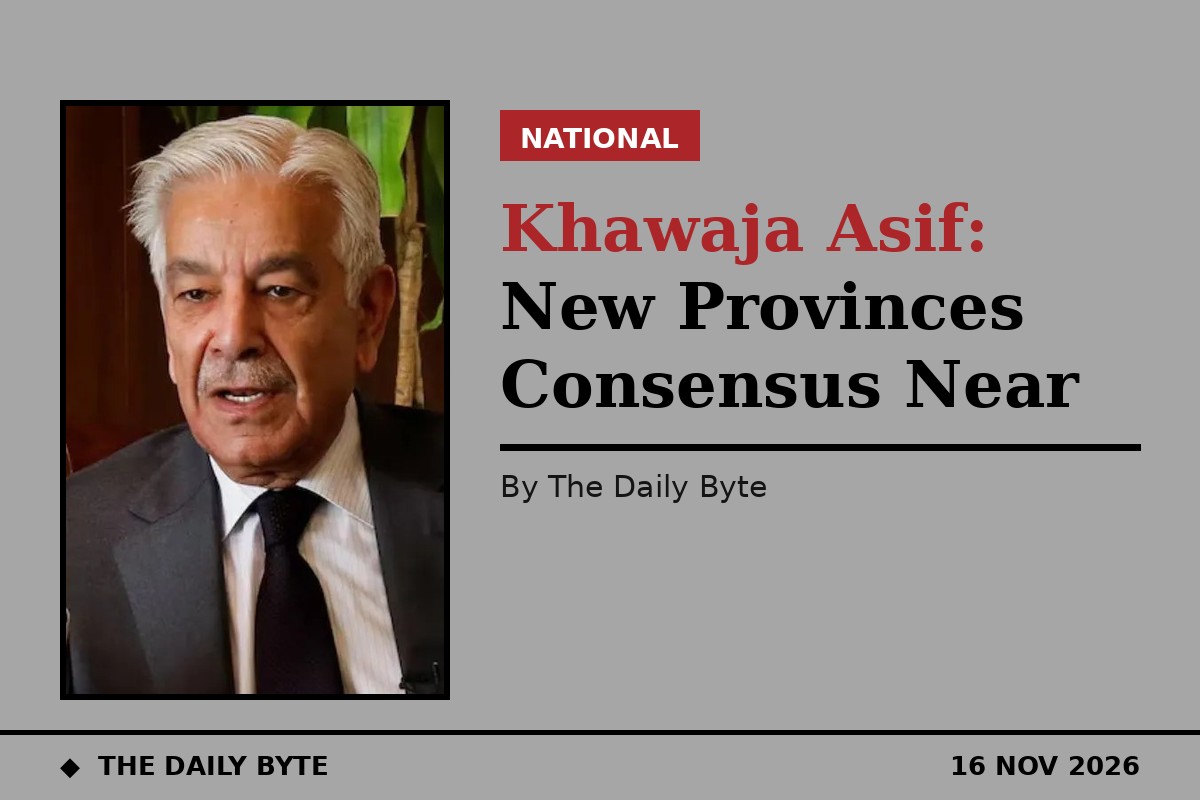
Defence Minister Khawaja Asif has said consultations on creating new provinces in Pakistan are moving towards consensus, and that the process could take shape before the end of 2026. Speaking on Geo News programme Naya Pakistan on Sunday, 15 November, Asif said discussions had been under way for several weeks and were now heading towards a conclusion.
“Consensus is being developed on the issue,” the minister said, adding that the process was “moving towards culmination”. He said he believed it would not take long to reach an agreement, and that the new system would take some shape before 2026 ends. “The new year will see the new system, God-willing,” he said.
Asif said that if a consensus was built and new provinces were created, the country’s political landscape would change in a progressive way. He insisted there was “no need for anyone to feel politically threatened” by the idea, describing the creation of new administrative units as “a very healthy thing” that would be good for all provinces and for Pakistan as a whole.
What the proposal involves
Asif has long argued for smaller administrative units, saying Pakistan could have as many as 12 provinces if the exercise followed administrative needs rather than linguistic, ethnic or political lines. The News has reported a proposal to reorganise the country into 12 provinces: Punjab into four, Khyber Pakhtunkhwa and Balochistan into three each, and Sindh into two. No final decision has been taken on boundaries, structures or process.
Under Article 239(4) of the Constitution, changing a province’s boundaries requires a two-thirds majority in both houses of Parliament as well as a two-thirds majority in the affected provincial assembly, so any reorganisation would need broad political agreement before it could proceed.
Asked about a referendum, Asif declined to comment directly, saying a vote in the National Assembly could create “complications”. He said he did not know what form the final step would take, and stressed that he was offering his personal assessment of the discussions rather than speaking from inside information.
How the debate reached this point
The debate gathered pace after Interior Minister Mohsin Naqvi proposed a referendum on new provinces, calling public opinion the best way to settle the matter. On Thursday night, Naqvi called on President Asif Ali Zardari, who then met Prime Minister Shehbaz Sharif on Saturday, 14 November, at the prime minister’s Model Town residence in Lahore.
The Presidency denied reports that Zardari and Naqvi had discussed provinces, while official sources told Dawn that the president and the prime minister agreed to “strictly adhere to constitutional provisions” on the issue. Sources quoted by The News said the two leaders agreed that Parliament could not be bypassed on whether a referendum should be held or what questions it should ask, and that the majority in Parliament would decide.
The Pakistan Peoples Party has shown no sign of softening its position on Sindh, where it cites a unanimous Sindh Assembly resolution opposing the province’s division. Sindh Chief Minister Murad Ali Shah said last week that the PPP had no objection to new provinces elsewhere if their people wanted them, but that dividing Sindh was “neither legally nor politically acceptable, as the people of the province had repeatedly rejected the idea through their elected representatives”.
What happens next
Asif said consensus was still being developed, that space would be given to parties on minor matters, and that no decision would be “forced” on anyone. He said the leadership of all four provinces should be consulted, whether or not their parties sat in Parliament, and that Zardari, PML-N President Nawaz Sharif and other leaders were working to build consensus. The PML-N has not set out a formal policy on the matter.
Asif also said the developments could give jailed PTI founder Imran Khan a “window of opportunity” to return to mainstream politics, if he agreed to the new system. He said Imran had no “fundamental objection” to new provinces, and that the establishment had never asked him to hold discussions on the issue.
MQM-P leader Mustafa Kamal has said a referendum would be held and called December a crucial month, while PPP chairman Bilawal Bhutto-Zardari has spoken to JUI-F chief Fazlur Rehman, condemning government action against his party. For now, though, Asif’s own words are the limit of what is confirmed: consultations are under way, he believes consensus is near, and he expects the new system to take some shape in the new year. Until a formal proposal reaches Parliament, the creation of new provinces remains a debate, not a decision.
Sources: Feature Pakistan, reporting Asif’s Geo News appearance; Trending News, reporting the minister’s remarks and the constitutional position; The News, reporting Naqvi’s referendum proposal and the 12-province plan.