Korea-Japan Roadmap Targets Economic Unity by 2045
South Korea and Japan have mapped out a three-phase roadmap to build economic solidarity by 2045, unveiled at a conference in Seoul on 12 November 2026. The plan responds to shared pressures both countries face, including low birthrates, population ageing and declining economic stature.
The conference, titled "Conference on Mapping Out a Roadmap for Korea-Japan Economic Cooperation: From Vision to Action", was held at the Korea Foundation for Advanced Studies conference hall in Seoul's Gangnam district. It was jointly hosted by the Chey Institute for Advanced Studies and the East Asia Institute, with participation from the Korean Association of Contemporary Japanese Studies and Japan's Nakasone Peace Institute, among others. It presented findings from joint research by South Korean and Japanese experts over the past year.
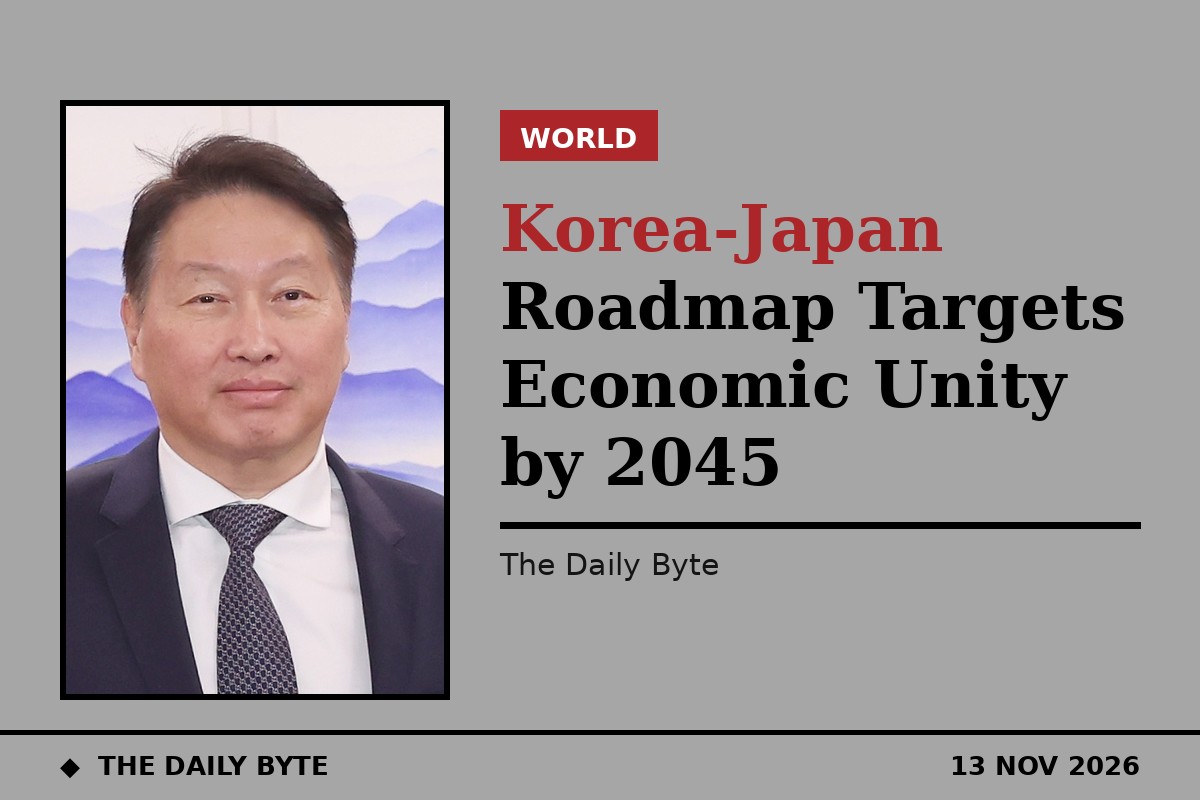
SK Group Chairman Chey Tae-won, who also chairs the Chey Institute for Advanced Studies, set out the plan in a video keynote address. He said he is preparing a permanent cooperation platform, dubbed the "Big Tent", to bring together business leaders, academics and research institutions from both countries. The platform aims to share what has already been achieved in bilateral cooperation, identify joint initiatives and turn them into policies and business projects. Chey first proposed the platform at Japan's Nikkei Forum in June, five months earlier.
"If the roadmap shows us the path forward, the platform will serve as the foundation for bringing together the strength to walk that path," Chey said. "We must establish the medium- to long-term direction of South Korea-Japan economic solidarity and bring together the capabilities of those who will carry it out."
Chey proposed setting concrete goals over three, five and 10-year periods: defining the desired level of economic cooperation within three years, identifying industries capable of delivering joint results and examining institutional barriers over five years, and putting in place measures that deliver tangible benefits to businesses and citizens within 10 years.
Three phases to 2045
The roadmap runs in three phases. From 2026 to 2031, the two sides would work issue by issue, with South Korea's accession to the Comprehensive and Progressive Agreement for Trans-Pacific Partnership (CPTPP) identified as a key milestone. From 2032 to 2036, they would declare a comprehensive economic partnership. From 2037 to 2045, they would conclude a Korea-Japan Economic Community Agreement.
Participants pointed to the ASEAN Economic Community as a model that respects member-state sovereignty, in contrast to the supranational integration of the European Union. The roadmap adopts that intergovernmental approach while setting its own phased timeline. The plan is a proposal from research institutes and business leaders, not an agreement between the two governments, and it sets out no baseline economic figures and no detail yet on how the phased targets will be measured.
Three axes of cooperation
The Korea-Japan research team presented three axes of cooperation: "Solidarity for Survival", centred on economic security and supply-chain cooperation; "Solidarity for Innovation", for advanced technology and industrial innovation; and "Solidarity for Attraction", through cultural and human exchanges. The team argued that cooperation should expand to joint procurement of energy and critical minerals, AI and semiconductor cooperation, stronger digital competitiveness, and shared structural problems such as ageing populations and regional decline.
Proposals from the conference
Professor Son Yul of Yonsei University recommended pursuing both "negative integration", lowering tariffs and other economic barriers, and "positive integration", tackling common challenges such as low birthrates, ageing, regional decline and the supply of energy and critical minerals.
Professor Lee Jung-hwan of Seoul National University said the scope of Korea-Japan AI cooperation should expand from bilateral technology collaboration to development cooperation in third countries, arguing that South Korea could play a more active role using its technology and resources. Professor Fukuwaga Yukiko of Japan's Waseda University proposed widening cooperation from manufacturing-centred trade into services, finance and digital sectors, including opportunities from the spread of AI and cooperation in capital markets and financial services.
In semiconductors, participants proposed combining Japan's materials and equipment technologies with South Korea's mass-production capabilities. Tomonobu Chishima, a professor at Japan's Hannan University, suggested jointly developing low-power AI chips for data centres and next-generation communications infrastructure, and establishing common evaluation standards to reduce duplicate testing. Choi Jeong-hwan of the Korea Institute for Industrial Economics and Trade proposed a Korea-Japan Digital Trade Agreement and joint training data for physical AI.
Takashi Terada, a professor at Japan's Doshisha University, proposed a "Korea-Japan Economic 3+3 Consultative Body" bringing together the foreign affairs, industry and trade, and finance authorities of both countries to discuss investment and finance. Participants also proposed channelling ideas gathered through the Big Tent platform into discussions between the two governments.