KP Seeks Tougher Penalties for Fake Medicines
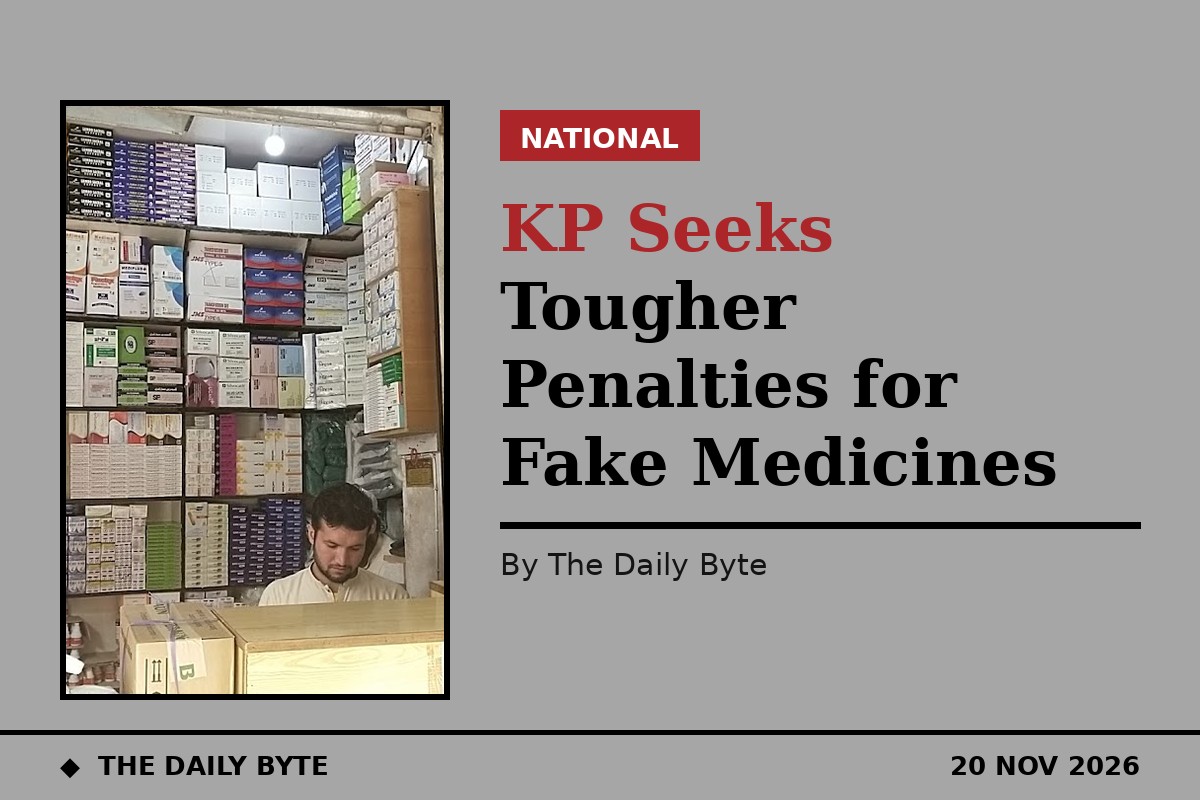
The Khyber Pakhtunkhwa government has introduced a bill in the provincial assembly proposing sharply tougher penalties for the sale of counterfeit, adulterated, unregistered and unlicensed medicines.
Under the Khyber Pakhtunkhwa Drug Amendment Bill 2026, selling unregistered or unlicensed medicines could result in up to 10 years in prison and a fine of up to Rs100 million. Selling counterfeit or adulterated medicines could carry a sentence of up to seven years and a fine of up to Rs50 million.
The bill also proposes a fine of Rs200 million for continuing to sell unregistered medicines despite a conviction, and up to 10 years in prison and a fine of up to Rs150 million for selling a medicine under a false name.
Protection for inspectors
The proposed legislation recommends up to one year in prison and a fine of Rs10 million for obstructing a drug inspector in the performance of their duties. Violating three rules under the Drug Act could result in up to five years in prison and a fine of Rs10 million.
The bill further proposes that the provincial Quality Control Board be authorised to send medicines abroad for laboratory analysis, and that the position of Special Drug Chairman be accorded a status equivalent to that of a High Court judge.
Enforcement drive under way
The bill comes amid a wider enforcement drive against spurious drugs in the province. The Federal Investigation Agency launched operations across Khyber Pakhtunkhwa on 18 November against alleged educational fraud, drug-law violations and theft of government electrical equipment, arresting three suspects in separate cases in Peshawar and Nowshera. Officials inspected 11 medical stores, seized suspected medicines and began investigating an institution accused of issuing medical degrees to about 75 students.
In a separate case, the Federal Investigation Agency arrested six suspects, including three employees of Lady Reading Hospital in Peshawar, over the illegal sale of government medicines worth hundreds of thousands of rupees. The medicines, meant for the hospital, were allegedly sold on illegally, and a significant quantity of government medicines was recovered from the warehouses of two private medical stores during raids. Records from private hospitals implicated in the illegal trade are being collected, and an FIA spokesperson said strict action would be taken against those who harm the national treasury.
The province has also reactivated its fleet of mobile drug laboratories, which had been lying idle, to test medicines on the spot in markets across Khyber Pakhtunkhwa. The vans carry Fourier-transform infrared and Raman spectroscopy equipment, allowing drug inspectors to carry out preliminary screening for counterfeit and substandard products and to send suspicious samples to the drug testing laboratory in Peshawar for detailed analysis.
The bill has been introduced in the provincial assembly and will need to be passed before the proposed penalties take effect.