KP Education Crisis: 4.9m Children Out of School
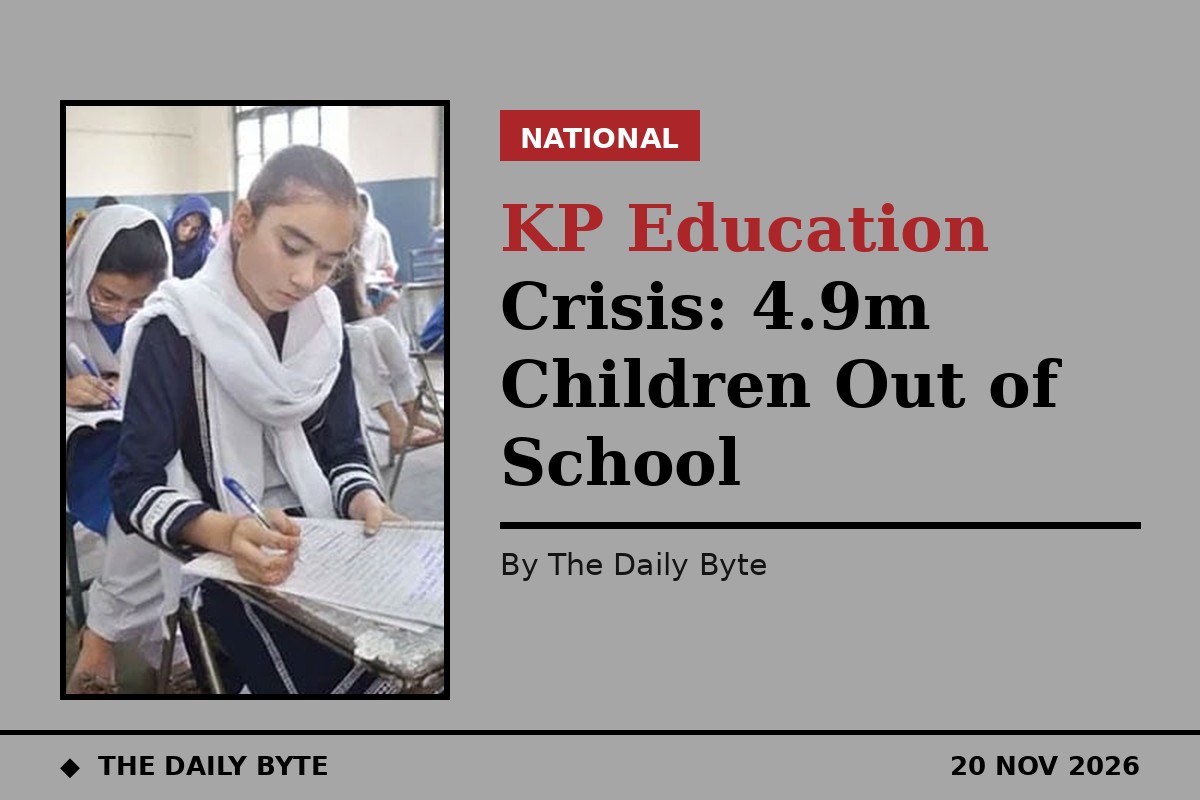
Nearly 4.9 million children are out of school in Khyber Pakhtunkhwa, including 2.9 million girls, according to official figures presented to the provincial government this week, in a picture of an education system struggling with closed schools, missing teachers and falling learning standards.
The figures were disclosed during a special briefing at the Governor's House in Peshawar, where the province's education adviser, Aamir Abdullah, presented the state of the public school system, its buildings, the finances of its universities and proposed reforms. Governor Faisal Karim Kundi, who chaired the briefing, stressed the need for quality learning and improved governance across schools, colleges and universities.
Closed schools and missing teachers
Khyber Pakhtunkhwa has 34,848 government schools, with about 5.96 million students enrolled and around 187,000 teachers. But the system faces a shortage of about 45,000 teachers, leaving an average of one teacher for every 41 students. As many as 11,617 schools operate with only one or two teachers, and 563 government schools are non-functional.
The briefing gave reasons for the closures: 264 schools had no teachers, 107 faced problems with the teacher-student ratio, 76 were closed because of law and order problems, 51 had no student enrolment, 35 lacked teaching staff and 17 faced problems linked to student absenteeism. In the tribal districts alone, 329 schools remain inactive, and in 107 schools across 12 districts neither students nor teachers are present. Peshawar records the highest absolute number of out-of-school children in the province.
The dropout rate at middle and high school level stands at 64 percent, the briefing disclosed.
Learning levels and crumbling buildings
The learning figures presented were stark. In several districts, 83 percent of students cannot read a single sentence in English, 82 percent are unable to read a paragraph in Urdu, and 60 percent cannot solve basic addition and subtraction problems.
Buildings are in a poor state. Officials said 4,260 schools lack essential amenities, 17,353 schools require reconstruction and 18,476 need repairs. Some schools damaged in the 2005 earthquake have still not been rebuilt, and rehabilitation of flood-damaged schools remains incomplete. Construction of Mardan Cadet College, begun in 2013-14, has not been completed, and a second cadet college project launched in Lakki Marwat in 2016 also remains unfinished. Of 1,700 information technology laboratories set up in government schools, 325 are non-functional.
The briefing put the cost of 131 proposed development projects to address these needs at Rs271 billion, with completion expected to take nine years. The overall education budget was reported at Rs397.90 billion, but the adviser said available funding was insufficient, noting that some areas requiring Rs400 million were receiving only Rs70 million.
Universities in financial crisis
The crisis extends to higher education. Of the province's 34 public universities, 26 are facing financial crises. The briefing noted that Swat University of Applied Sciences has only 269 students, while Swat Agriculture University has an enrolment of 636. The province's gross tertiary enrolment rate is just 8 percent, and 208 of 698 academic departments across the universities have produced no research publication in three years.
A Rs5 billion rescue plan
In response, the provincial government has prepared a 180-day revitalisation plan worth Rs5 billion, covering 70 targeted projects aimed at restoring closed schools, modernising facilities and tackling absenteeism. It includes a 100-day teacher training programme linked to the e-transfer system for merit-based postings, the establishment of seven Danish Schools, the conversion of 424 schools to solar energy, 15 model schools and 500 internships for young people.
The government also plans to outsource a further 1,500 public schools, building on 421 already outsourced, and to enrol out-of-school children in 12 priority districts. A further 6,000 children are to receive information technology training, with 300 to be trained and sent abroad, and the information technology park in Dera Ismail Khan is to be upgraded.
The figures returned to public debate on Friday, when a petition was filed asking who will educate the province's 4.9 million out-of-school children.