KP Makes Daily Reading Hour Mandatory in Schools
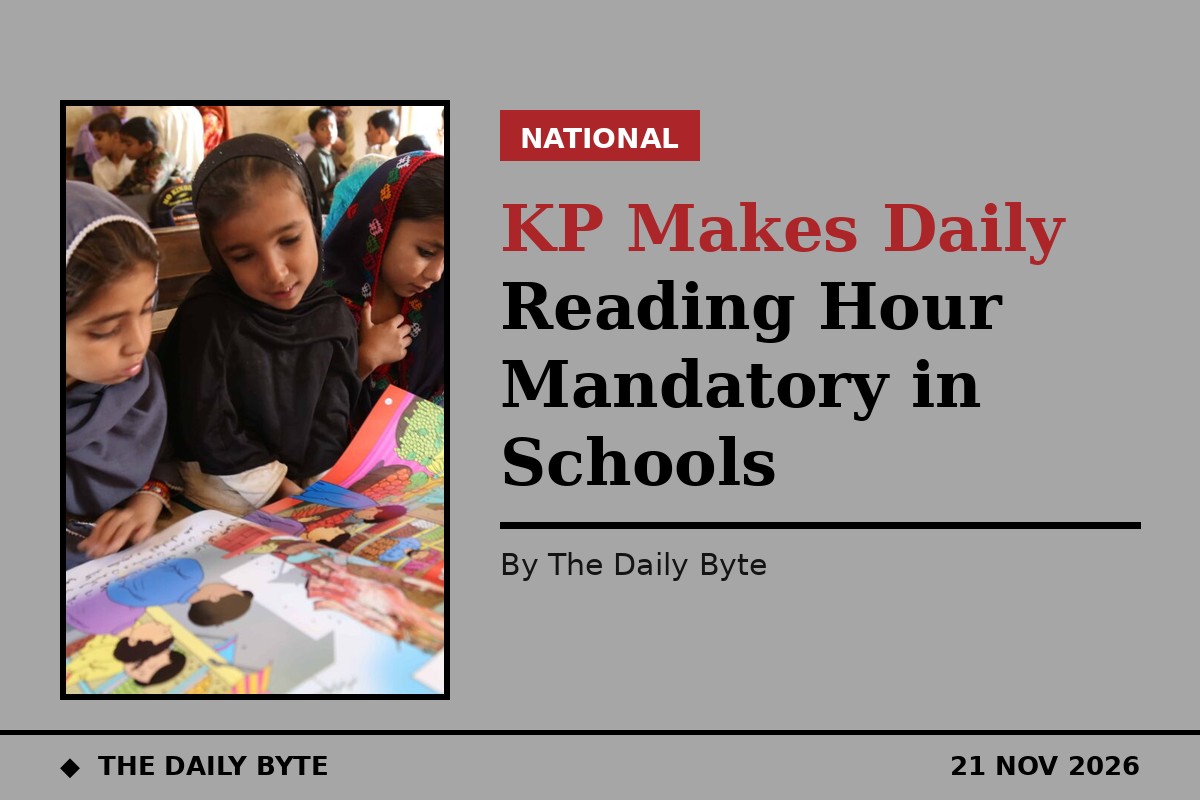
The Khyber Pakhtunkhwa government has made a daily reading hour mandatory in government schools across the province, in a bid to improve reading skills among primary-level students.
The Elementary and Secondary Education Department issued a notification on 20 November directing all government primary schools, and the primary sections of middle, high and higher secondary schools, to allocate one hour in their daily timetables for reading activities. The initiative is aligned with the Khyber Pakhtunkhwa Foundational Learning Policy 2024.
What the notification requires
Under the notification, every government school in the province must set aside one hour each day for reading. The hour is intended for primary-level students, and it applies not only to standalone primary schools but also to the primary sections of larger schools, so that younger pupils in middle, high and higher secondary schools are covered too.
The department has also made Mathematics Remediation mandatory, requiring schools to dedicate at least one mathematics period per week to primary students. The measure aims to strengthen basic mathematical skills and help children understand fundamental concepts, rather than simply memorising them.
The notification further directs the Director of Curriculum and Teacher Education to include at least one hour of reading in the primary-level scheme of studies, embedding the reading hour in the formal curriculum framework rather than leaving it as an informal instruction to schools.
The learning gap it is meant to close
The reading hour lands against a stark picture of learning levels in the province. According to a briefing by the adviser to the chief minister on education, reported by The News on 18 November, 83 percent of students in several districts cannot read a single sentence in English, 82 percent are unable to read a paragraph in Urdu, and 60 percent cannot solve basic addition and subtraction problems.
The same briefing set out the scale of the system the reading hour must work in. Khyber Pakhtunkhwa has 34,848 government schools, with about 5.96 million students enrolled and around 187,000 teachers. The system faces a shortage of about 45,000 teachers, with an average of one teacher for every 41 students, and as many as 11,617 schools operate with only one or two teachers. A total of 563 government schools are non-functional, and nearly 4.9 million children are out of school.
The province’s education system is also under financial strain, with 26 public universities facing financial crises. The briefing said seven Danish Schools will be established in the province and the information technology park in Dera Ismail Khan will be upgraded, as part of a wider set of reform initiatives.
What happens next
The notification gives schools a clear instruction but no public timetable for when compliance will be checked, and the reports of the move did not say how district education officers would monitor the new hour. The reading hour will need teachers, books and timetable space in schools where staffing is already stretched, and its success will depend on whether the hour is actually protected in the school day.
If it is implemented as directed, the hour would give primary pupils in every government school in the province a daily, structured chance to practise reading. For a province where four in five children in some districts cannot read a paragraph in their own language, that daily practice is the point of the policy — and the test of it will be whether reading levels move when the next assessments are done.