Kristallnacht 88th Anniversary Marked Across Germany
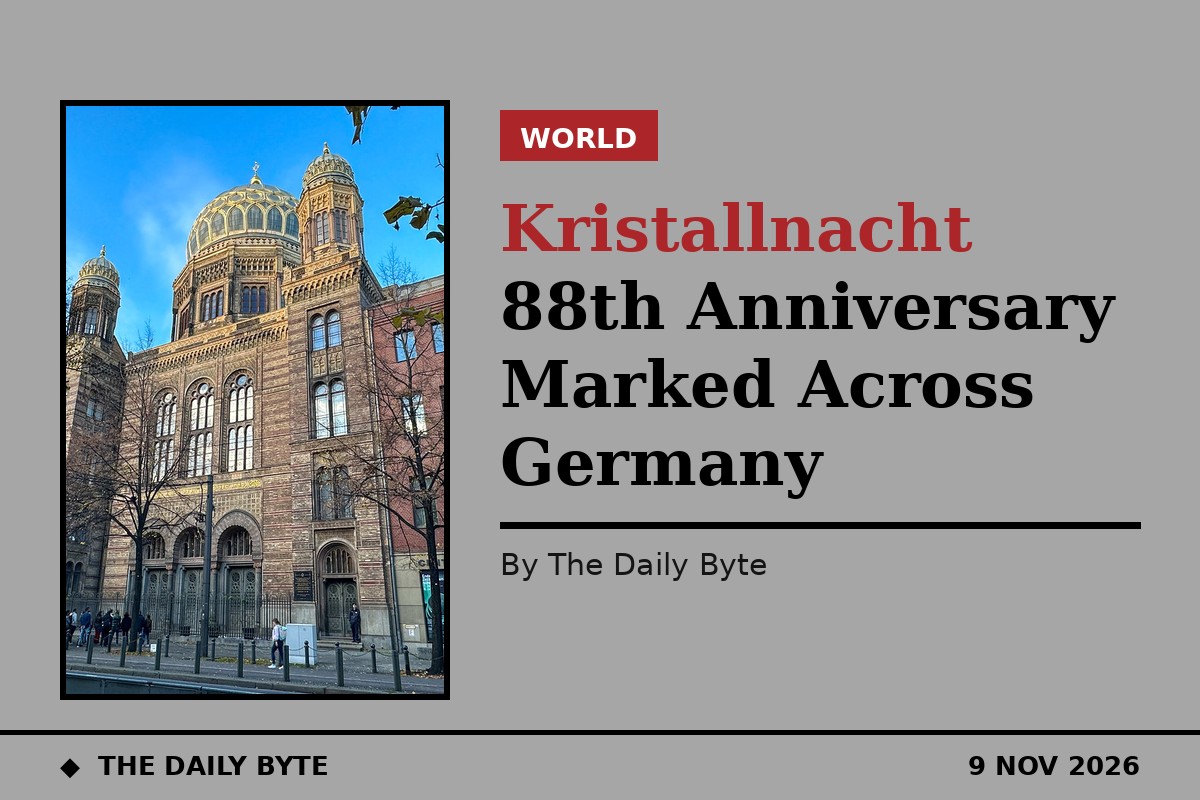
Germany marks the 88th anniversary of Kristallnacht on Monday, 9 November 2026, with ceremonies across the country remembering the night Jewish communities came under organised attack. A 94-year-old survivor of the pogrom has returned to Berlin to warn police leaders that rising antisemitism demands action, not remembrance alone.
On the night of 9-10 November 1938, Nazi leaders organised antisemitic riots across Germany and neighbouring Austria. During the pogrom, known as Kristallnacht, or the Night of Broken Glass, more than 1,400 synagogues were set ablaze and thousands of Jewish-owned businesses were vandalised. At least 91 Jews were murdered, and tens of thousands of Jewish men were arrested and sent to concentration camps.
Survivor returns to Berlin with a warning
George Shefi, a 94-year-old Holocaust survivor and one of the last living witnesses to the Kristallnacht pogrom, returned this week to his native Berlin to share his testimony with senior law enforcement officials from the United States, Germany and other European countries. He spoke at the New Synagogue in Berlin, a building largely destroyed during Kristallnacht, at an event titled "Not on Our Watch: Operationalizing Never Again".
The gathering also honoured Wilhelm Krutzfeld, the local police official who intervened on the night of the pogrom and attempted to save the New Synagogue from the flames, defying the stormtroopers who had set fire to it. Police officers from three German states read passages from Zachor, meaning "Remember", a book honouring Krutzfeld's legacy.
Shefi's message, delivered 88 years after the night that ended any illusion of safety for German Jews, was that protecting Jewish communities requires action by the authorities. The event was organised by the International March of the Living with the German Police Union, the European Federation of Police Unions, Rutgers University's Miller Center on Policing and Community Resilience, and the Jewish Community in Berlin.
Antisemitic incidents remain high
The warning comes against a background of high levels of antisemitism in Germany. The Federal Association RIAS documented 8,725 antisemitic incidents in Germany in 2025, an average of nearly 24 a day. Those included four cases classified as extreme violence.
Writing ahead of the anniversary, Dr Shmuel Rosenman, chairman of the International March of the Living, said a commemoration must ask what Germany's responsibility for its history requires today, not only remember the pogrom and its victims. He noted that the police leaders gathering in Berlin were sitting in a synagogue and remembering a night when synagogues across Germany were attacked — and that what Germany does after every anniversary has passed matters just as much.
Ceremonies across Germany today
Memorial services are being held in towns and cities across Germany on Monday. The city of Offenbach is holding a wreath-laying ceremony at 5pm in front of the city hall, followed by a second wreath at the memorial stone on Platz der Deutschen Einheit, with representatives of the Jewish community and the Society for Christian-Jewish Cooperation taking part. Meerbusch is holding a public memorial service at 6pm, and Bocholt is commemorating the victims at 7.30pm at the site of its desecrated synagogue.
The Jewish Agency for Israel and the American Society for Holocaust Education and Remembrance have also launched a joint initiative, #ShineTheLight, inviting Jewish communities and individuals around the world to mark the anniversary by turning on a light and sharing reflections on social media.
The anniversary falls one day after pro-Palestinian activists replaced Germany's Flag of Unity with a Palestinian flag outside the Reichstag in Berlin, an incident that drew condemnation from the president of the Bundestag and from Israel's ambassador to Germany. Police arrested three people after the flag flew for about an hour before firefighters removed it.