Lahore Anti-Smog Drive Fines 14,653 Smoky Vehicles
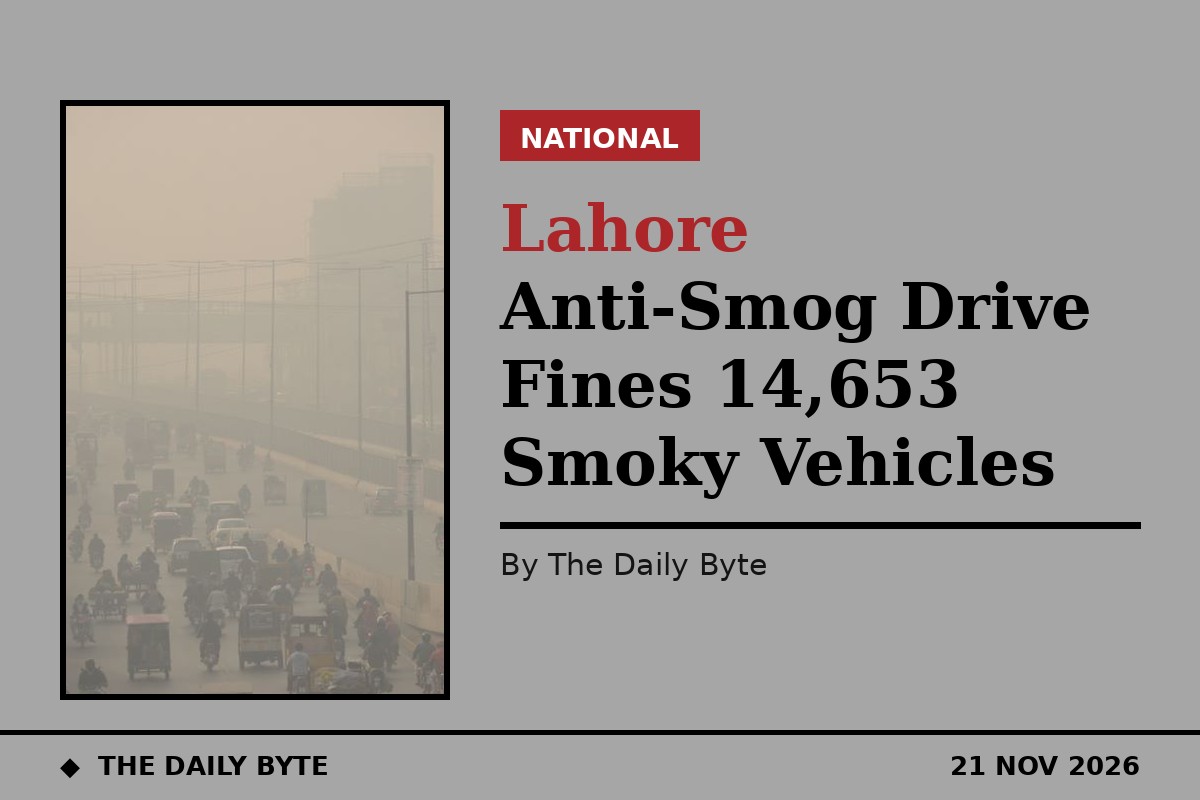
Lahore Traffic Police have fined 14,653 smoke-emitting vehicles as part of an intensified anti-smog drive across the city, with night checkpoints, licence suspensions and artificial intelligence now being used to catch polluters.
Chief Traffic Officer Abdul Raheem Shirazi announced the latest enforcement figures on Saturday, saying the crackdown had been stepped up across several categories of violation. The figures are the totals for the drive so far, and they show how wide the net has been cast: alongside the smoke-emitting vehicles, thousands more have been penalised for carrying uncovered loads, running without fitness certificates or overloading.
The enforcement figures
According to the figures shared by Lahore Traffic Police, 14,653 challans have been issued to smoke-emitting vehicles. A further 10,306 vehicles have been penalised for transporting soil and sand without protective covers, and 31,618 unfit vehicles have been identified operating without fitness certificates. The largest category is overloading, with 272,760 vehicles challaned.
The totals have risen sharply in the space of ten days. On 11 November, the same drive had issued 11,871 challans to smoke-emitting vehicles, acted against 7,919 uncovered-load carriers and 25,833 unfit vehicles, and fined 253,286 vehicles for overloading. The new figures show the operation continuing to grow as the smog season deepens.
Shirazi said the authorities are suspending the driving licences of drivers whose vehicles emit dangerously high levels of smoke, and may also suspend the route permits of commercial vehicles found repeatedly in violation. Uncovered soil and sand carriers have been banned from entering Lahore altogether.
Night checkpoints and AI detection
The traffic police have set up special checkpoints at night to target vehicles that contribute to air pollution, catching offenders who might avoid daytime enforcement. Officers are also taking direct action against severe offenders on the road, rather than relying only on fines issued later.
Technology is playing a growing part in the drive. Lahore Traffic Police are using artificial intelligence to identify smoke-emitting vehicles automatically, allowing for more targeted enforcement on the city’s roads. The system is used alongside checkpoints and patrols, and officials say it helps them pick out the worst offenders from the heavy traffic.
The drive is part of a wider push against smog in the city. Lahore Police have arrested 67 suspects and registered 40 cases this year for violating environmental laws and engaging in activities that contribute to smog. Separately, Punjab Police fined 11,360 people a total of Rs10 million for smog-related violations on 15 November, registering 1,766 cases and arresting 1,241 suspects in this year’s anti-smog drive.
Why the drive matters
The enforcement comes as Punjab continues to battle hazardous smog. On Friday, Lahore recorded an hourly air quality index of 465 between 7am and 8am, while Gujranwala and Multan registered readings of 661 and 641 respectively, according to Dawn, citing real-time air quality data. Other cities, including Sargodha, Sialkot, Rahim Yar Khan and Bahawalpur, also reported elevated pollution levels.
The Punjab Environment Protection and Climate Change Department has been running a parallel enforcement operation against polluting industries and non-compliant brick kilns. Between 1 January and 18 November, its teams inspected 84,370 brick kilns, demolished 1,429 units, sealed 968 and registered 1,248 cases against violators. During the critical smog period between 1 September and 18 November, authorities conducted 29,999 inspections, demolished 519 kilns, sealed 494 and registered 408 cases, imposing fines worth Rs101.45 million.
Officials confirmed that enforcement operations under the Lahore anti-smog drive will continue, with the aim of reducing smog and improving air quality across the city. For drivers, the message is that a vehicle pumping out visible smoke now risks a challan, a suspended licence and, for commercial operators, a suspended route permit.