Lahore Plans Five Low-Emission Zones to Cut Smog
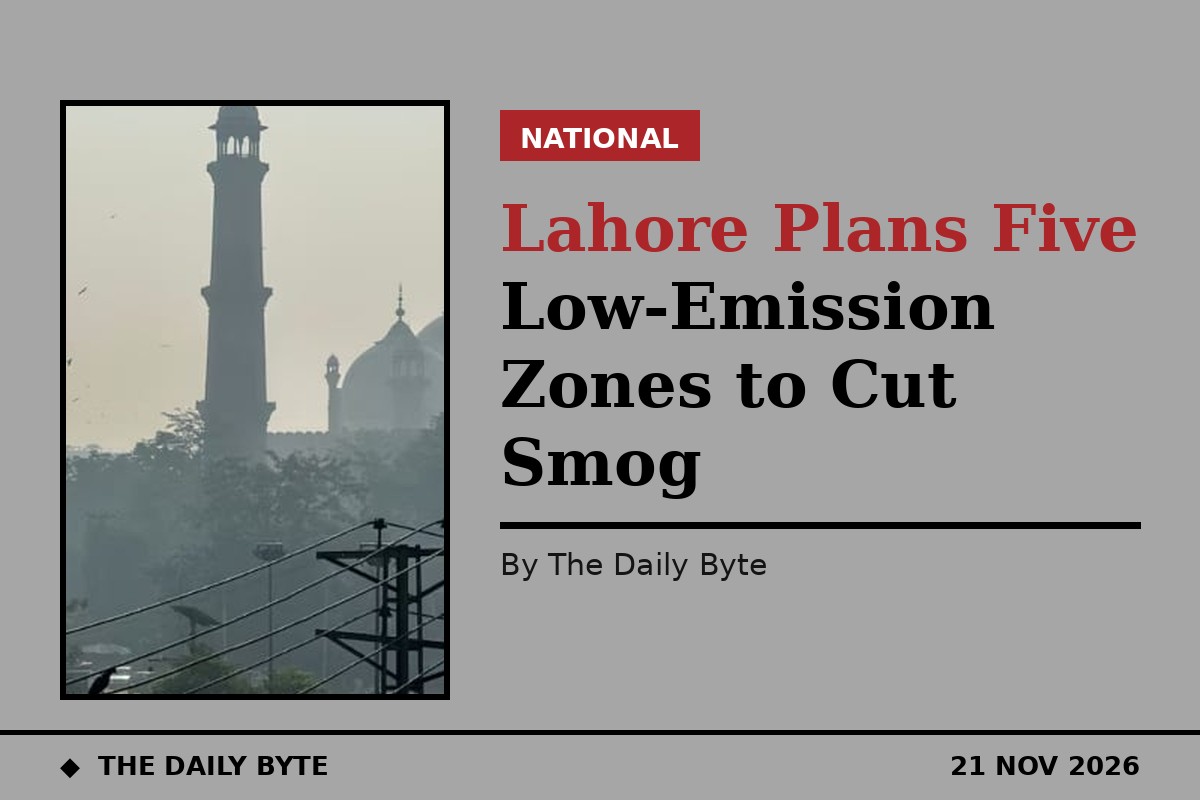
A Lahore University of Management Sciences (LUMS) study has identified five potential low-emission zones in Lahore, as Punjab prepares a policy framework to curb vehicle fumes and improve air quality in the provincial capital.
The proposed zones cover areas including Badami Bagh, Shalamar, Gulshan Ravi, Sanda, Tajpura, Harbanspura, Thokar Niaz Baig, Ali Town, Johar Town and Township. The Environment Protection and Climate Change Department is collecting area-wise data from relevant government agencies, while a policy framework for the initiative is being prepared.
The study provides a research-based foundation for identifying the areas where targeted action against vehicular pollution is most needed. A policy booklet, titled From High-Emission Zones to Low-Emission Zones: A Pathway Towards a Climate-Resilient Punjab, is also under preparation. The proposed zones, however, remain at the planning stage, with implementation dependent on further assessment and coordination among government departments.
The plan has taken on renewed significance as Lahore prepares to become the Economic Cooperation Organisation (ECO) Tourism Capital for 2027. The title was formally handed over to the Punjab government in Shusha, Azerbaijan, on 18 November 2026.
Why the city needs it
Lahore's air turned hazardous again on Friday, with the city's air quality index reaching 465 in the morning, according to Dawn. Other Punjab cities were also badly affected, with Sargodha at 289, Sialkot at 232, Rahim Yar Khan at 228 and Bahawalpur at 198.
A national air pollution report cited by Dawn found that Lahore's annual average PM2.5 concentration is more than 110 micrograms per cubic metre, over 22 times the World Health Organization's annual guideline of five micrograms per cubic metre. Transport is the largest source of primary PM2.5 emissions in the city, followed by industry at 28 per cent and brick kilns at 17 per cent.
Enforcement against polluters has intensified. The Punjab Environment Protection and Climate Change Department carried out 84,370 inspections of brick kilns across the province between 1 January and 18 November, demolishing 1,429 units, sealing 968 and registering 1,248 cases against violators, with fines of Rs178 million.
The wider clean-air plan
Punjab has established 81 air quality monitoring stations across the province, including 11 in Lahore, to provide real-time pollution data. The government plans to expand the network to more than 100 stations by early next year. The Punjab AQI Portal and the AQIPunjab mobile application also provide air quality updates, forecasts and health advisories.
Under the Lahore Air Improvement Framework, the department is deploying several technology-driven measures. Its AirIntel component will build a dust emission inventory and analyse particulate matter to guide mitigation, alongside a planned air quality superstation for hourly source apportionment. Vehicular emissions will be checked through the proposed Vehicular Emission Scanning System using remote sensing at nine entry points, complemented by a city-scale hyperlocal sensor mesh and industrial continuous emission monitoring systems. A proposed Chief Minister's EcoCard will offer a 50 per cent subsidy on diesel particulate filters.
The Environmental Protection Agency continues to inspect industries, brick kilns, vehicles and construction sites. During the smog season, quick-response teams check violations, thermal drones detect crop residue burning, and anti-smog guns suppress dust at key Lahore sites.
Enforcement and awareness
Between 1 January and 19 November 2026, the EPA conducted 7,969 inspections in Lahore, issued 1,938 notices, seized 42 tonnes of plastic, sealed 1,861 premises and imposed Rs14.2 million in fines, alongside campaigns promoting reusable alternatives in markets and heritage sites.
Awareness drives include the Punjab Green School Certification Programme, which has enrolled 31,225 schools, 24,640 public and 6,585 private, including 2,966 in Lahore, reaching roughly 8.5 million students.
An AI-powered Punjab Climate Observatory is also planned in Lahore to monitor air, water, soil and weather, housing laboratories, data centres and early warning systems to improve forecasting for heatwaves, heavy rain and floods.
What happens next
For now, the five low-emission zones remain a proposal, not a decision. Their future depends on the data the environment department is gathering and on agreement between the departments involved. But with the tourism title arriving in 2027, cleaner air, effective waste management and well-maintained public spaces will be essential to improving the experience of residents and international visitors alike.