Lahore Smog: AQI Hits 451 as Punjab Defends Measures
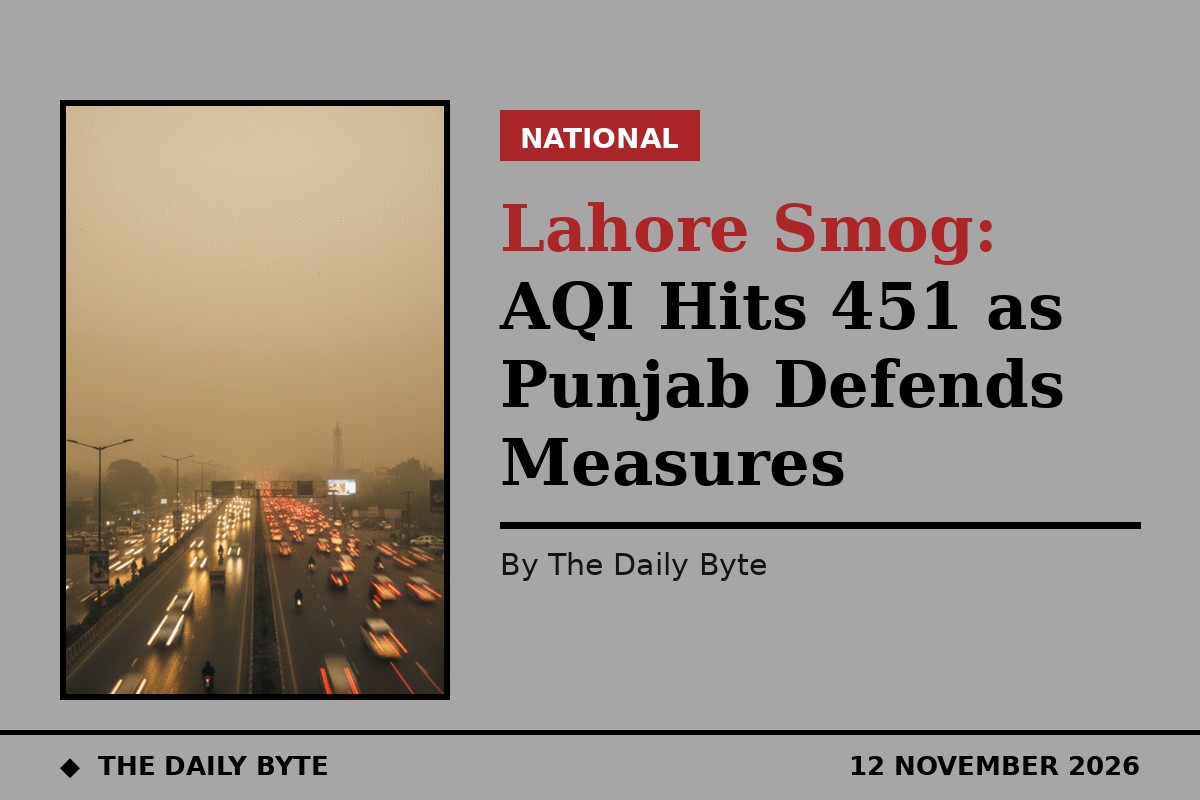
Lahore was again the world's most polluted major city on Wednesday, with its air quality index (AQI) climbing to 451, as the Punjab government insisted that smog "is not a political issue" and defended its anti-smog record. Senior Minister Marriyum Aurangzeb told a press conference in Lahore that the crisis was "a scientific, environmental and public health challenge", and claimed the city's air quality had improved by 64 per cent.
It was the third consecutive day that Lahore topped the global ranking of major cities compiled by Swiss monitor IQAir. By 5pm on Wednesday the city's AQI stood at 242, with New Delhi second at 194. Earlier in the day the reading had reached 451, and the city's PM2.5 level — fine particles small enough to reach deep into the lungs — was 33 times the World Health Organisation's annual guideline.
Other Punjab cities also choked
Lahore was not alone. Faisalabad recorded an AQI of 283, Peshawar 245 and Gujranwala 228, all in unhealthy territory. Within Lahore, some neighbourhoods fared far worse than the citywide average: Gulberg II recorded 639, while Syed Maratib Ali Road stood at 475. The Pakistan Meteorological Department forecast no rainfall in Lahore over the following 24 hours, leaving little prospect of the air clearing naturally.
What the Punjab government says it has done
Aurangzeb said Punjab had set up an Environmental Protection Force of 1,000 personnel, equipped with vehicles, body cameras and thermal drone cameras. More than 9,000 industrial units had installed environmental control systems, she said, and over 14,000 brick kilns had been converted to zigzag technology, with action taken against units and kilns found breaking the rules.
She also pointed to sharp falls at individual monitoring stations, saying Civil Secretariat had dropped from 614 to 155, Bedian Road from 746 to 172, Upper Mall from 621 to 177, Punjab University from 768 to 181, and Allama Iqbal Town from 1,063 to 207. She credited the improvement to anti-smog operations, favourable weather, higher wind speeds and continuous field monitoring.
The Diwali dispute — and what the data says
Punjab authorities blamed much of this week's pollution on smoke from Diwali firecrackers drifting across the border from India, with light winds carrying pollutants into Pakistani Punjab after the festival weekend. Aurangzeb said conditions should ease from the early afternoon as winds shifted. India's foreign ministry had not immediately responded to a request for comment.
But a report from the Pakistan Air Quality Initiative, released on Tuesday, complicates that explanation. Satellites counted 16,714 likely crop-residue fires in Punjab between 1 October and 9 November, and Lahore's average PM2.5 stood at 126 micrograms per cubic metre — eight times the WHO guideline — exceeding the national 24-hour standard on all 40 days measured. After Diwali, Lahore's PM2.5 rose only about 10 per cent on the previous week's average, while Faisalabad and Multan each rose 40 per cent. On days when air passed over fire-affected areas, Lahore averaged 175 micrograms per cubic metre, against 93 on other days.
The Punjab Environment Protection and Climate Change Department's own assessment, issued on 9 November, found pollution down 27 per cent in October on NASA satellite data and 19 per cent at ground stations. It forecast Lahore's AQI at 295 on 11 November and 284 on 12 November, falling to 218 on 13 November.
What happens next
Aurangzeb has said smoke-emitting vehicles will be kept off the roads and that vehicle fitness and emissions enforcement will be stricter. For now, though, the numbers tell their own story: on 11 November 2024 Lahore's AQI crossed 2,000 and reached about 2,400; on 11 November this year it stayed below 450 — an improvement the government cites, but one that still left the city breathing the world's dirtiest air.